Balancing Growth And Delivery
🔄 Balancing Growth and Delivery
In the last lesson you picked a task worth delegating and matched it to the right person. Now pull back and look at that person's whole plate. The question shifts from "is this one task a good fit?" to "does this person's overall workload keep them delivering reliably while still growing?" Get that balance wrong in either direction and you'll either bore a strong performer into leaving or bury a willing one until things start slipping.
By the end of this lesson, you will have learned to:
- Shape a workload with the 70/20/10 mix of familiar, stretch, and brand-new work.
- Negotiate a stretch assignment that fits a person's aspirations, readiness, and capacity.
- Design a plate that avoids both stagnation and overwhelm.
⚖️ Shape the Workload with 70/20/10
A useful rule of thumb for shaping someone's work is the 70/20/10 Task Mix. Each slice does a distinct job:
| Slice | Share | What it's for |
|---|---|---|
| Familiar | ~70% | Work they already do well, keeping delivery dependable and giving them solid footing. |
| Stretch | ~20% | Work just beyond their current skill, where real growth happens because success is still realistic. |
| Brand-new | ~10% | Work that carries real learning risk — the occasional leap that needs the most support. |
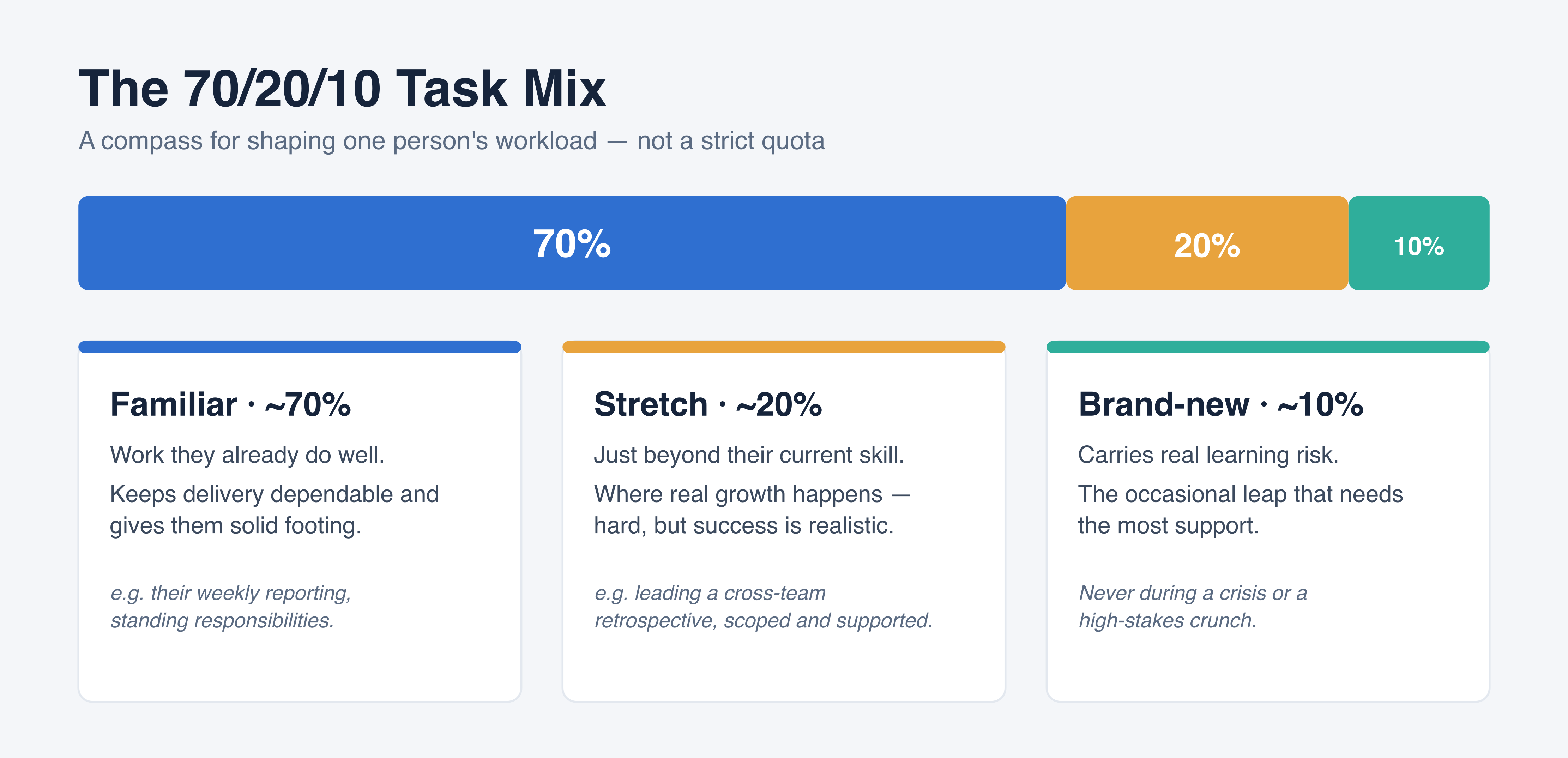
Treat these numbers as a compass, not a quota. Nobody's week divides into tidy percentages, and the mix shifts with the person and the season — a new hire leans heavier on the familiar, while a seasoned performer hungry for growth can carry a bigger stretch slice. What matters is the shape, not the decimals: mostly steady work that keeps delivery dependable, a meaningful stretch that pulls them forward, and only a light push into the genuinely new. Revisit this balance every quarter, because a mix that fit someone six months ago may now be boring them or burying them. One rule inside the mix is firm, though: never introduce brand-new work while someone is in a crisis or racing a high-stakes deadline. Learning needs a little slack to absorb mistakes, and a crunch has none to spare — the leap that would have grown someone in a calm week will simply sink them in a frantic one.
🎯 Negotiate a Stretch That Fits
The 20% is where you'll spend most of your energy, and the best stretch assignments are negotiated, not handed down. Treat it as a shared design problem, and run it through the ARCS framework — four things to check together before you commit:
- Aspirations — what they actually want to grow toward, so the stretch pulls in a direction they care about.
- Readiness — how far beyond their current skill this reaches; a "stretch" that repeats what they know teaches nothing, and one that's a cliff sets them up to fail.
- Capacity — an honest read of what's already on their plate.
- Support — the specific help you'll attach, so they're stretched, not stranded.
The most common trap here is the eager report who says "I can make it work" before you've tested whether they can. Your job is to slow that down and right-size the scope.
Watch a manager, Chris, take an eager "I can handle it" from Dan, one of his reports, and turn it into a stretch that will actually land:
- Dan: Honestly, I'd love to run the cross-team retrospective. I can fit it in, no problem.
- Chris: I want you on it. Let's make sure it's a real stretch and not a drowning. You've led retros inside your own team, but never across two departments, right?
- Dan: Right. The cross-team part is new for me.
- Chris: Okay, let's protect your current delivery then. What if we scope this to just facilitating the sessions for now, rather than owning the whole report, and I sit in on your first agenda review? Would that feel like a real stretch without tipping into too much?
- Dan: Yeah, that actually makes it feel possible instead of terrifying.
Notice what happened there. Chris accepted the ambition, but he narrowed the scope and attached visible support, turning a vague "I can handle it" into a stretch Dan can actually land.
🛡️ Design Against Stagnation and Overwhelm
Zoom back out to the full plate and you're steering between two failure modes:
- Stagnation — an all-familiar workload where a capable person quietly coasts, gets bored, and eventually looks elsewhere.
- Overwhelm — too much stretch and brand-new work at once, so the person drops balls, loses confidence, or burns out.
The 70/20/10 shape is your guardrail against both. Design it deliberately rather than by accident:
- Protect the familiar core so reliable delivery is never at risk.
- Assume most people can carry only one real stretch at a time.
- Sequence the harder work away from known crunch periods, and stagger new challenges so they don't all land in the same month.
- When you add a stretch, decide what comes off the plate rather than hoping they'll absorb it.
The single idea to carry out of this lesson is that development is a matter of proportion: mostly solid ground, a meaningful stretch, and only a small, well-timed leap into the unknown. Everything above stays abstract until you put numbers to a real workload, so you'll first do a quick fill-in-the-blank check to lock in the mix and its crisis-timing rule, then negotiate a live stretch assignment with a report, and finally draft the follow-up that lays out their next quarter. Before your next 1:1, try sketching one person's plate in rough 70/20/10 terms and ask yourself which slice is missing.
