Selecting Work and People
📣 Welcome to the Course
Welcome to Delegate for Results and Growth! Delegation is one of the highest-leverage moves you make as a manager, and it's also where good managers most often get stuck: hoarding work they should hand off, or dumping work they should have kept. This course turns delegation into a deliberate tool that both delivers results and grows your people, so you never have to choose between the two. This first lesson starts at the front of the process: choosing the right work, the right person, and the right moment before you ever hand anything off.
In this lesson, you will learn to:
- Decide which work to keep and which offers real delegation value.
- Match a delegable task to the right person using capability, capacity, and development needs.
- Weigh risk, learning value, and timing to pick the right moment to hand off.
🗂️ Decide What to Keep vs Hand Off
Start by sorting your plate, not your people. Before you ask "who could do this?", ask "should this leave my hands at all?" A small slice of your work genuinely belongs to you. Keep three kinds of work:
- Confidential work — compensation decisions, a report's performance issue.
- Sole-risk work — anything where you are the only one who can carry the risk.
- Core managerial duties — setting direction and handling accountability conversations.
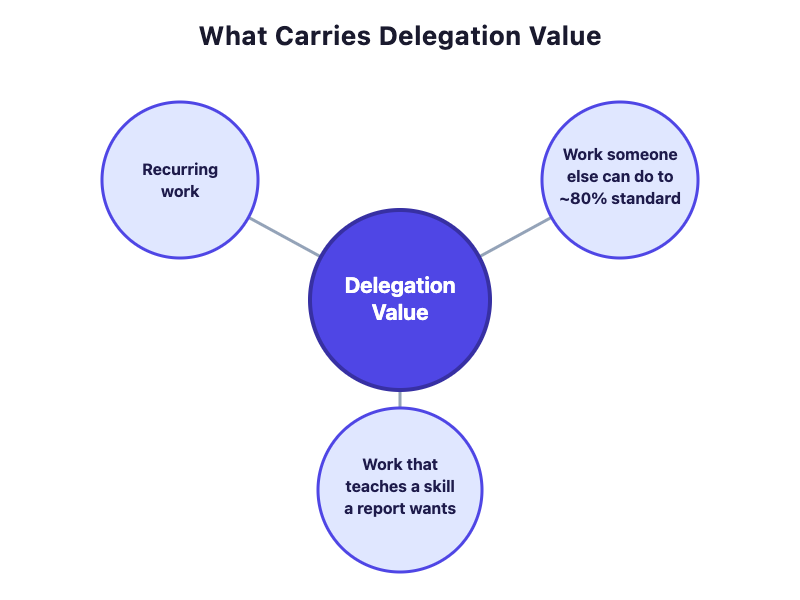
Almost everything else is a candidate. The strongest candidates carry real delegation value: work that recurs, work someone else could do to eighty percent of your standard, and especially work that teaches a skill your report wants to build. The trap for new managers is keeping a task simply because it's faster to do it yourself today. That logic feels responsible while it quietly starves your team of growth and buries you. When you catch yourself thinking "it's just easier if I handle it," treat that as a signal to look harder, not a reason to keep it.
One caution before you go further. The reflex to hand things to "whoever is easiest to ask" tends to overload your most reliable person and skip everyone else. Deciding what's delegable is step one; deciding it fairly comes next.
🤝 Match the Task to the Right Person
Once a task is worth delegating, resist naming an owner in your head and moving on. The move here is to explore the match rather than assume it. A good fit sits at the intersection of three things:
- Capability — the person's actual skill for this specific task.
- Capacity — their current workload and how much room they really have.
- Development needs — whether the work grows them in a direction they want.
Miss any one and the hand off wobbles. The way you test the match is by asking, not telling: you're gathering evidence, not selling the assignment.
Here's a manager, Natalie, exploring that match with Chris, a report she's considering for a quarterly competitor-analysis writeup:
- Natalie: I've got the quarterly competitor-analysis writeup coming up. Before I hand it to anyone, I want your honest read: how much of that kind of synthesis have you actually done end to end?
- Chris: Some. I've pulled the data together before, but I've never written the "so what" section myself.
- Natalie: Useful to know. And realistically, with the migration you're closing out, where's your capacity over the next three weeks?
- Chris: Honestly, tight. I could make it work, but the first week is buried.
- Natalie: Good. This lines up with where you said you wanted to grow, so I don't want to burn it by dropping it into a crunch.
Notice what that conversation surfaces: real capability (he can gather but hasn't synthesized), an honest capacity read (he'd over-commit if you let him), and a genuine development fit. That's three data points you'd have missed if you'd just assigned it.
This is where the Fair-Access Delegation Check earns its place — a quick fairness test to run before you lock in a differentiated choice. First, check for evidence, not habit: is this match driven by task-specific evidence, or by affinity, reputation, and who's easiest to ask? Next, check for fair access over time: are you giving each report fair access to stretch work, not just handing it to the same reliable person? Finally, check for balanced attention: are you over-monitoring one person or under-supporting another without evidence? Fairness here isn't treating everyone identically — it's making sure your differences rest on evidence, not habit.
⏰ Get the Timing Right
The right task and the right person can still be the wrong decision if the timing is off. So the final judgment weighs three things together:
- Risk if it goes sideways — how much damage a stumble would cause. High-stakes, client-facing, or hard-to-reverse work raises the bar on both who takes it and when.
- Learning value for the person — how far this stretches them in a direction they want to grow. The bigger the growth payoff, the more it's worth waiting for the right conditions.
- Current conditions around them — everything else on their plate right now. Even a perfect task-and-person match backfires if it lands in the middle of a crunch.
The principle to carry is simple: you don't launch a stretch hand off into someone's crisis. When a person is firefighting a high-stakes deadline, adding unfamiliar work sets them up to drop both.
That doesn't mean "keep it forever." It means naming a timing trigger. If a good candidate is genuinely stretched this week but the work isn't urgent, you can decide to hand it off once their crunch clears, and say so out loud: "Let's revisit the moment the launch stabilizes." If the work truly can't wait, your options shift to choosing another owner or holding it briefly yourself, not defaulting to whichever feels comfortable.
The single most important takeaway of this lesson: delegation is a three-part match — task, person, and timing — and each part rests on evidence rather than reflex. What follows lets you build that instinct in stages: first a quick sort of a real task list into keep-it versus delegate-it, then a live conversation to test whether a promising person is actually the right fit, and finally a written recommendation that weighs risk, learning, and a crisis against each other. As you go, keep one habit close: when you feel the urge to just assign it, slow down and ask one more question first.
