Monitoring Without Micromanaging
🛰️ Monitoring Without Micromanaging
You've handed off the work with a clear agreement: the outcome, the authority, the check-in points. Now comes the part that trips up most new managers. You have to stay involved enough to catch trouble early, without hovering so close that you smother the ownership you just gave. Get this right and monitoring protects both the result and the person's growth. Get it wrong and you either abandon them or micromanage them back into leaning on you for every move.
By the end of this lesson, you will have learned to:
- Set a check-in cadence that fits the task's risk, deadline, and the person — not your nerves.
- Run evidence-based check-ins that surface real obstacles while keeping the person in charge.
- Diagnose an off-track delegation before deciding how far to escalate.
⏱️ Set a Cadence That Fits the Task
Your first move is to decide how often you'll check in, and to set that cadence before the work starts rather than in a panic halfway through. A good cadence isn't about your comfort level — it flexes to four things:
- Risk — how much damage a slip could do.
- Deadline — how tight the timeline is.
- Competence — how proven the person is on this specific task.
- Commitment — how solid their motivation feels.
When risk is high, the deadline is close, the person is new to the work, or their commitment feels shaky, you tighten the cadence and check in more often. When the risk is low, the timeline is generous, and a proven owner is genuinely eager, you go light-touch and check in at milestones. A first-timer building a client-facing report due Friday needs a midweek touchpoint, not just a Friday-morning reveal. A seasoned owner running a low-stakes internal cleanup can simply report when they hit the milestone.
Whatever you choose, say it out loud when you hand off the work, so the check-in feels like part of the plan rather than a surprise inspection. And treat it as adjustable: as someone's competence grows, stretch the intervals out.
🔎 Run Evidence-Based Check-Ins
When you actually sit down, anchor the conversation on evidence: the deliverable, the milestone, the numbers in front of you. The classic trap is accepting "it's all under control" as an answer, because reassurance isn't evidence. The fix is to lead with open-ended questions, the kind that can't be closed off with a quick "fine." You can use the Open-Question Check-In Method to guide the open-ended questions you ask:
- Show me — anchor on the real work: "Walk me through where it actually stands right now."
- What's hard — surface the obstacle: "Where is this getting stuck?"
- What would help — hand the problem-solving back: "What have you already tried, and what would help you crack it without me taking it over?"
When a problem does surface, resist the reflex to snatch the work back. Your job is to help them think, not to grab the pen. Let's look at how this would work in a real work conversation.
- Nova: How's the data reconciliation coming?
- Milo: It's basically fine, I'll catch up by Friday.
- Nova: Good to hear. Walk me through where it actually stands right now.
- Milo: Well... the vendor changed their export format, so two columns aren't mapping. I've been wrestling with it.
- Nova: That's the real blocker, then. What have you already tried, and what would help you crack it without me taking it over?
Notice Nova didn't accept "basically fine," and she didn't reach in and fix it herself. She pressed gently for specifics until the real obstacle appeared, then handed the problem-solving straight back to Milo.
🛠️ Diagnose Before You Recover
Sometimes a check-in tells you the work is genuinely off track. Before you reach for a fix, diagnose the root cause. Is it a skill gap, an unclear agreement, a missing resource, an external blocker, or a real ownership problem? Each calls for a different response, and jumping straight to "I'll just take it back" usually treats the symptom while leaving the cause untouched.
When support and coaching truly aren't enough, escalate deliberately rather than defaulting to more patience. The Accountability Escalation Ladder gives you the steps in order:
- Reset the delegation agreement and re-clarify expectations.
- Increase direction or narrow the person's authority.
- Add resources or adjust the milestone.
- Involve a stakeholder.
- Reassign the work.
- Only as a last resort, move into formal performance-management channels.
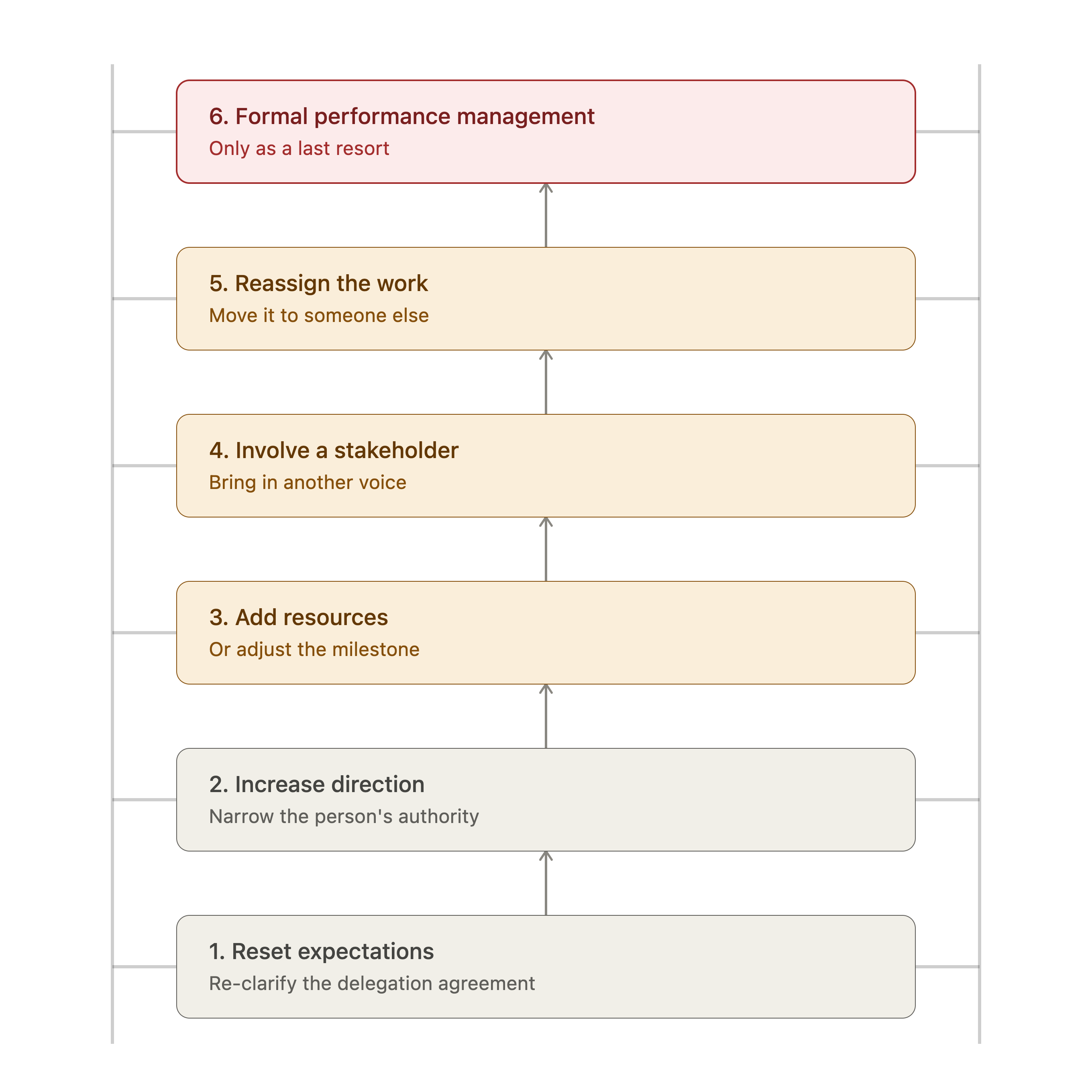
The skill is matching the rung to the evidence, not to your mood. Start as low on the ladder as the situation allows and climb only when a step genuinely fails. A vendor format problem, for instance, is a resource gap, not a character flaw — it calls for adjusting the milestone or adding a hand, and jumping straight to reassignment there would punish someone for a problem that was never theirs. Repeated missed commitments with no ownership are a different story: by then you've usually already reset the agreement and added support, so staying stuck on the bottom rung just lets the drift continue. The one thing to guard against is mistaking avoidance for kindness. Dragging out "let's give it more time" when the evidence clearly says otherwise isn't patience — it's a hard conversation you're ducking, and it almost always costs the team more than the honest version would have.
Here's the through-line of this whole lesson: monitoring works when your cadence and your response are both sized to the evidence, so you surface problems early and fix the cause while the person keeps ownership. Next you'll put that into motion across a few practices: first a quick self-check to spot the right monitoring cadence for different task conditions, then a live check-in where you press for specifics without taking the work back, and finally a recovery plan you could actually reuse. The behavior to carry in with you: when someone says "it's fine," ask them to walk you through where it actually stands.
