Diagnosing the Brand Triangle
Diagnosing the Brand Triangle
The iceberg gave you a way to see what sits underneath a brand. Now you need a way to spot when a brand has quietly drifted out of alignment, when what you meant to build and what people actually feel have pulled apart. That tool is the Brand Triangle, and it's the diagnostic you'll reach for whenever a brand "isn't landing" but nobody can say exactly why. As a Digital Marketing Manager, you sit right where these gaps surface first: in the comments, the reviews, and the reply-all threads.
Three Corners: Intend, Create, Perceive
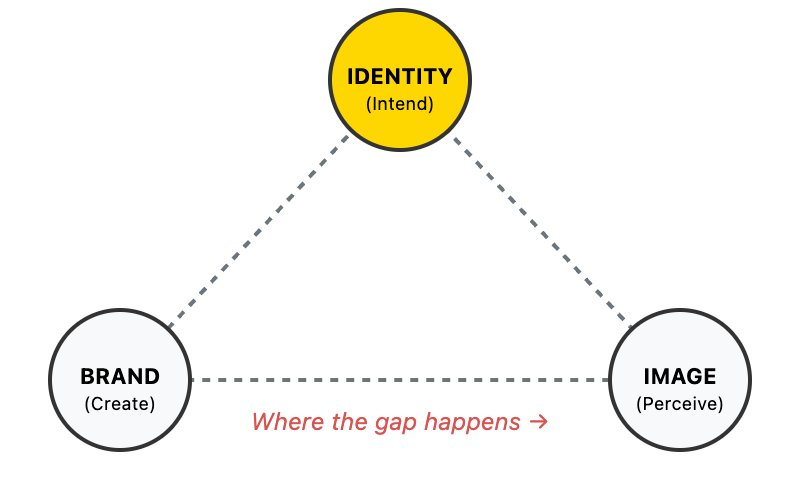 The Brand Triangle has three corners, and the whole point is that they're not the same thing. The first is your brand identity: what you intend. This is the brand you mean to build, the premium-and-reassuring feeling you set out to create. The second is the brand: what you actually create, the real stuff you ship, like the ad, the website, the onboarding flow, the tone of a support reply.
The third corner is your brand image: what others perceive. This is the impression that forms in a customer's head after they've bumped into your brand a few times, and it's the only corner you don't directly control. Here's the catch most marketers miss: customers never see your intention. They only ever meet what you created, and from that they build their own image. Your good intentions live entirely in your head until a touchpoint makes them real.
- Jake: We intended the campaign to feel premium and reassuring. So why are reviews calling us "cold"?
- Victoria: That's the Brand Triangle showing a gap. What you intended is one corner; what customers perceived is another.
- Jake: So the intention doesn't count?
- Victoria: It counts as a target. But the only corner customers feel is the experience you actually built: the emails, the support replies. If those read cold, "cold" becomes the image.
- Jake: So we close the gap by fixing what we created, not by restating what we meant.
Notice that Victoria doesn't argue about what Jake intended. She moves straight to the corner customers actually touch.
Finding the Gap
Diagnosing the triangle means holding two corners side by side: what you intended versus what customers perceive. When those two match, the brand is coherent. When they don't, you've found a gap, and that gap is your real problem, not the logo and not the tagline.
The discipline is to resist explaining the gap away. If you intended "caring" and customers say "impersonal," the instinct is to insist that you really do care. But the perception is the data. Treat it as true, then walk back to the middle corner, what you created, to find where the intention broke. Maybe the support reply opens with a ticket number instead of a name. Maybe the onboarding email reads like a manual. The gap almost always traces to a specific touchpoint where what you built failed to carry what you meant.
So your diagnostic move is a three-step read. State the intention plainly. Pull the actual perception from real customer language. Then hunt through the touchpoints in between for the exact place the signal got lost.
Realigning the Three Corners
Once you've located the gap, the fix is almost never to say your intention louder. Re-running the same campaign with the word "caring" bolted on won't change anything, because the problem was never the message you declared, it was the experience you delivered. You close the gap by changing what you create at the touchpoint where the gap is widest.
That's the move worth practicing: go to the worst touchpoint first. If "premium" reads as "overpriced" because the ad never shows the value, rewrite the ad to make that value tangible. If "caring" collapses at the support desk, replace the templated opener with a warm, named reply. Each concrete change pulls the brand corner closer to your identity, which slowly drags the image into line behind it. Coherence isn't a slogan you add; it's the result of every touchpoint finally telling the same story.
The single takeaway: a brand is coherent only when what you intend, what you create, and what others perceive line up, so your job is to find where they don't and then fix the touchpoint, not the talking point. This is where it gets concrete. You'll first run a quick check to make sure the three terms snap into place on sight, then take the diagnosis into a live conversation with a consultant, and finally turn it into a recommendation someone could act on. Start the habit now: the next time a brand "isn't landing," name all three corners out loud before you touch a single asset.
