Defining the Brand
Welcome to the Course
You've spent the last few years running campaigns, juggling channels, and chasing numbers. Now you're being handed something bigger: ownership of the brand itself. The trouble is that "brand" is one of the most misused words in marketing, and getting it wrong quietly distorts every decision that follows. This course builds your foundation from the ground up.
By the end of this course, you'll be able to:
- Distinguish a brand from its logo, product, and marketing campaigns
- Read any brand through the Brand Iceberg, separating visible assets from the strategic drivers beneath the surface
- Diagnose gaps between what you intend, what you build, and what customers actually perceive using the Brand Triangle
- Explain the emotional and psychological drivers behind loyalty and willingness to pay a premium
- Map the touchpoints where customers form their lasting impression of a business
This first unit tackles the question everything else rests on: what a brand actually is, and why it's so much more than the logo on the screen.
A Brand Is Not the Logo, the Product, or the Campaign
Here's a moment you'll recognize. Leadership unveils a new logo, and someone says, "There's our brand." It feels true, because the logo is the most visible thing anyone shipped. But it's a trap, and as the person now owning brand strategy, you're the one who has to gently untangle it.
Start by separating four things that constantly get blurred. The logo is a visual mark, a symbol that helps people recognize you. The product is what you actually sell and what it does. A marketing campaign is a time-bound push to promote something, like an ad set or a launch. And the brand is none of those individually: it's the impression that lives in someone's head when they think of you.
A useful analogy: the logo is like a person's face, the product is what they do for a living, and a campaign is one memorable conversation you had with them. But the brand is your overall sense of who they are, whether you trust them, how you feel when their name comes up. You can recognize a face instantly and still not trust the person. That gap is exactly why the logo is not the brand.
- Jake: The rebrand's live. New logo's everywhere, so the brand's basically done, right?
- Victoria: The logo's done. But ask a customer what they think of us, and they won't describe the logo. They'll talk about whether the app worked and how support treated them.
- Jake: So the logo's just... the label on the box?
- Victoria: Exactly. The brand is what they remember being inside it.
Notice that Victoria doesn't dismiss the logo. She just relocates it to its real, smaller job.
What Customers Actually Remember
So if the brand isn't the logo, what is it made of? It's made of perceptions, emotions, and experiences, the residue every interaction leaves behind.
Think about how customers actually talk. They rarely say "I love your typography." They say things like "setup was painless," "support actually fixed it," or "shipping took forever and nobody told me." Each of those is an experience that produced a feeling: relief, trust, frustration. Those feelings stack up over time into a perception, a gut sense of what you're like to deal with. That accumulated gut sense is the brand.
This is why, as a Digital Marketing Manager, your most valuable raw material isn't a moodboard. It's customer language: reviews, support tickets, comments, replies. When you read a comment, train yourself to name the emotion underneath it. "The app just works" isn't a feature note, it's relief. "Took three emails to get an answer" isn't a logistics complaint, it's eroded trust. Those named emotions are the brand forming in real time, and they're far more honest than any internal deck.
The Brand Is the Total Impression
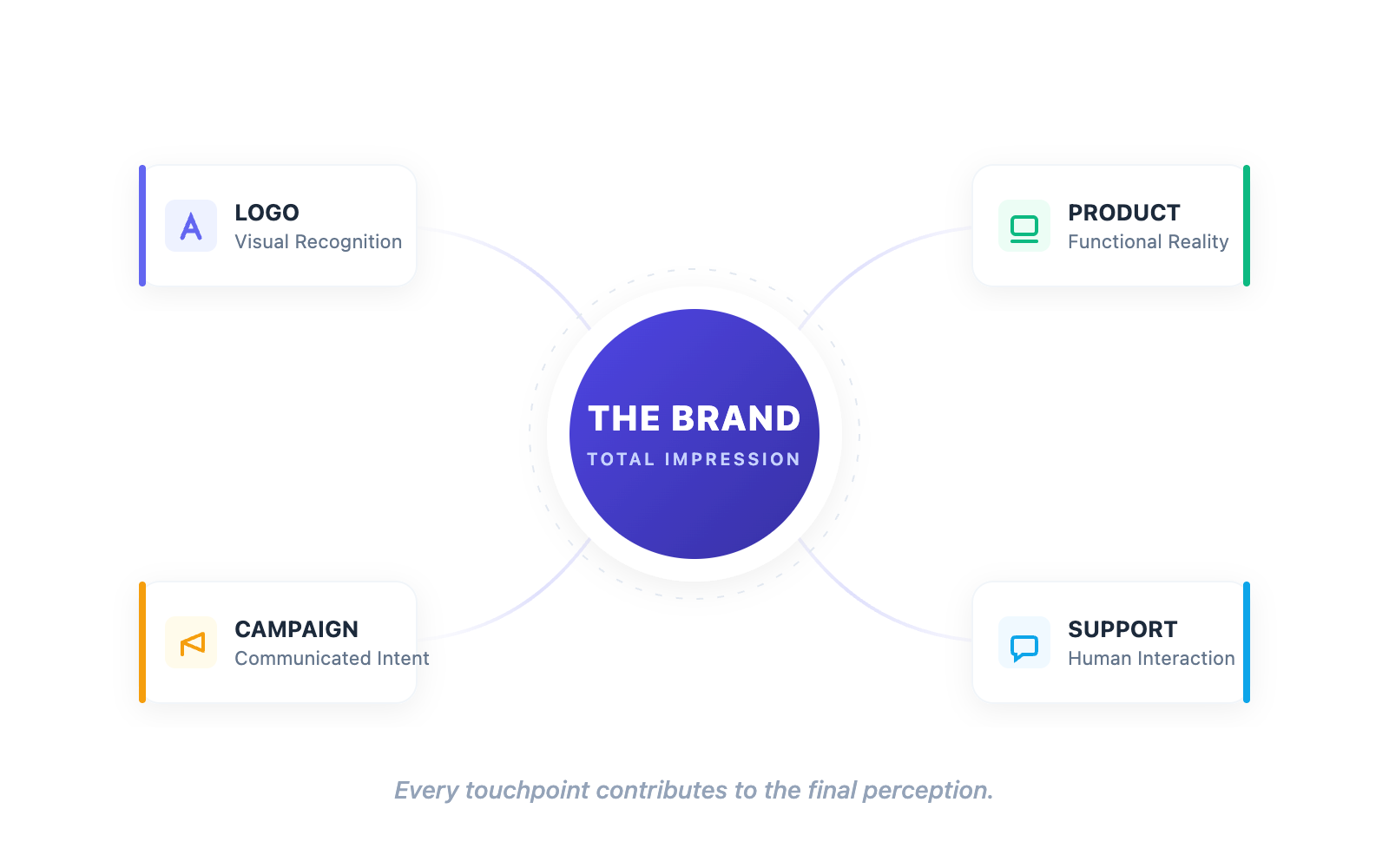
Pull it together and you get a single working definition you can carry into any meeting: a brand is the total impression created by every interaction someone has with your business.
"Every interaction" is the part people skip. It includes the ad they scrolled past, the website that loaded slowly, the unboxing, the onboarding email, the support reply, and the product itself on day ninety. No single touchpoint is the brand; the brand is the sum. And that sum is built whether you manage it or not. If shipping is chaotic and support is cold, those become the brand just as surely as a beautiful logo does. Your job isn't to invent the brand from scratch, it's to shape the impression that's already accumulating across all of it.
The single takeaway: a brand isn't something you design and ship, it's the total impression every interaction leaves in a customer's mind, and the logo is only the smallest visible piece of it. Before this becomes a live conversation, you'll do a quick sorting exercise: given real statements, can you tell at a glance which ones describe the logo, the product, a campaign, or the brand itself? Treat it as pattern practice. The faster you can spot the difference cold, the more naturally you'll hold the line the next time a stakeholder says "the logo is our brand" and genuinely believes it.
