Use Quantitative Evaluation with a Weighted Decision Matrix
Use Quantitative Evaluation with a Weighted Decision Matrix
A simple list of pros and cons treats every factor as though it matters equally. In reality, salary might matter more to you than office location, or strategic impact might outweigh team size. The Weighted Decision Matrix solves this by letting you assign numerical importance to each factor, score every option, and arrive at a total that reflects your actual priorities. This shifts your decision-making from qualitative intuition to quantitative rigor, providing a structured method to cut through indecision.
The foundation of a Weighted Decision Matrix is deciding how much each factor matters to you relative to others. This weighting step is a direct translation of your values and work-style preferences.
Start by listing the factors you will use to evaluate your options. Common factors include Salary and Compensation, Growth Opportunity, Leadership Scope, Strategic Impact, Remote Flexibility, and Work-Life Balance. Aim for five to eight factors—enough to be comprehensive without becoming unwieldy.
Next, assign each factor a weight on a scale of 1 to 5, where 1 is "nice to have" and 5 is a "non-negotiable priority." For example, if mentoring is central to your professional identity, you might assign Leadership Scope a 5. If relocation is not an issue, Location might receive a 2.
The key is honesty. If every factor is weighted a 4 or 5, the matrix loses its purpose. Force yourself to differentiate. Ask: "If I could only optimize for three of these factors, which would I choose?" Those three should carry your highest weights. Remember, weights are a snapshot of your priorities right now; you should set them before scoring your options to avoid reverse-engineering a choice you have already made emotionally.
Scoring Options Based on Researched Data
With your weights set, score each career option on every factor using a scale of 1 to 5. Ground every score in evidence—salary benchmarks, job descriptions, and interview insights—rather than assumptions.
Suppose you are evaluating three options: a Senior Manager role at a large tech company, a Lead position at a mid-size startup, and a Director role at a nonprofit. For Salary, your research might show the tech company offers the highest base, the startup offers aggressive bonuses, and the nonprofit offers the lowest. You might score these 5, 4, and 2 respectively. For example:
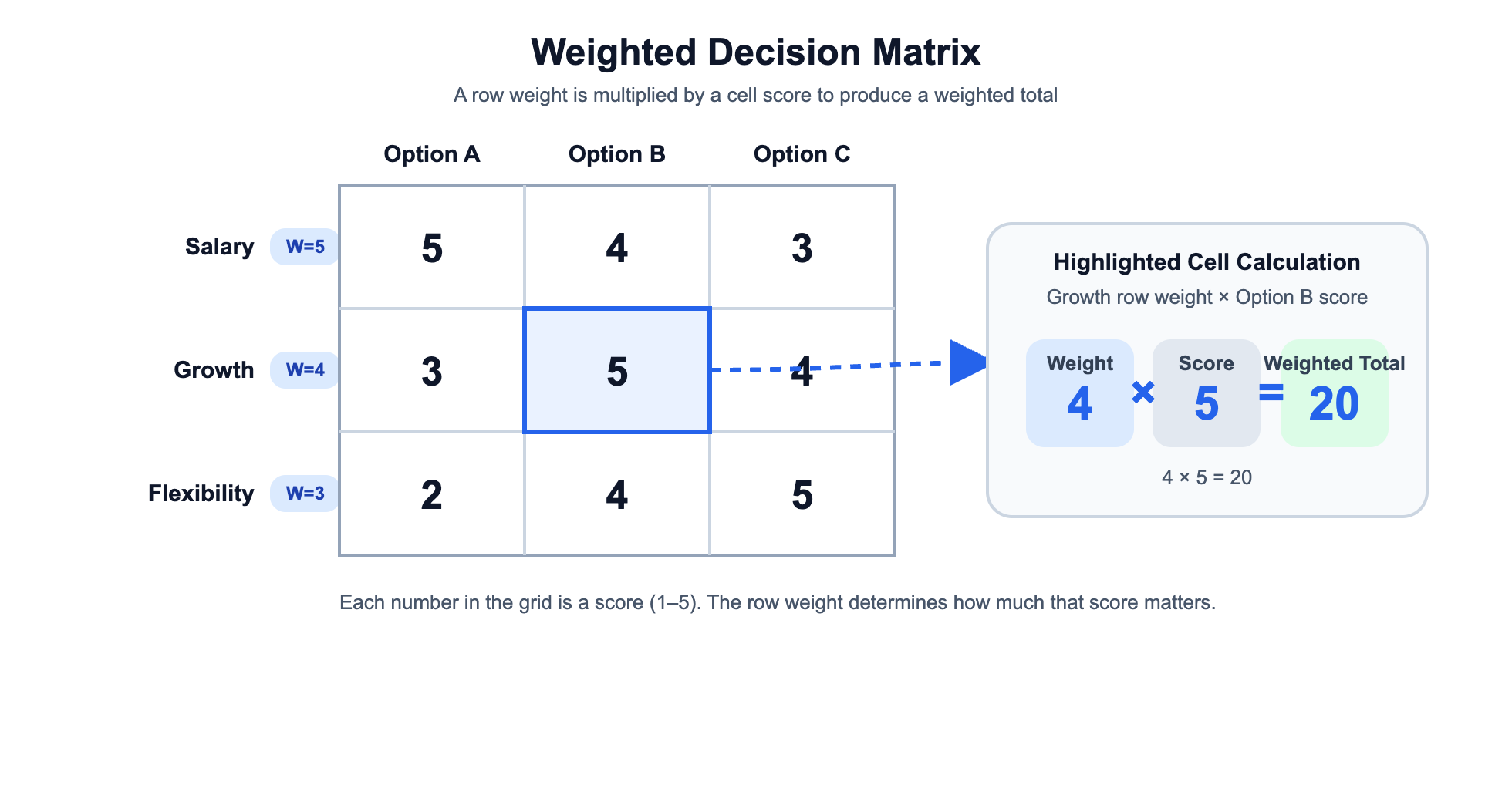
To calculate the results, multiply the score by the weight for each cell. If Growth Opportunity has a weight of 4 and the startup scores a 5, the weighted score is 20. Sum all weighted scores for each option to get a total weighted score. This process prevents you from being dazzled by a single feature—like a high salary—while overlooking mediocre performance on factors that matter more to you.
Interpreting Matrix Results to Inform Final Choices
A completed matrix provides a clear ranking, but the totals are a starting point for analysis, not an automatic verdict. Begin by looking at the margin between top options. If the gap is only two points, the decision may come down to unquantifiable factors like "gut feeling." If the gap is significant, the matrix is sending a clear signal.
Examine where each option won and lost. Even if an option has the highest total, it might score poorly on a factor you weighted as a 5. Ask yourself: "Can I live with a low score on a non-negotiable priority?" If not, the highest total score may not be the right choice.
Consider the following conversation between two professionals reviewing a completed matrix:
- Jessica: I ran the numbers and the Senior Lead role at that fast-growing fintech came out on top with a total of 162. The Strategy Director role scored 148. So the fintech wins, right?
- Milo: On paper, sure. But walk me through the individual scores. What did the fintech get on Work-Life Balance? You weighted that a 5.
- Jessica: It scored a 2. The recruiter mentioned sixty-hour weeks are the norm during scaling.
- Milo: So your highest-priority factor got one of the lowest scores. That 162 is being carried by salary and growth, but you said burnout was the reason you started this search.
- Jessica: You're right. If I adjust the weight of Work-Life Balance, the roles actually tie.
- Milo: That's your answer. The total score is useful, but it can't override a dealbreaker hiding in plain sight.
Notice how Milo does not dismiss the matrix—he uses it as a tool for deeper questioning. By directing Jessica to examine a low score on her highest-weighted factor, he surfaces a critical conflict that the total alone would have obscured. This is exactly the kind of interpretation skill that separates a mechanical use of the framework from a truly strategic one. When you review your own matrix, make a habit of scanning for these mismatches before accepting the final ranking at face value.
Additionally, it is wise to test the sensitivity of your weights. Try adjusting a weight by one or two points and see whether the ranking changes. If bumping Work-Life Balance from a 3 to a 4 flips the top two options, that tells you the decision is tightly balanced and your confidence in that particular weight matters a great deal. If the ranking stays the same regardless of moderate adjustments, you can feel more secure that the winning option is robustly the best fit.
Finally, remember that the matrix is a decision support tool, not a decision replacement. Its greatest value is in making your reasoning explicit and comparable. With your weighted matrix complete and your results interpreted, you are ready to put this framework to the test. In the upcoming role-play session, you will present your matrix results to a mentor and defend why you weighted certain priorities higher than others, giving you practice in articulating the logic behind your numbers under real conversational pressure.
