The Science of Decision-Making
Welcome to the Course
Making a career decision can feel like standing at a crossroads with no road signs. You have done the hard work of self-assessment and market research; now, you must turn that data into a clear, confident choice. This course is designed to help you do exactly that.
Throughout this course, you will learn structured decision-making frameworks that remove guesswork and emotional fog. You will start by understanding the psychological traps that derail good decisions, then build matrices to compare your options side by side. From there, you will factor in lifestyle realities like work-life balance and risk tolerance, integrating everything into a long-term strategy that aligns your next move with where you want to be in five or ten years.
The Science of Decision-Making
The biggest enemy of a great decision is not a lack of options—it is what happens inside your head when you have too many choices. Decision paralysis occurs when you become so overwhelmed by data that you freeze. You keep researching and revising, but you never actually commit. The antidote is not more data; it is a structured framework that tells you when you have enough data to move forward.
Cognitive biases further compound the problem by distorting your reasoning. The Sunk Cost Fallacy is the tendency to stick with a path because of the time, money, or effort you have already invested, even when the evidence says it is no longer the right fit. A professional might think, "I've spent eight years building my reputation in this division—I can't walk away now," even though a different role would better serve their goals. The reality is that the sunk cost is gone regardless of what you choose next, and it should not dictate your future.
Consider the following conversation between two colleagues discussing a career crossroads:
- Natalie: I've been thinking about applying for that Senior Strategy role. It checks every box—project scope, strategic impact, and alignment with my strengths.
- Ryan: That sounds like a great fit. What's holding you back?
- Natalie: Honestly? I've spent six years building the client portal here from scratch. Walking away feels like throwing all that work away.
- Ryan: I get that. But ask yourself this—would you take your current role if it were offered to you today for the first time?
- Natalie: Probably not. It was the right challenge three years ago, but I've outgrown it.
- Ryan: Then the six years aren't a reason to stay. They're proof you're ready for what's next.
Notice how Ryan's question—"Would you take your current role if it were offered to you today for the first time?"—cuts straight through the Sunk Cost Fallacy. By reframing the decision as a fresh choice rather than a continuation of past investment, Natalie is able to see that her hesitation is rooted in what she has already spent, not in what she actually wants going forward. This is a technique you can use on yourself.
The second bias to watch for is Confirmation Bias—the habit of seeking out information that supports what you already want to believe while ignoring evidence that contradicts it. A practical way to counter this is to deliberately argue against your preferred option by asking yourself, "What would I need to see to change my mind?" and then honestly looking for it.
Building a Pros and Cons Matrix for Career Options
The Pros and Cons Matrix is one of the oldest decision tools in existence, and for good reason—it forces you to externalize what is swirling around in your head. When you write things down in a structured format, you move from vague feelings to concrete, comparable factors.
To build one, start by listing your career options as columns, then brainstorm the pros (benefits, advantages, things that excite you) and the cons (drawbacks, risks, things that concern you) for each option. The key here is specificity. Instead of writing "good salary", write "base salary of \$120K with 15% bonus potential". Instead of "long hours", write "average 55-hour weeks with travel two weeks per month". This level of detail is what transforms a casual list into a decision-grade tool.
The following example illustrates how to structure this comparison using specific, data-driven entries:
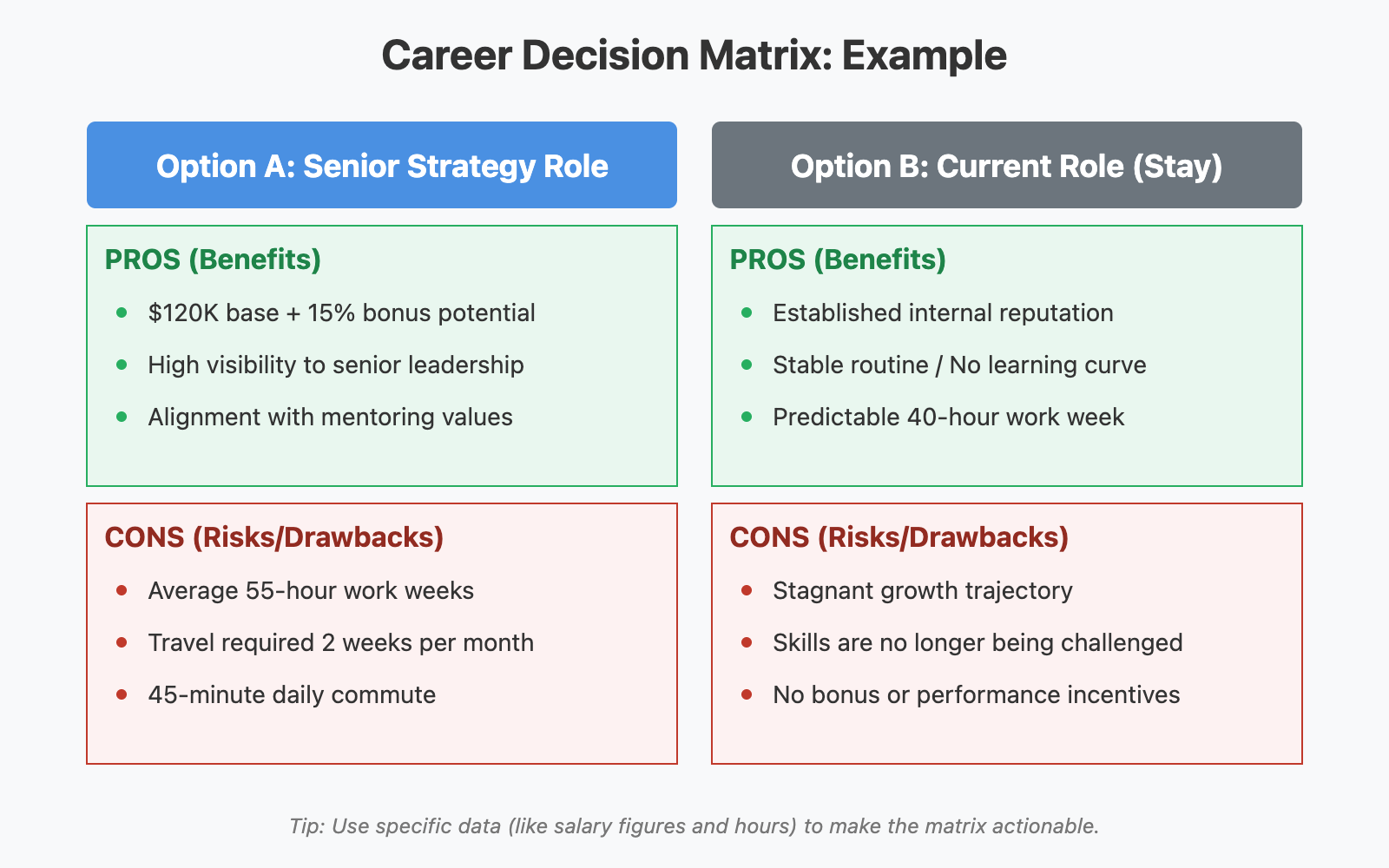
As shown in the matrix above, your evaluation should include factors like visibility to leadership, commute time, alignment with personal values, and growth trajectory. Aim for at least five factors on each side for every option. If you find yourself listing many pros and almost no cons for one choice, it is a strong signal that confirmation bias may be creeping in.
Once complete, review the matrix for patterns. Are the cons mostly about short-term discomfort, or do they signal long-term misalignment? The matrix clarifies what you are actually trading off, transforming the question of "Which career should I choose?" into "Which trade-offs am I most willing to accept?".
