Choosing the Right Database
NoSQL and Choosing per Dataset 🗄️
The last lesson showed what a relational database gives you: a fixed structure, enforced up front, and transactions that either fully succeed or fully fail. That is a good fit for payments, but not every dataset behaves like a payment.
In this lesson, you will learn to:
- Tell apart document, key-value, wide-column, and graph databases by the shape of data each is built for.
- Name major managed NoSQL services and the workloads they support.
- Decide when to split data across relational and NoSQL stores instead of forcing every dataset into one database.
Flexible Structure: Document, Key-Value, Wide-Column, and Graph 🧩
NoSQL is an umbrella term for databases that don't use the fixed table-and-schema model. The name is a little misleading. It doesn't mean "no structure" and it doesn't mean these databases are hostile to SQL. It means the structure isn't declared in advance and enforced on every write. Instead, each record can carry whatever fields it needs, and the application decides what those fields mean.
There are four families you'll hear named, and it helps to think of them by the shape of the data they hold.
A document database stores one self-contained record per item, usually written in a format like JSON, which is just text organized into labeled fields. Two records in the same collection can have different fields. One patient's intake questionnaire might have twelve answers, another's forty, and neither has to match a predefined column list. That's a good fit for content whose fields keep evolving.
A key-value store is the simplest of all: you hand it an identifier, it hands you back a value, extremely fast. Think of a coat check. You give the ticket number, you get the coat. No searching, no joining tables. Shopping carts, user sessions, and device readings looked up by device number all live here.
A wide-column store is built for enormous tables where different rows can hold different columns. It's designed for the case where you have billions of rows and you almost always read them by a known identifier and a time range, such as sensor readings over the last hour.
A graph database stores the connections between things as first-class data. Its natural questions are relationship questions: who is connected to whom, and by how many hops. Fraud rings, referral networks, and recommendation systems are the usual examples.
The common thread across all four is that structure is loosened in exchange for something else, usually speed at very large scale, or the freedom to store records that don't all look alike.
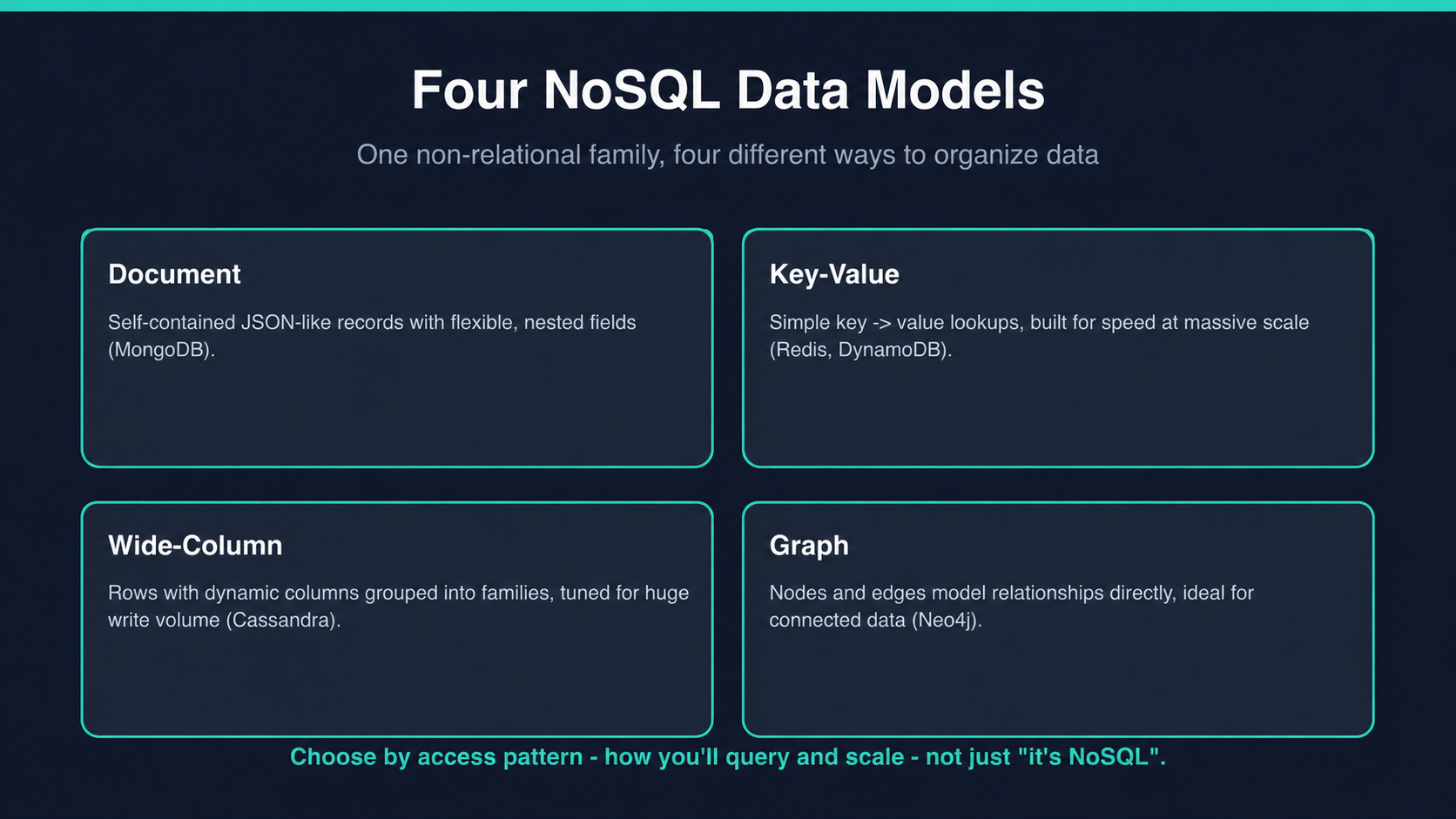
The comparison makes the decision practical: begin with the data shape and the question the application needs to answer, rather than treating NoSQL as one interchangeable category.
The Managed Services You'll Actually See ☁️
You will rarely install these yourself. As with relational databases, the big providers run them for you.
On Amazon Web Services, Amazon DynamoDB is the flagship key-value store, and it also handles document-style records. On Microsoft Azure, Azure Cosmos DB is a multi-model database with APIs for document, key-value, graph, and column-family workloads.
Google Cloud offers two you should know: Google Firestore, a document database popular with mobile and web applications, and Google Bigtable, a wide-column store designed for very large, very fast workloads such as time-series and sensor data. Learning these four names is worth the ten minutes. When a developer says "we'll put it in Dynamo," you want to know immediately that they mean fast lookups by a single identifier at high volume, not a place to run complicated multi-table reports.
Choosing Between Them, and Why It's Usually a Split ⚖️
The useful comparison isn't "which database is better." It's five questions asked about a specific set of data:
- Data shape. Is every record the same, with the same fields, or do the fields vary from one record to the next? Stable shapes suit relational; varying shapes suit document.
- Relationships. Does this data constantly need to be joined to other data, or is each record largely self-contained? Heavy joins are relational territory.
- Access patterns. Do you know in advance how the data will be read, or will people ask unpredictable ad hoc questions? NoSQL rewards known access patterns, while SQL is far more forgiving of new questions.
- Scale. Hundreds of requests per second, or hundreds of thousands?
- Transaction and consistency guarantees. The one people skip: what the business actually requires. This last question is where most arguments get settled.
Here, Dan and Nina are engineers building a ride-hailing app: Dan is pushing for one flexible store, while Nina is protecting the payment workflow's integrity.
- Dan: I want everything in one flexible store. It scales better, and the trip records change shape constantly.
- Nina: Agreed on the trip records, and on the live location pings. What about fares and refunds?
- Dan: Same store. Why complicate it?
- Nina: Because charging a rider is several changes that must all land or none of them. If the card is charged but the receipt and driver payout don't record, we've taken money with no matching record. Which one do you want to be explaining?
- Dan: Fair. So a relational store for fares and refunds, and a wide-column store for the location feed by driver ID and time range?
- Nina: That's the split. Right tool per data set, not per project.
Notice that Nina didn't argue about scalability in the abstract. She named a specific consequence and let Dan draw the line himself.
One important caveat: capabilities vary by NoSQL model and by service. Several managed NoSQL services now offer transactions across multiple items, and some offer a choice between strong and eventual consistency. Never assume all NoSQL databases behave the same way. Check the specific service.
The takeaway is that relational versus NoSQL is a per-dataset question, not a per-project one, and the requirement that most often forces the answer is what has to be guaranteed rather than what has to be fast. Up next, three practices: match the four NoSQL types to their structures, recall the managed service names, and step into a live conversation with a developer who wants to build everything on one store.
