Defining Brand Personality
Defining Brand Personality
You've claimed a space in the market with a positioning statement. Personality is how that space sounds and feels the moment a customer actually meets it: the tone of a subject line, the energy of an Instagram caption, the warmth (or coldness) of a support reply. Positioning is the strategic claim; personality is the human voice that makes the claim believable across every touchpoint. Get it right and your channels stop sounding like five different brands stitched together.
Characterizing Your Brand with the Five Dimensions
Start by giving yourself a vocabulary. The frame for reference here is Aaker's Five Dimensions of Brand Personality: Sincerity, Excitement, Competence, Sophistication, and Ruggedness. Sincerity reads as honest, wholesome, and down-to-earth. Excitement is daring, spirited, and trend-forward. Competence signals reliable, intelligent, and capable. Sophistication carries glamour, premium polish, and charm. Ruggedness feels tough, outdoorsy, and durable.
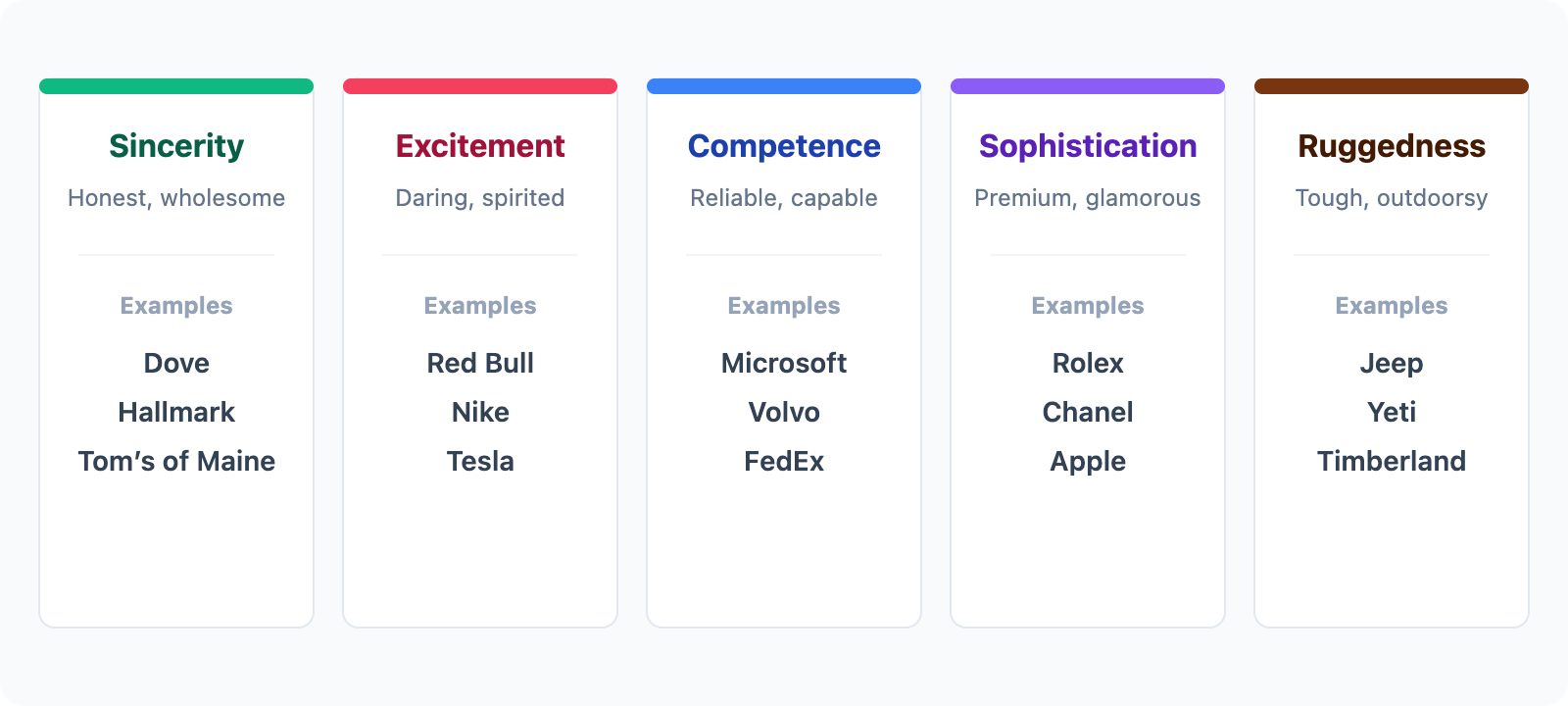
The move is to characterize your brand against all five rather than reaching for the one that flatters you. Walk through each dimension and ask, "On a scale of low to high, how much of this are we?" A productivity tool might score high on Competence and low on Ruggedness; an adventure-gear brand flips that exactly. Doing this honestly across all five gives you a profile, not a guess, and it stops the conversation from defaulting to whatever sounds coolest in a meeting.
Defining a Distinct Personality That Attracts Your Ideal Customer
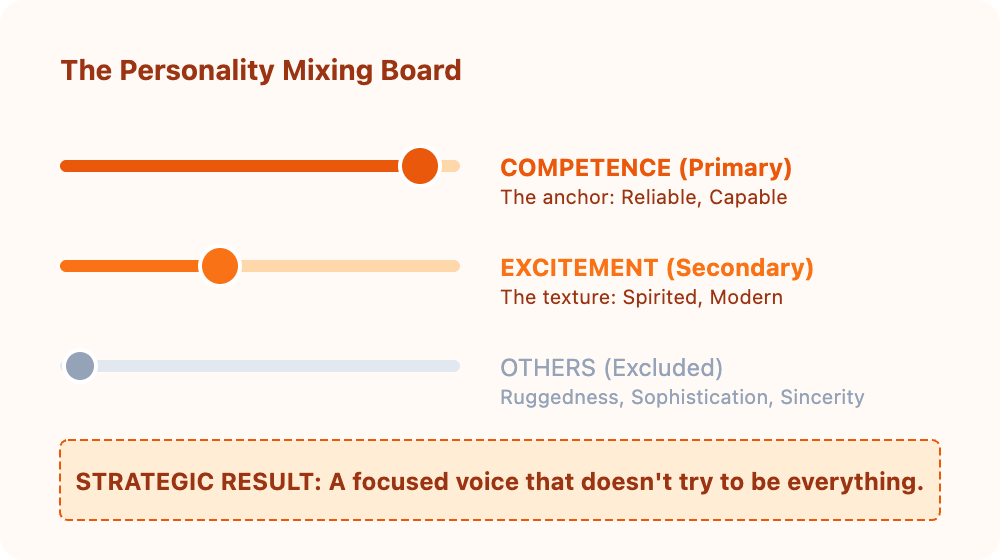 Now narrow it. A brand that scores "high on everything" has no personality at all. The discipline is to pick one primary dimension that leads, add one complementary secondary dimension for texture, and then name what you deliberately leave out. The exclusion is what makes the personality distinct, because it tells your writers what not to do.
Crucially, you choose based on your ideal customer, not your own taste. The right question is, "Which personality reassures the buyer we built this for?" A nervous, non-technical buyer is calmed by Competence and unsettled by pure spectacle; a status-driven buyer responds to Sophistication. Match the personality to the customer's emotional need and it does recruiting work for you.
- Jake: I want this relaunch to feel exciting - bold, loud, scroll-stopping.
- Victoria: Exciting grabs attention, but who's our buyer? The person who just wants the setup to work the first time.
- Jake: ...so spectacle might actually make them nervous we're all style, no substance.
- Victoria: Right. Lead with Competence (reliable, capable), let a touch of Excitement keep it from feeling dull, and consciously skip the hype language.
Notice Victoria didn't kill Excitement, she demoted it to secondary and anchored the call in the customer rather than the mood of the room.
Integrating Personality into Consistent Messaging Behaviors
A personality the team can't apply is just an adjective on a slide. Translate it into concrete do/don't behaviors across the levers writers actually touch: headline style, CTA language, imagery cues, and support tone. For a Competence-led brand, a headline does "Set up in under a minute, no hub required" and doesn't do "Lighting reinvented forever." A CTA does "Get started" and avoids "Unleash the magic." Support tone does name the fix plainly and doesn't bury reassurance under exclamation points.
Then enforce it across channels, because consistency is what builds recognition. The same personality should govern an email, a paid social post, and a returns reply, even though the format differs. When a writer can copy a do/don't example instead of interpreting "be confident but warm," the brand sounds like one voice everywhere.
The single takeaway: a brand personality is a deliberate choice of one leading dimension, calibrated to your ideal customer and made real through repeatable messaging rules, not a vibe. Next you'll spot which Aaker dimension a given voice or image is expressing, then defend a primary-secondary blend in a live debate, and finally turn that blend into do/don't guidance your team could use tomorrow. As you go, keep asking the one question that keeps personality honest: which dimension does our specific buyer actually need to feel?
