Claiming Brand Positioning
Claiming Brand Positioning
You've turned a feature-stacked draft into a value statement that leads with the outcome. That tells a customer what they get. Positioning does something different: it tells them where you sit in their mind relative to every alternative. A value statement can be true and still get lost if the market already has a clear leader and you sound like a paler version of it. This unit is about claiming a space competitors can't easily occupy, and saying it in one defensible sentence.
Choosing a Positioning Strategy
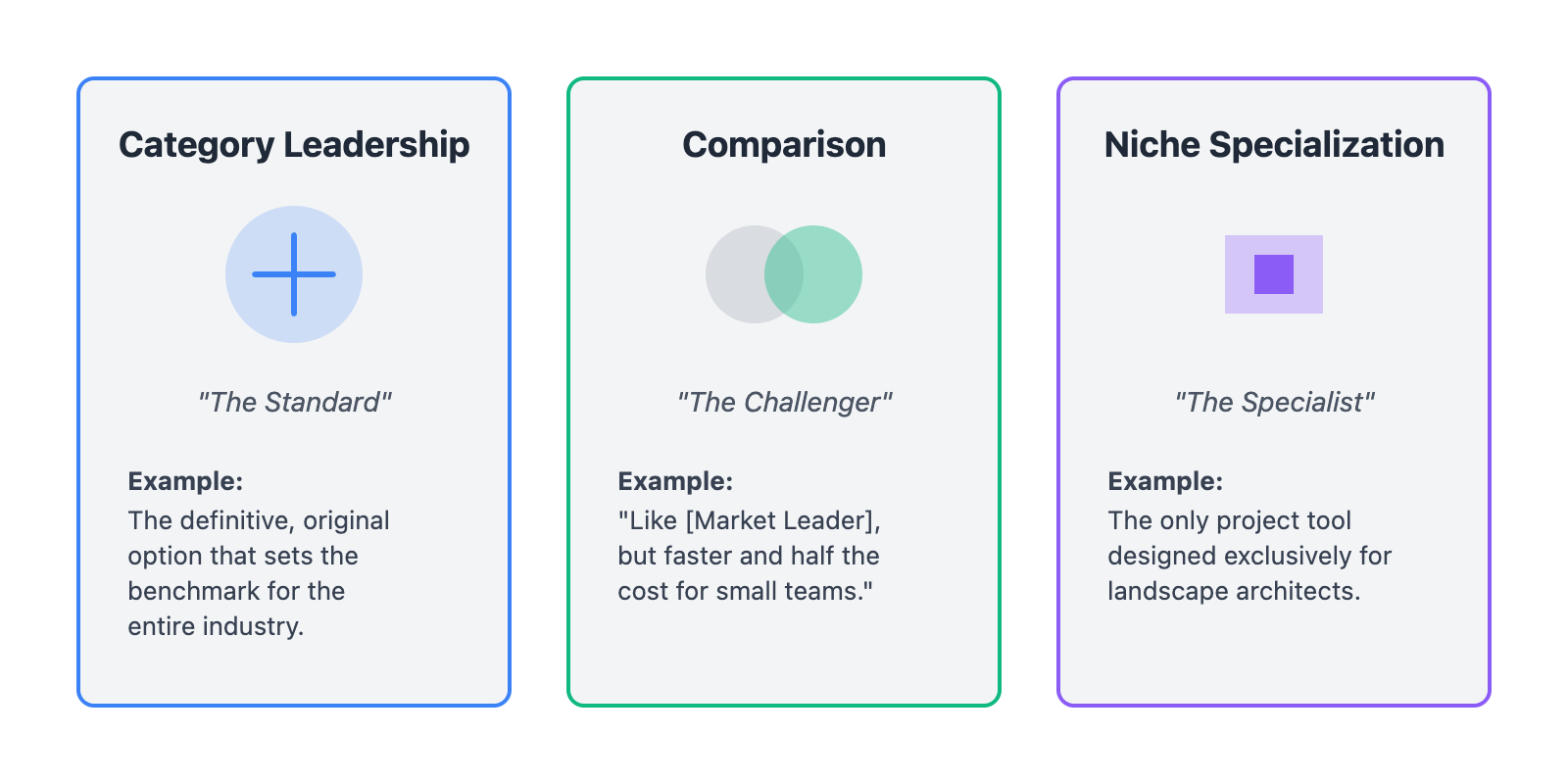
Before you write anything, decide how you intend to claim space, because the three available moves aren't interchangeable. Category leadership plants a flag as the definitive option in a category ("the original," "the standard"); it's powerful but expensive to defend, and it only works if you can credibly claim the top. Comparison positions you directly against a known rival, borrowing their frame to highlight where you're better or different, which is the classic challenger move when one player already dominates.
The third move is niche specialization, which narrows the field until you're the obvious choice for one specific audience or need, trading breadth for ownership. Which one fits depends on the differentiator you locked earlier and the gaps your competitive research exposed. If your research surfaced an underserved segment, niche specialization is often the most honest and most defensible route; if the category has a believable leadership slot still open, claim it. The strategy you pick shapes every word of the statement that follows.
Writing the Positioning Statement
The workhorse here is the Brand Positioning Statement Template: "For [target audience], [brand] is the [category/frame of reference] that [differentiator + benefit], because [reason to believe]." Each slot does a job. The audience names who you're for, and by omission, who you're not. The category sets the frame so people know what to compare you against. The differentiator and benefit carry the value you already defined. The reason to believe is the proof that stops the claim from being a wish. The discipline is filling every slot with something specific, because generic filler in any one slot collapses the whole sentence.
- Dan: I've got: "For everyone who wants better lighting, we're the smart brand that makes life easier, because we care about customers."
- Victoria: Every slot is generic. Who specifically is it for, and what's the actual proof?
- Dan: Non-technical buyers who don't want a setup project. And the proof is it pairs in under a minute with no hub.
- Victoria: That's your statement. "For non-technical homeowners, we're the smart light that works the first time, because it pairs in under a minute with no hub."
Notice Victoria didn't add words; she forced each slot to earn its place. A specific reason to believe does more work than any adjective.
Pressure-Testing Against Strong Brands
A statement that reads well to you still has to survive scrutiny. The fastest test is one question: could a competitor say the exact same thing with their name swapped in? If yes, the slot is generic, not ownable. Hold your draft up against brands that position sharply and you'll feel the difference. Strong positioning is clear, meaning you instantly know the category and the audience, and ownable, meaning the differentiator is genuinely theirs and grounded in a real reason to believe rather than an aspiration anyone could borrow. When a phrase fails either test, replace it with the most specific evidence you have instead of reaching for a bigger adjective.
The takeaway is simple: positioning isn't a slogan you write, it's a space you claim, and the template only works when every slot is specific enough that a rival couldn't copy it. Next you'll spot-check the three strategies, draft a full statement leadership could actually circulate, then pressure-test it line by line in a live conversation. As you draft, keep asking the one question that exposes weak positioning fastest: could a competitor say this exact sentence?
