Understanding Reverse Causation
Introduction
So far in Correlation Is Not Causation, you have learned two powerful ideas. Lesson one showed that a strong correlation never proves cause and effect on its own. Lesson two revealed how confounding variables can lurk behind the scenes, driving both observed variables and manufacturing a relationship that isn't really there. With this third lesson, you are now past the halfway mark of the course.
Today we tackle a different kind of mistake — one that can trip us up even when no hidden third variable is involved. Sometimes the two correlated variables really are connected, but we tell the causal story in the wrong direction. We assume is causing , when in reality is causing . This idea is called reverse causation, and learning to spot it is the focus of this lesson.
Which Way Does the Arrow Point?
When we notice that two variables move together, our minds tend to jump straight to a cause-and-effect story. We pick one variable as the "cause" and the other as the "effect," often based on whichever explanation feels most intuitive. But a correlation is symmetric — it tells us that and are associated, without revealing which one is influencing which.
Given a correlation between and , at least three explanations are on the table:
- causes
- causes
- A confounding variable drives both
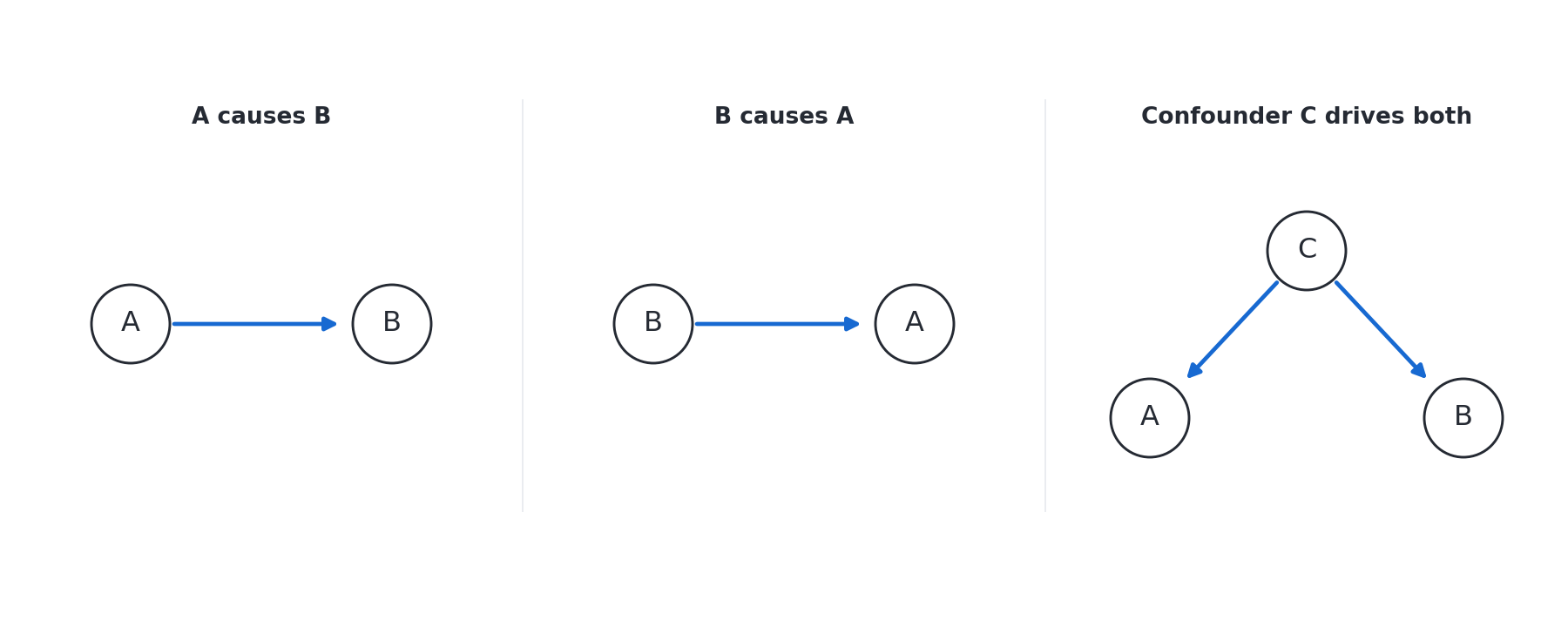
In the previous lesson, we focused on that third possibility. Now we turn our full attention to the second one: the scenario where the true direction of influence is the reverse of what we initially assumed.
What Is Reverse Causation?
Reverse causation occurs when the variable we treat as the "effect" is actually the one doing the causing, and the variable we treat as the "cause" is actually being caused. The arrow of influence runs in the opposite direction from the story we tell.
Consider this example. A study finds that people who take more medications tend to have worse health outcomes. A hasty conclusion might be: medications are making people sicker. But think again — people who are already in poor health are prescribed more medications because they are sicker.
- Assumed direction: more medications → worse health
- Plausible reverse direction: worse health → more medications
The correlation is real, and there may be a direct link between the two variables, but the causal story could be flipped. In this case, the "effect" (poor health) is likely what drives the "cause" (more medications). Without more evidence, the correlation alone cannot tell us which direction is correct.
