Understanding Coincidental Correlations
Introduction
Welcome back to Correlation Is Not Causation! This is the fourth of five lessons, which means you are approaching the finish line. Over the last three lessons, you built a solid set of tools: recognizing that correlation alone never proves cause, identifying confounding variables that manufacture false links, and spotting reverse causation where the arrow of influence points the wrong way.
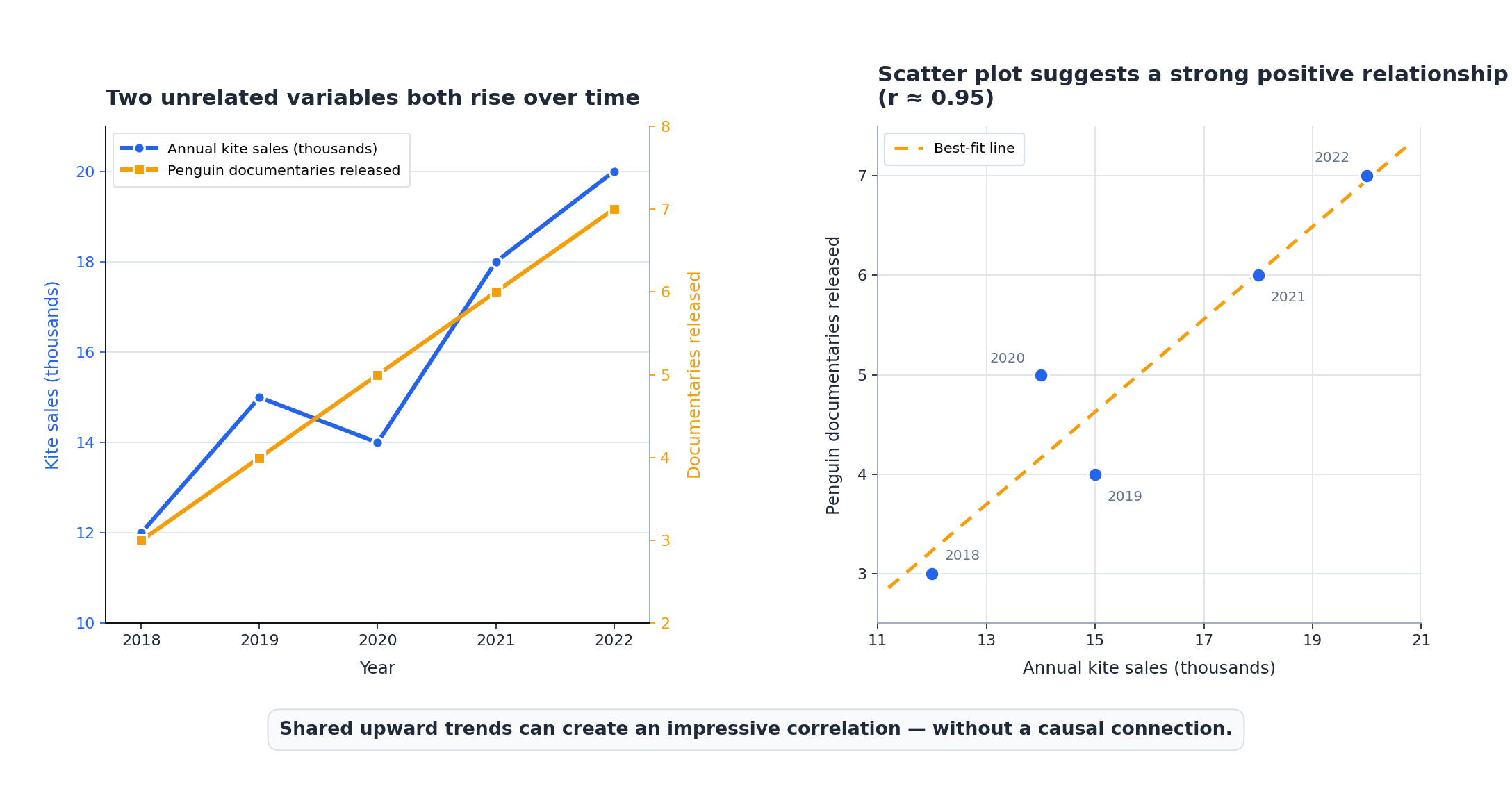
Each of those pitfalls involved some real connection between the two variables — whether through a hidden third factor or a flipped direction. In this lesson, we confront something even more surprising: sometimes a strong correlation exists between two variables that have absolutely nothing to do with each other. The pattern is pure coincidence. These meaningless associations are called coincidental or spurious correlations, and recognizing them is an essential data literacy skill.
When No Explanation Is the Explanation
In previous lessons, whenever we saw a correlation we asked questions like "Is there a confounder?" or "Could the effect actually be causing the cause?" Both questions assume some kind of real connection between the two variables, even if it is indirect or reversed.
But what if the honest answer is simply neither? What if two variables just happened to move in a similar pattern by luck? This is the core idea behind coincidental correlations: no confounder, no reversed arrow, and no causal link of any kind. The correlation is real in the data, but it carries no real-world meaning.
What Is a Coincidental Correlation?
A coincidental (spurious) correlation is a strong statistical association between two variables that arises without any causal mechanism connecting them. The numbers line up, the scatter plot looks convincing, and the correlation coefficient may even be impressively close to or — yet the relationship is completely meaningless.
One well-known collection of such examples comes from researcher Tyler Vigen, who searched through public data sets and found hundreds of strong but absurd correlations. For instance, over a span of years, per capita cheese consumption in the United States tracks almost perfectly with the number of civil engineering doctorates awarded. Another example pairs the divorce rate in Maine with per capita margarine consumption. In every case, no one would seriously argue that one variable is causing the other. These pairings are funny because they are meaningless, and that is exactly the point.