Evaluating Causal Claims
Introduction
Welcome to the final lesson of the Correlation Is Not Causation course! Over the past four lessons, you have built a powerful set of tools. You learned that correlation does not prove causation, explored how confounding variables can manufacture illusions of direct effects, saw that the direction of cause and effect can run backward, and discovered that some correlations are nothing more than coincidence. Now it is time to bring all of those ideas together into a single, repeatable strategy. In this lesson, you will develop a step-by-step checklist for evaluating any causal claim drawn from a correlation and practice applying it to real-world scenarios.
The Three Alternative Explanations at a Glance
Before we combine everything into a checklist, let's place our three alternative explanations side by side so you can see how they differ at a glance.
| Alternative | Core question | Classic clue |
|---|---|---|
| Confounding | Could a hidden third variable drive both X and Y? | Both variables share an obvious link to income, age, lifestyle, or another background factor. |
| Reverse causation | Could Y actually be causing X? | The supposed cause looks more like a response to the other variable. |
| Coincidence | Could the pattern be chance or parallel trends? | The two variables seem logically unrelated, or the link was found by searching many comparisons. |
Every causal claim based on correlation is vulnerable to at least one of these threats, and often more than one. The challenge is not just knowing the list — it is learning to apply it systematically every time you encounter a new claim.
A Step-by-Step Evaluation Checklist
Whenever you encounter a headline or study claiming "X causes Y," you can follow five straightforward steps:
- State the claim clearly. Identify which variable is the supposed cause and which is the supposed effect.
- Check for confounding. Ask whether a third variable could plausibly influence both X and Y. If so, the observed correlation might vanish once that variable is accounted for.
- Consider reverse causation. Flip the arrow. Could Y be driving X instead of the other way around?
- Assess coincidence. Could this pattern be a chance finding, a product of data mining, or two unrelated trends moving in the same direction over time?
- Weigh the alternatives. Decide which explanation is most convincing. Often more than one alternative applies, but one usually poses the strongest threat to the claim.
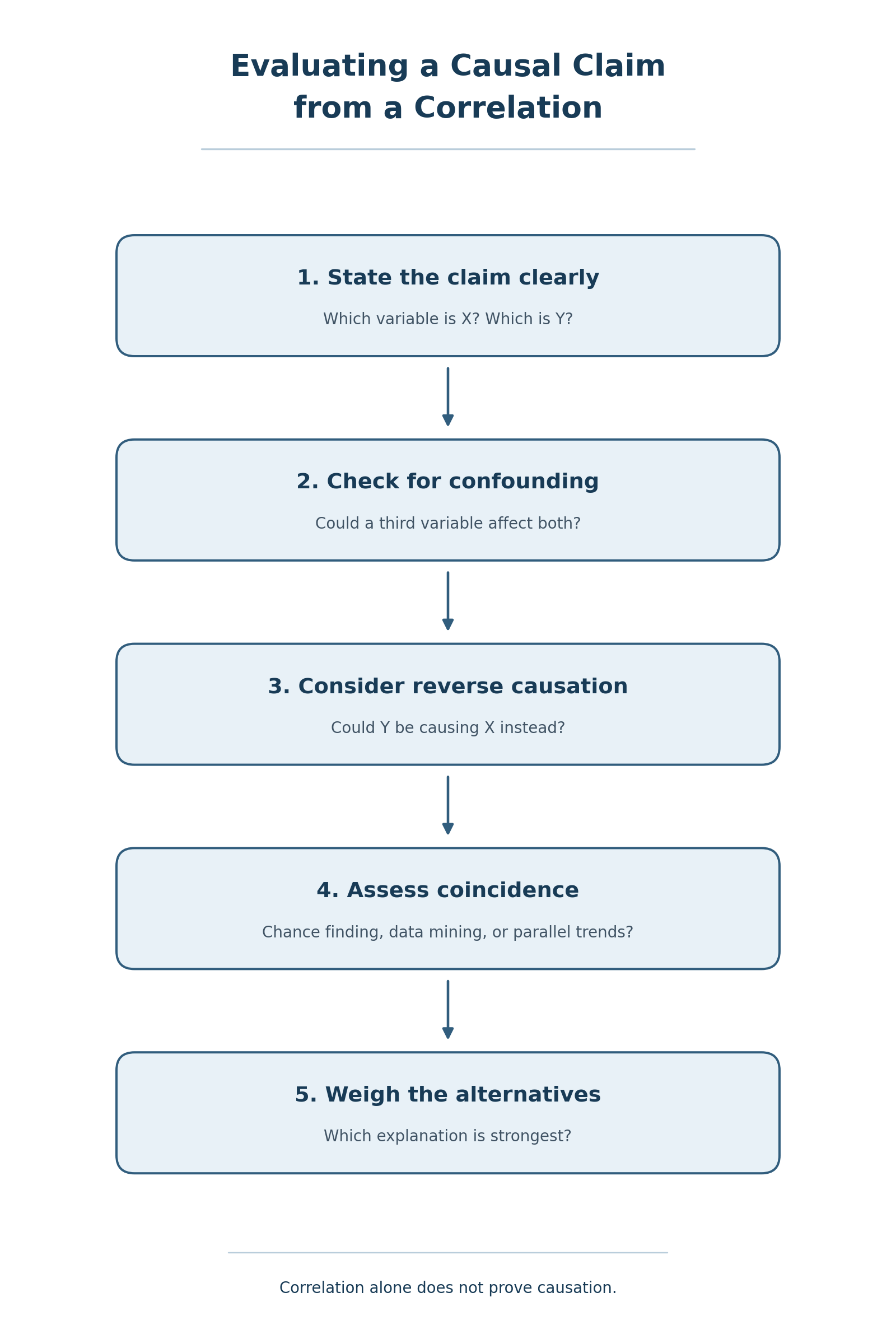
This checklist does not prove that causation is impossible. It simply ensures you do not accept a causal claim without first considering what else could explain the data. Even a correlation as strong as must survive these questions before you treat it as evidence of cause and effect.
