Understanding Confounding Variables
Introduction
Welcome back to Correlation Is Not Causation! You are now on the second of five lessons in this course, and the ideas here build directly on what we covered last time. In our first lesson, we established a critical principle: a strong correlation or a well-fitting regression line never proves causation on its own. We practiced spotting the logical leap from "these two variables move together" to "one must be causing the other."
But that principle raises a natural follow-up question: if the correlation is real yet causation is not, then what is producing the pattern? One of the most common and important answers involves something called a confounding variable. Understanding confounders is the focus of this lesson.
The Hidden Force Behind a Pattern
Recall the ice cream trucks and sunburn scenario from our previous lesson. The correlation was real, but the explanation had nothing to do with ice cream causing sunburn. Instead, hot, sunny weather was quietly pushing both variables upward at the same time.
That weather factor was pulling both strings from behind the scenes, creating a pattern that looked like a direct link. This kind of hidden influence shows up constantly in real data, and it has a formal name. Learning to recognize it is one of the most valuable skills in data literacy.
What Is a Confounding Variable?
A confounding variable (also called a lurking variable) is a third variable that influences both the explanatory variable and the response variable. Because it pushes both observed variables in a coordinated way, it can create or strengthen an apparent relationship that has little or no direct cause-and-effect basis.
Here is the key structure. Suppose we observe a correlation between Variable and Variable . A confounding variable works like this:
- influences
- also influences
- The result: and appear related, but the real driver is
A simple causal diagram captures the idea visually:
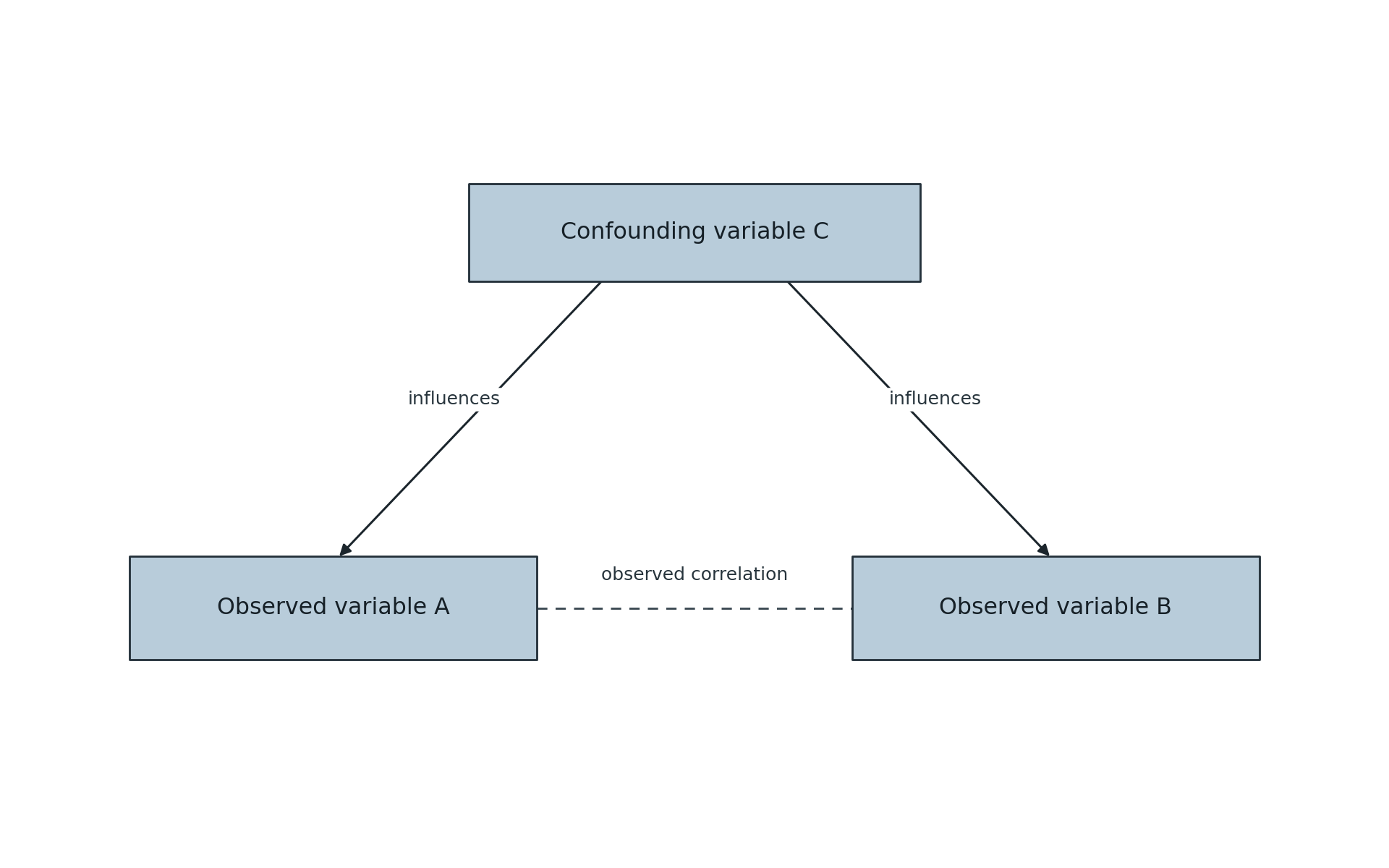
The word lurking captures the problem well: this variable is often not measured, not included in the analysis, and may not even be obvious at first glance. It hides in the background while the two observed variables get all the attention.
