Correlation Versus Causation
Introduction
Welcome to Correlation Is Not Causation, the fifth and final course in this learning path! Over the previous four courses, you built a strong toolkit: scatter plots, the correlation coefficient , regression lines, residuals, and predictions. In this first lesson, we step back and ask a critical question about everything you have learned so far. Just because two variables move together, does that mean one is causing the other to change?
This lesson tackles what is arguably the single most important idea in all of statistics. It is a short sentence that carries enormous weight: correlation does not imply causation. Let's explore what that means and why it matters.
Revisiting What Correlation Tells Us
The correlation coefficient measures the direction and linear strength of a relationship between two quantitative variables. A value of tells you that points cluster tightly around an upward-sloping line. A least-squares regression line then gives you an equation like
that summarizes the trend and lets you make predictions. These are powerful tools for describing patterns in data.
But here is the key realization: nothing in the formula for or the regression equation tells you why the pattern exists. The math captures how two variables move together — it says absolutely nothing about whether one variable is actually making the other change.
A Tempting but Dangerous Leap
Suppose a researcher collects data and finds that cities with more ice cream trucks also have higher rates of sunburn. The correlation is strong, the regression line fits well, and the relationship is clearly positive. It would be tempting to conclude: "Ice cream trucks cause sunburn!"
That conclusion feels obviously silly. A more plausible explanation is that a third factor — hot, sunny weather — influences both variables at the same time:
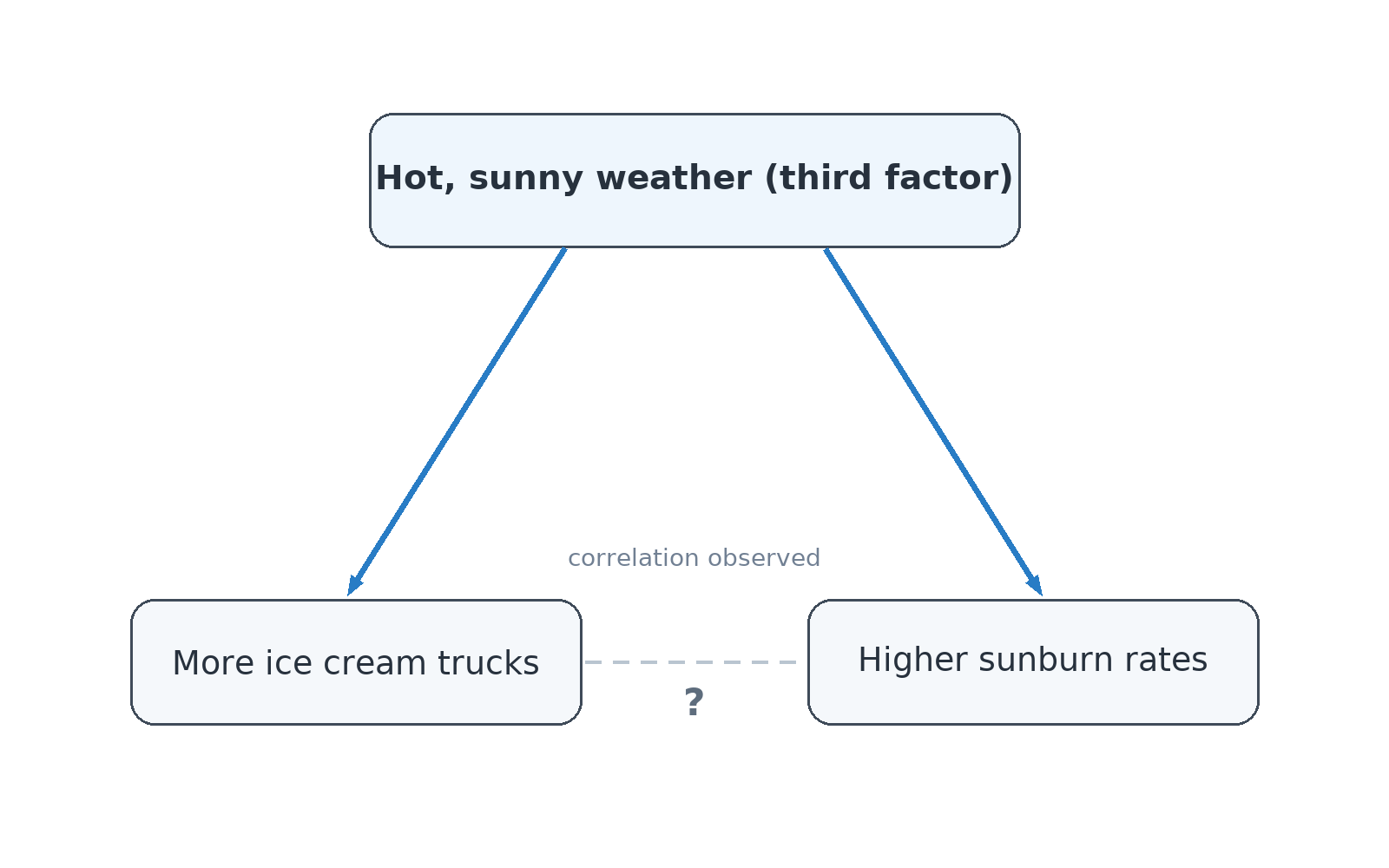
Yet this kind of logical leap happens all the time in news headlines, business reports, and even academic summaries. The pattern is always the same: two variables are measured and found to be correlated, and then someone concludes that one variable causes the other.
The problem is that the second step does not follow from the first. Correlation tells you that a pattern exists. Causation means that changing one variable produces a change in the other, whether directly or through a causal pathway. These are fundamentally different claims, and the gap between them cannot be closed by a strong value or a well-fitting line alone.
