Finding Coordinate Side Lengths
Introduction
After reading coordinate grids in the first lesson and finding midpoints in the second, you’re ready for the third lesson of Coordinate Skills in the Real World. A floor plan can show a room’s corners without listing its wall lengths; coordinate differences let you find a straight side from its endpoint labels. You’ll identify the side’s endpoints and direction, then use the coordinate that changes to calculate its length.
Recognize the Side Before Measuring
Think of moving between two endpoints on a plan. Along a horizontal side, the left-right position () changes while the up-down position () stays the same. Along a vertical side, changes while stays the same. Because coordinate units have the same length on both axes, the change in the coordinate that moves gives the side’s length.
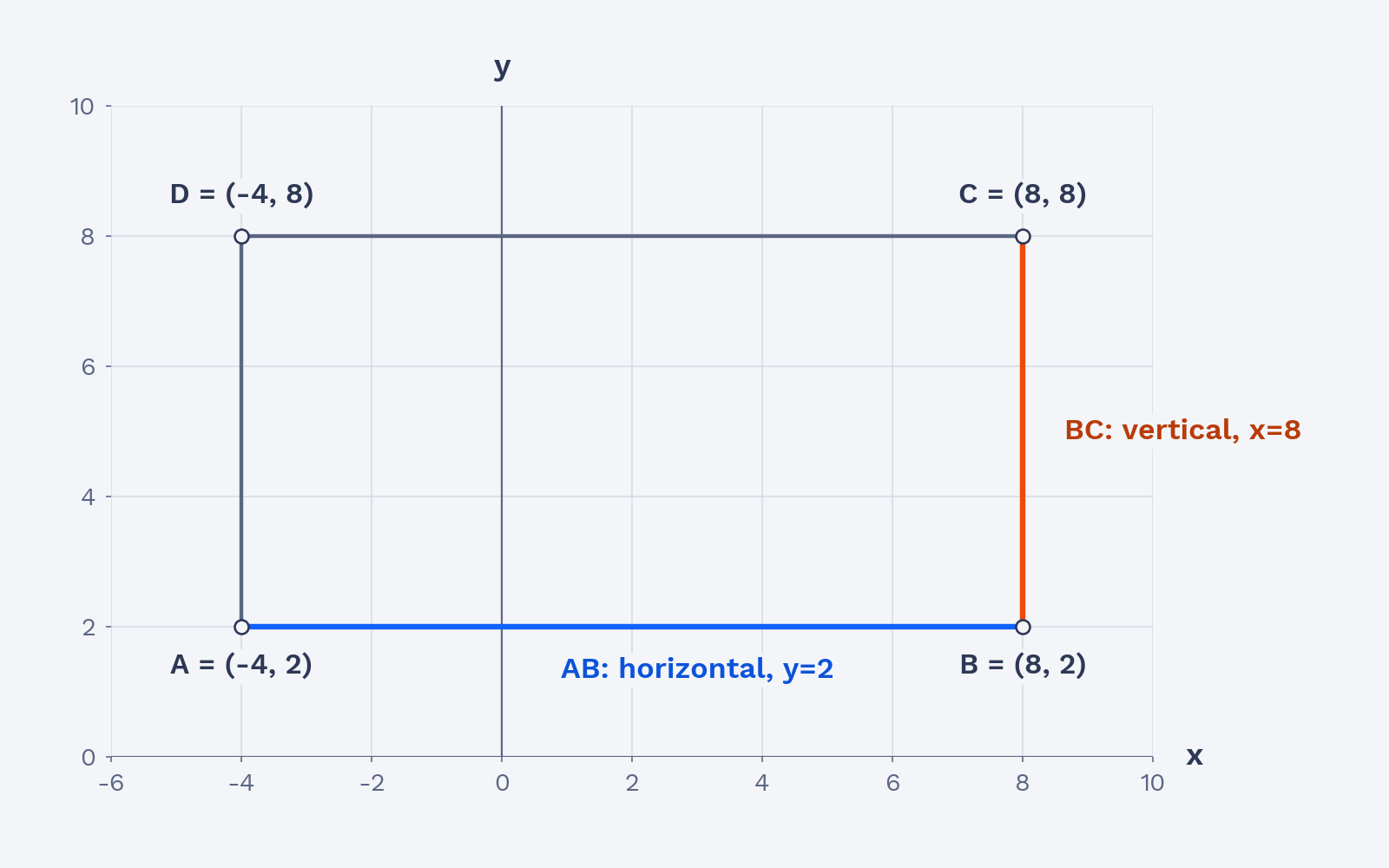
For example, consider a rectangle with vertices , , , and :
| Side | Endpoints | Orientation | Shared coordinate |
|---|---|---|---|
| and | Horizontal | ||
| and | Vertical | ||
| and | Horizontal | ||
| and | Vertical |
The same endpoint test works for a triangle: a side is horizontal or vertical based on the coordinates of its own two vertices, not on the shape of the whole figure.
This method applies directly to horizontal and vertical sides. For a diagonal side, both coordinates may change, so a different method is needed. We will use that method in the next lesson.
Calculate a Side Length
Once you identify the side and its endpoints, compare the coordinate that changes. Use the absolute difference so the length is nonnegative, regardless of the direction you subtract in:
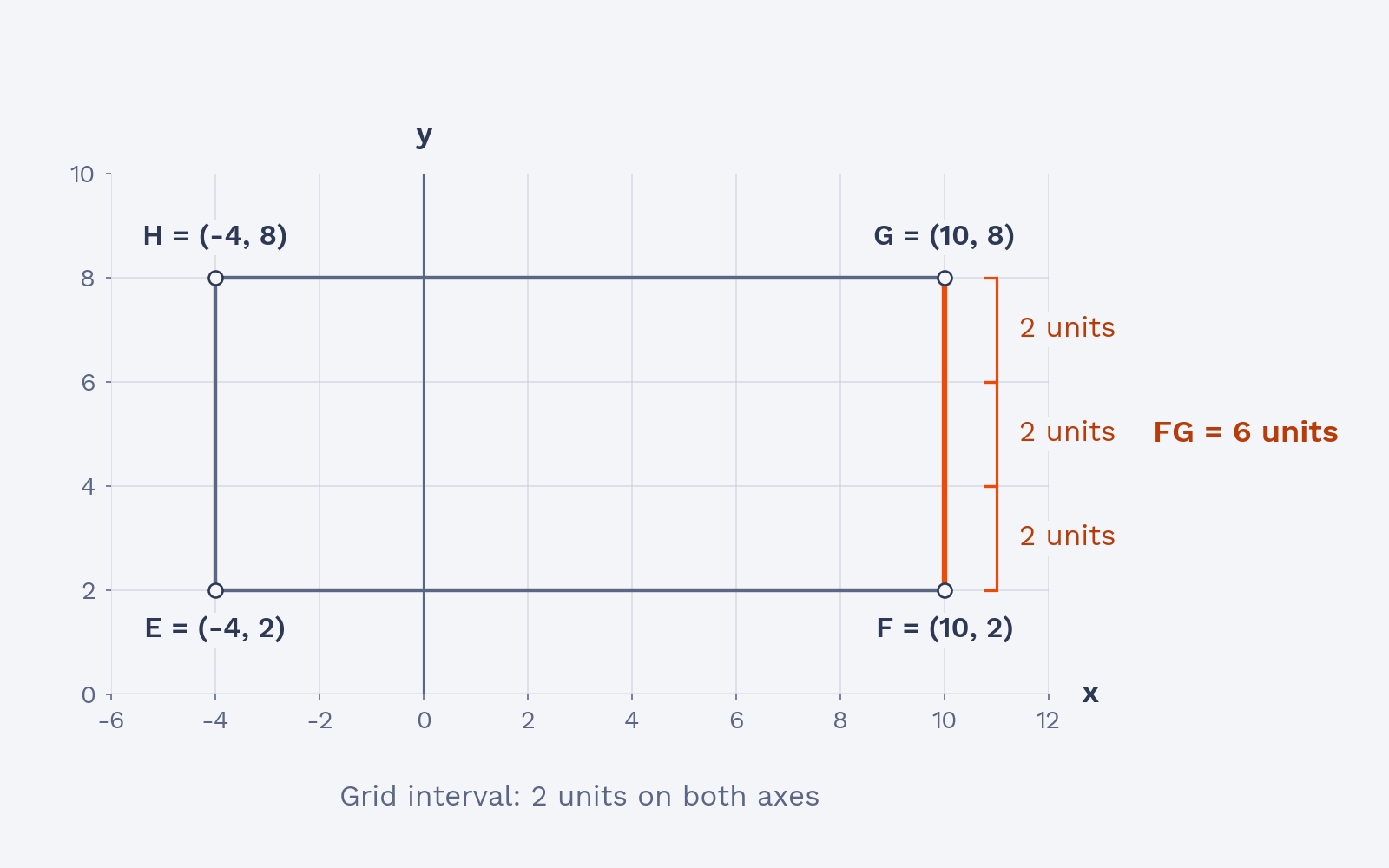
Suppose a rectangular plaza has vertices , , , and . Side is horizontal because both endpoints have , so compare their -coordinates:
Side is 12 coordinate units long.