Finding Diagonal Lengths
Introduction
Welcome to the final lesson in Coordinate Skills in the Real World. You’ve read coordinate grids, found midpoints, and calculated horizontal and vertical side lengths; now you’ll find the length of a side that slants between two vertices. This skill can help you find the straight edge of a triangular lot from its corner coordinates instead of estimating from a drawing.
Think of the Diagonal as a Right Triangle
Last lesson, a horizontal or vertical side changed only one coordinate. A diagonal side changes both and , and those changes form the horizontal and vertical legs of a right triangle. The diagonal is the hypotenuse—the side opposite the right angle. Because coordinate units have the same length in both directions, you can square the leg lengths, add them, and take the square root to find the diagonal. Adding the legs instead would measure a bent route, not the straight side.
Calculate From the Named Endpoints
Use the two vertices named for the side. If their coordinates are and , the nonnegative leg lengths are the absolute changes in the coordinates:
Consider triangle with these vertices:
| Vertex | Coordinates |
|---|---|
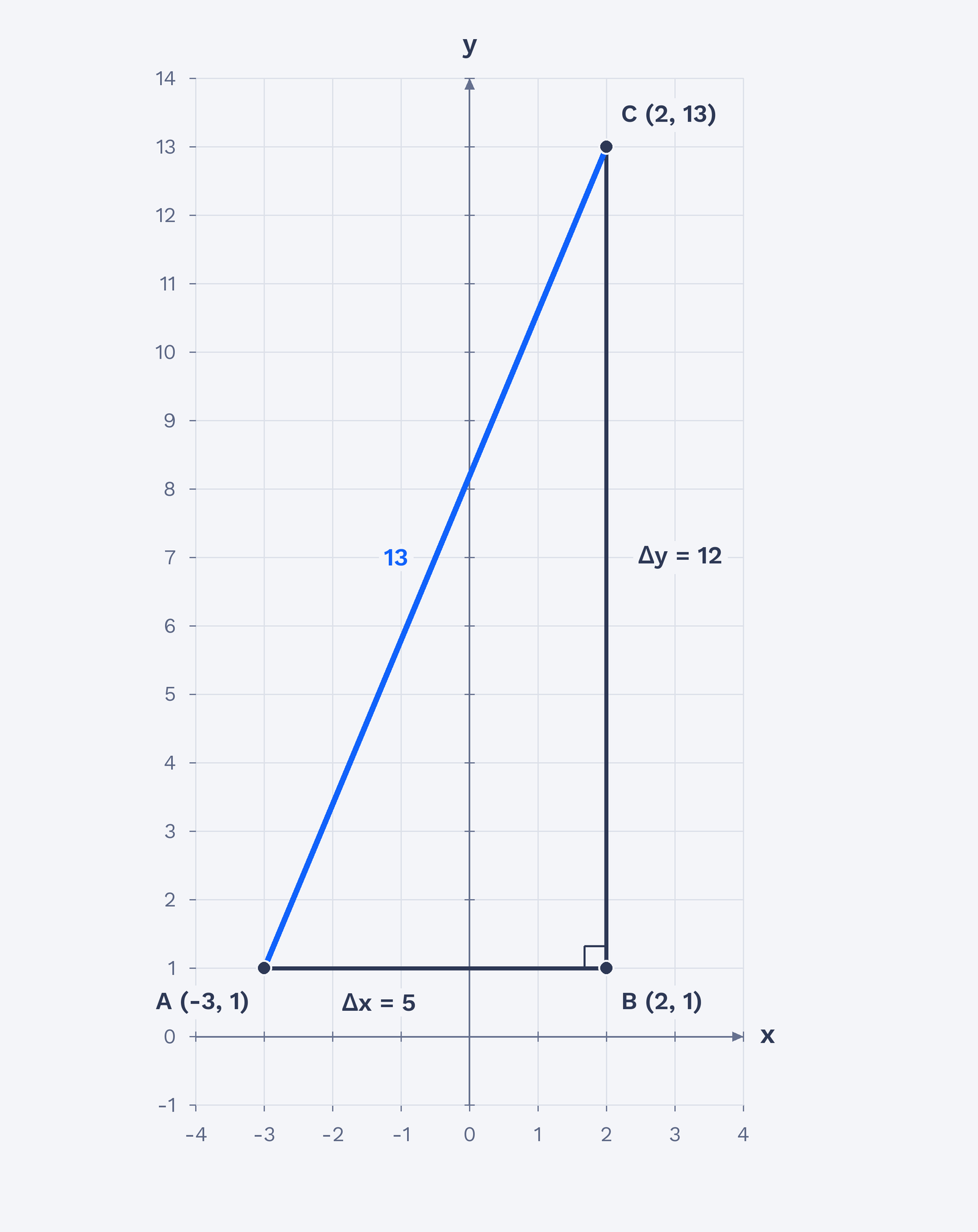
To find side , use endpoints and . Their coordinate changes are and ; side is the hypotenuse of the right triangle whose corner is .
Side is exactly 13 coordinate units long.
Read the Grid Interval Correctly
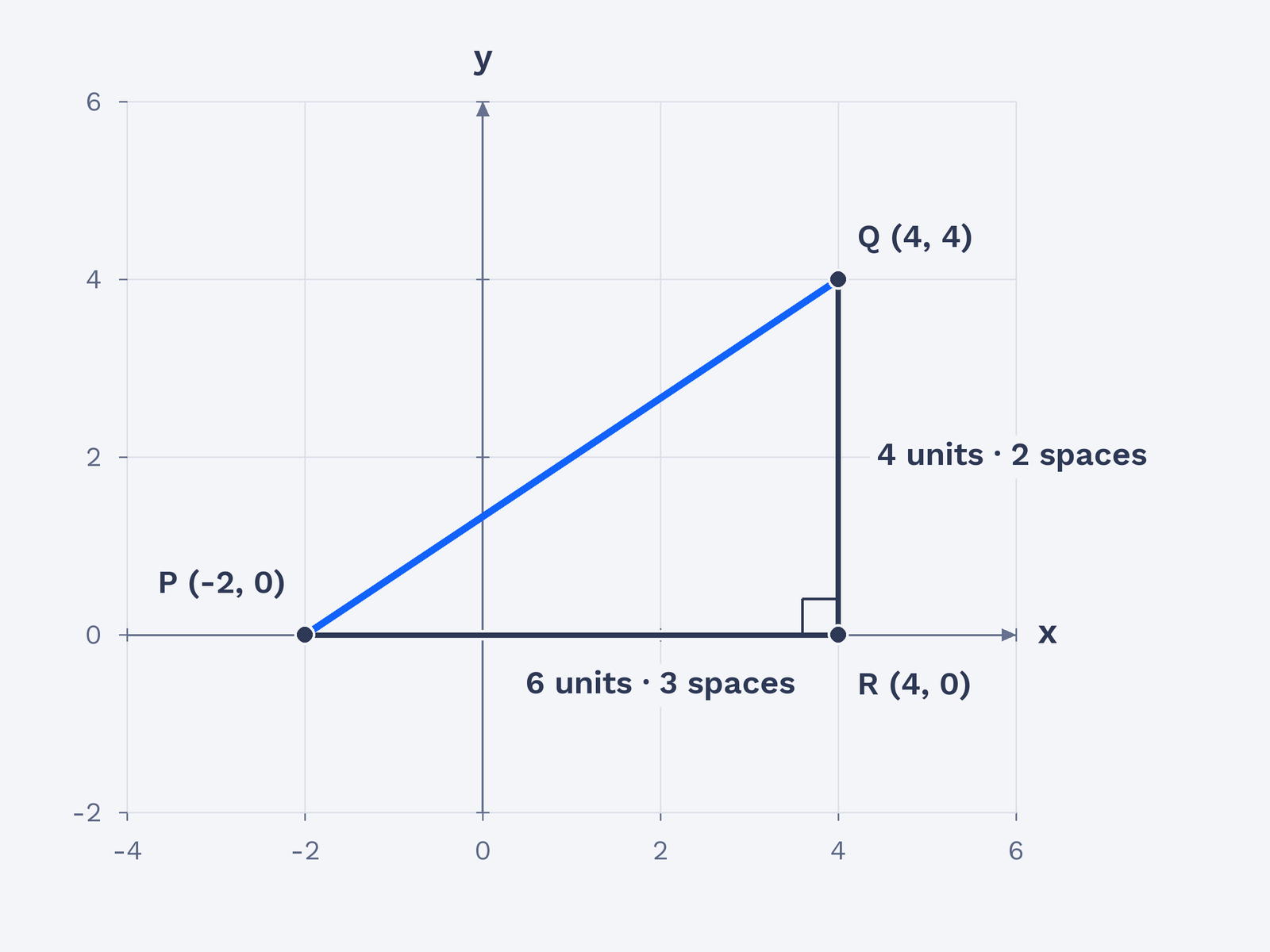
Now apply the same method to a triangular lot with labeled ticks 2 coordinate units apart on both axes. Its vertices are , , and . To find diagonal side , use and ; marks the right-angle corner of the horizontal and vertical legs.
The coordinate changes are and . These span three horizontal tick spaces and two vertical spaces. The coordinate labels already give the actual coordinate values, so the leg lengths are 6 and 4 coordinate units; do not multiply by 2 again.
The exact length is:
So side is exactly coordinate units long.
