Solving Proportions by Scaling
Introduction
Welcome back to Comparing Rates and Solving Proportions! You have reached Lesson 4 of 5, so we are nearly at the finish line of this course. So far, we have compared options using unit rates, learned to recognize proportional relationships, and identified the constant of proportionality that ties two quantities together. Now it is time to put all of that groundwork to practical use: given a known ratio and one new piece of information, we will learn how to solve for an unknown quantity by scaling.
By the end of this lesson, you will be able to set up a proportion, find the right scale factor, use it to solve for the missing value, and confirm that your answer makes sense.
From Identifying Ratios to Solving With Them
In the last few lessons, our main question was "Is this relationship proportional?" We answered it by computing ratios, comparing them, and naming the constant . That skill is valuable, but in everyday life we often face a slightly different question: "If I know one ratio, what is the missing value in an equivalent ratio?"
For example, a recipe might call for 2 cups of flour for every 3 eggs. If you want to use 12 eggs, how much flour do you need? You already know the two quantities are proportional, so the ratio stays the same. The challenge now is to find the number that keeps the ratio equal — and that is exactly what solving a proportion by scaling lets us do.
What Is a Proportion?
A proportion is simply an equation that says two ratios are equal. We write it like this:
Each side is a ratio, and the equation claims they represent the same relationship. As you may recall from earlier lessons, equivalent ratios are created by multiplying (or dividing) both terms of a ratio by the same number. That number is what we call the scale factor, and it is the key tool for this lesson.
Finding the Scale Factor
The scale factor is the number that transforms one ratio into the other. To find it, we look at the pair of terms we can compare — the two values that sit in the same position and are both known — and ask: "What did I multiply (or divide) by to get from one to the other?"
Consider this proportion:
We know both denominators: and . To go from to , we multiply by , because . That means the scale factor is 3. Because equivalent ratios require us to apply the same factor to both terms, we also multiply the numerator by :
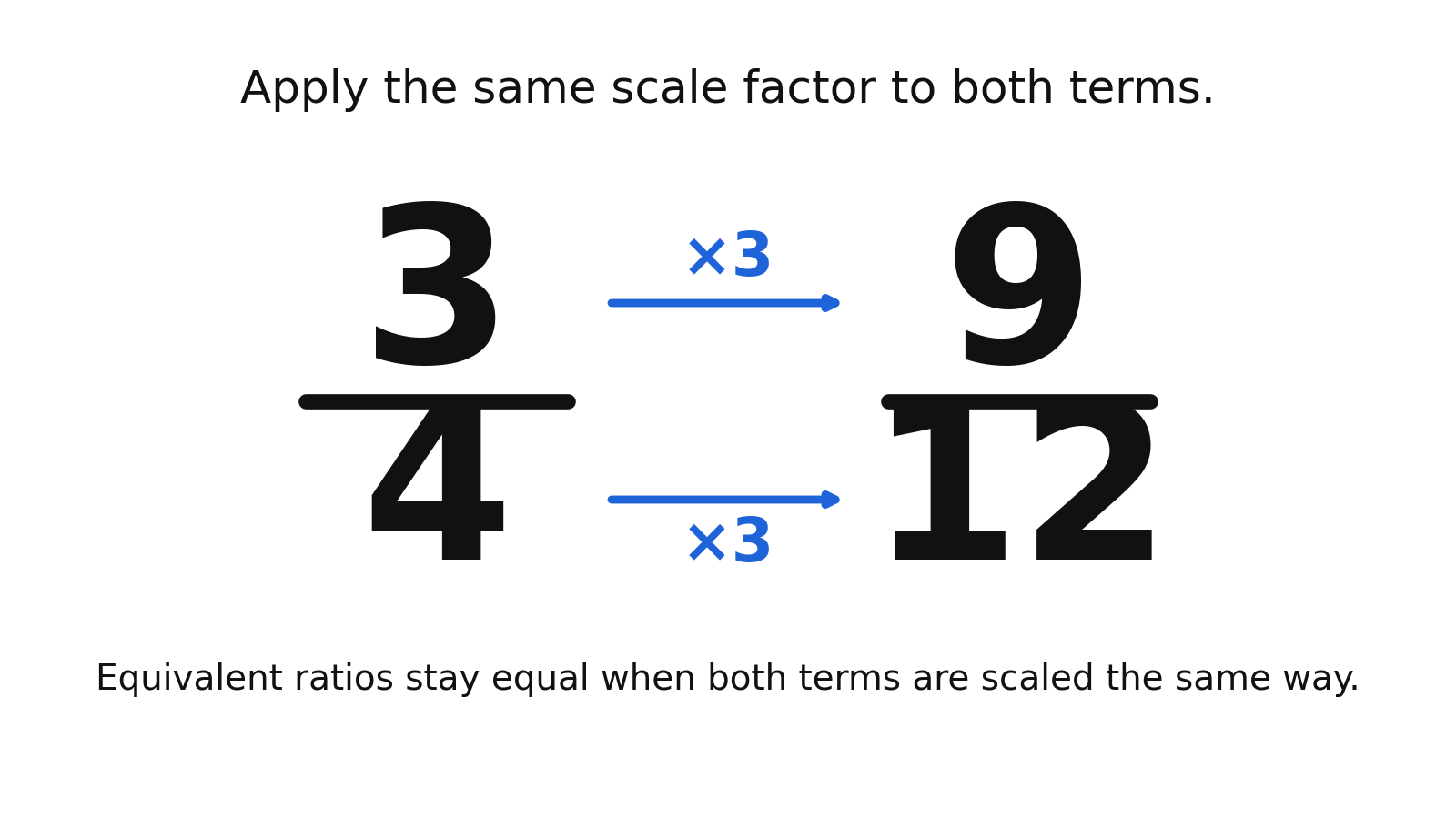
So . Both terms of the original ratio were scaled by the same factor, keeping the ratio equal.
