Congratulations — you have made it to the final lesson of Comparing Rates and Solving Proportions! Over the course of this series, you have learned to compare options with unit rates, spot proportional relationships, pin down the constant of proportionality, and solve proportions by scaling. That is an impressive toolkit. In this lesson, we will add one more technique that rounds it all out: cross-multiplication. This method works for any proportion — even when the scale factor between two ratios is not a tidy whole number. By the end, you will be able to solve a proportion using cross-multiplication and verify that your answer is correct.
When Scaling Gets Tricky
In the previous lesson, solving a proportion by scaling meant finding the single factor that transforms one ratio into the other. That approach works beautifully when the factor is a whole number like 3 or 4. But what happens when the numbers do not divide evenly?
Consider this proportion:
73=10x
To find the scale factor, we would divide 10 by 7, which gives 710 — not exactly a convenient number to work with mentally. In situations like this, we need a method that sidesteps the scale factor entirely and gives us a straightforward equation to solve. That method is cross-multiplication.
The Cross-Multiplication Rule
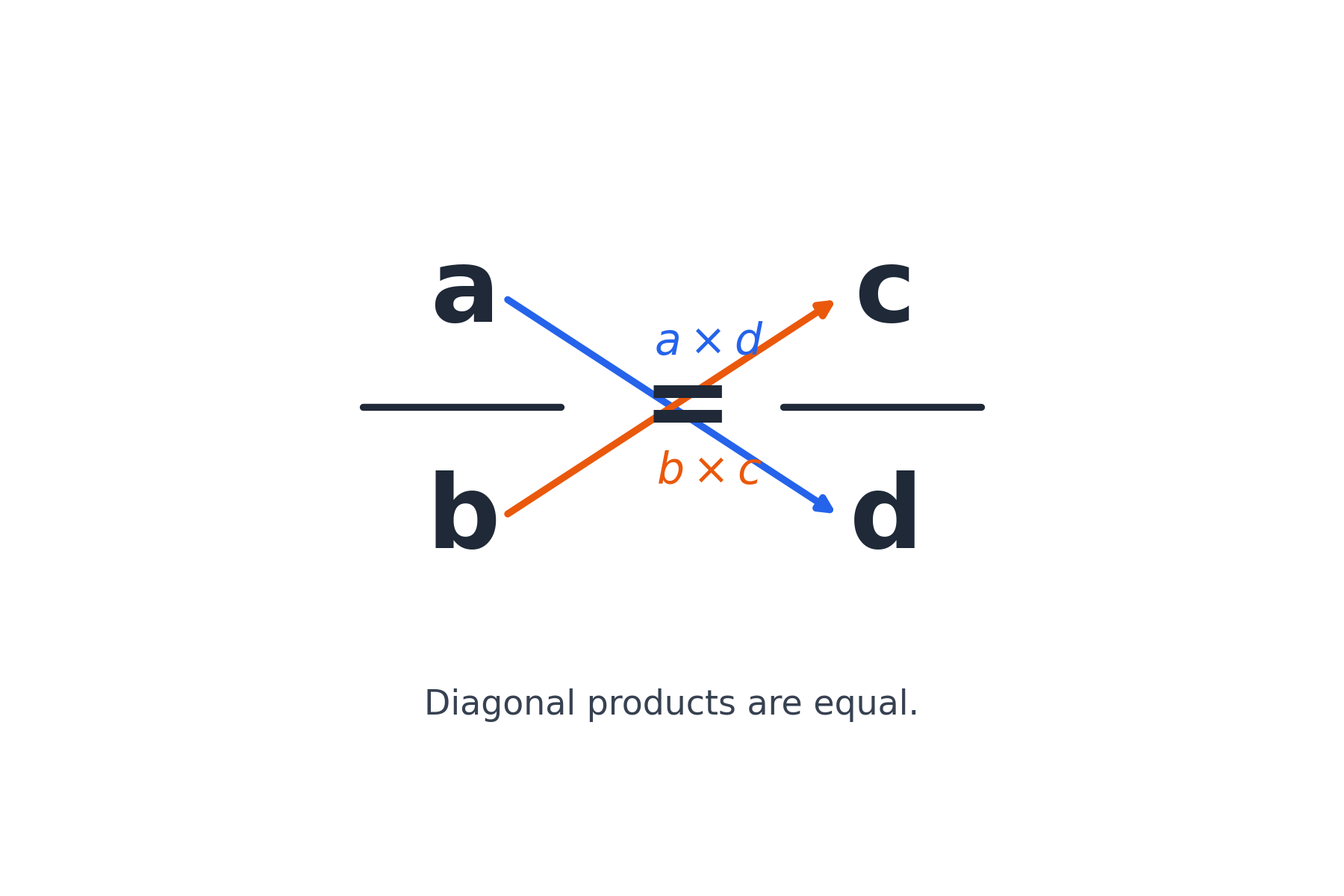
Cross-multiplication converts a proportion into a simple equation with no fractions. The rule states: if two ratios are equal, then their diagonal products are also equal. Given
ba=dc
we can write
a×d=b×c
Picture it this way: draw an × across the proportion. The numerator on the left multiplied by the denominator on the right gives one product, and the denominator on the left multiplied by the numerator on the right gives the other. Those two products are always equal. Once we have this equation, solving for the unknown is just basic arithmetic — multiply, then divide.
Why Does Cross-Multiplication Work?
Join the 1M+ learners on CodeSignal
Be a part of our community of 1M+ users who develop and demonstrate their skills on CodeSignal
Solving a Proportion Step by Step
Tackling Non-Integer Scale Factors
Verifying Solutions: A Closer Look
Applying Cross-Multiplication in Context
The Cross-Multiplication Process at a Glance
Conclusion and Next Steps
In this lesson, we learned how to solve proportions using cross-multiplication. This technique converts any proportion into a straightforward multiply-and-divide problem, making it especially useful when the scale factor between two ratios is not a clean whole number. We also practiced verifying solutions by substituting the answer back in and confirming that both ratios are exactly equal.
This wraps up the final lesson of Comparing Rates and Solving Proportions — you now have a complete set of tools for working with ratios, rates, and proportions. Head into the practice tasks to put cross-multiplication to work on your own, from guided fill-in-the-blank problems all the way to a real-world painting project!
This rule is not a magic trick; it follows directly from how equations and fractions work. Starting with ba=dc, multiply both sides by b×d:
b×d×ba=b×d×dc
On the left side, b cancels with the denominator b, leaving a×d. On the right side, d cancels with the denominator d, leaving b×c. The result is a×d=b×c — exactly the cross-multiplication rule. So cross-multiplication is really just a shortcut for clearing both denominators in one step.
Let's walk through a clean example to see the full process. Suppose we need to solve:
52=20x
Step 1 — Cross-multiply. Multiply along the diagonals:
2×20=5×x⟹40=5x
Step 2 — Solve for the unknown. Divide both sides by 5:
x=540=8
Step 3 — Verify. Substitute x=8 back into the original proportion and check that both ratios are equal. In this case, both simplify to 52 or exactly 0.4.
The ratios match, so x=8 is correct. Notice that these three steps — cross-multiply, divide, verify — form a simple routine you can apply to any proportion.
Now let's see where cross-multiplication really shines. Consider a proportion where scaling would be awkward:
94=x6
If we tried scaling, we would need the factor that turns 4 into 6, which is 46=1.5. That is manageable but easy to misapply. With cross-multiplication, the process stays clean:
4×x=9×6⟹4x=54x=454=13.5
To verify, we can check the cross products with our new value: 4×13.5=54 and 9×6=54. Since the products are exactly equal, the solution is correct.
Verification is a small step that makes a big difference. After solving any proportion, always substitute your answer back in and confirm that both sides are truly equal. Here are the most reliable ways to check:
Simplify both fractions. Reduce each ratio to its lowest terms. If they produce the same simplified fraction, the solution is exactly correct.
Check the cross products. Multiply the denominator of one side by the numerator of the other using your solved value. If both diagonal products are identical, your solution is exact.
Convert both fractions to decimals. This is a quick "sanity check" to see if your answer is in the right ballpark. However, be careful: if you round the decimals, they might appear equal even if there is a small error. For exact verification, rely on simplified fractions or cross products.
For the example 94=13.56, the simplified fraction method or the cross-product method will confirm the answer is exactly correct, whereas the decimal method involves repeating decimals (0.4) that can only be approximated on a calculator.
Let's put everything together with a real-world scenario. Suppose a can of paint covers 350 square feet per gallon, and you need to paint a wall that measures 1,050 square feet. How many gallons do you need?
Set up the proportion with consistent units:
350 sq ft1 gallon=1,050 sq ftx gallons
Cross-multiply:
1×1,050=350×x⟹1,050=350x
Solve:
x=3501,050=3
Verify:1×1,050=1,050 and 350×3=1,050. The cross products match exactly, confirming that 3 gallons is the right answer. This also passes a common-sense check: 1,050 is exactly three times 350, so needing three times the paint makes perfect sense.
Here is the complete routine, combining everything from this lesson:
Step
Action
Example with 52=20x
1
Set up the proportion with the unknown
52=20x
2
Cross-multiply (diagonal products)
2×20=5×x⇒40=5x
3
Solve for the unknown (divide)
x=40÷5=8
4
Verify by checking both ratios (simplifying or cross products)
52 and 208 both simplify to 52 ✓
Whether the numbers are whole, fractional, or decimal, these four steps will guide you to the correct answer every time.