The Constant of Proportionality
Introduction
Welcome back to Comparing Rates and Solving Proportions! You are now on Lesson 3 of 5, which means we have passed the halfway mark of this course. In our first lesson, we learned how to compare options using unit rates. In our second lesson, we discovered how to test whether two quantities form a proportional relationship by checking that every ratio in a data set stays the same. Today, we give that special constant ratio an official name — the constant of proportionality — and explore why it matters beyond just passing a test.
By the end of this lesson, you will be able to identify the constant of proportionality in a proportional relationship, calculate it from paired data, and explain what it actually means in everyday situations.
Why the Constant Ratio Deserves Its Own Name
In the previous lesson, we practiced computing ratios across tables and comparing them. When every ratio matched, we concluded the relationship was proportional. But we never paused to ask: what does that shared ratio actually represent, and why is it so useful?
Think of it this way. If every hour of work earns the same pay, that per-hour amount is more than a number that passes a consistency check. It is the single value that connects hours to dollars in every possible pair. Knowing it means you can predict pay for any number of hours — not just the rows listed in a table. That predictive power is exactly why this ratio earns a formal name: the constant of proportionality.
What Is the Constant of Proportionality?
The constant of proportionality is the unchanging ratio between two proportional quantities. It is the factor that links every pair of values in the relationship. If we call our two quantities and , and they are proportional, then for every pair:
Here, is the constant of proportionality. We can also rewrite this relationship as:
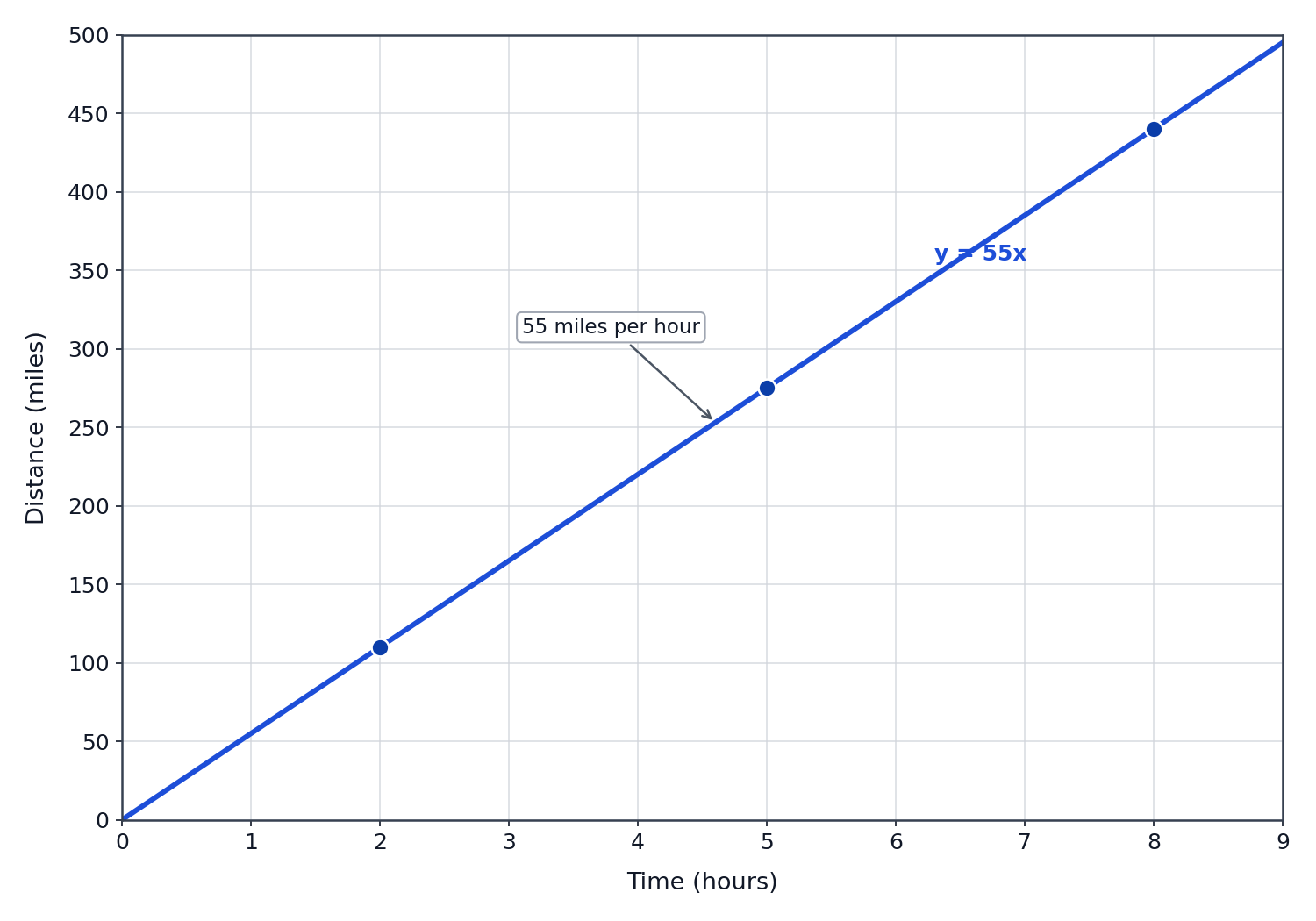
This form tells us that is always times . The value is exactly the unit rate we have been working with since Lesson 1 — it tells us how much changes for each single unit of . What is new is recognizing this unit rate as the defining feature of the entire proportional relationship, not just a handy comparison tool.