Recall that two events are mutually exclusive when their outcome sets have nothing in common. That classification step was not just an academic exercise — it was preparation for this moment: choosing the right formula.
When you have confirmed that two events cannot occur together, the math becomes beautifully simple. There are no shared outcomes to worry about, no double-counting to fix. All you need to do is add.
Be a part of our community of 1M+ users who develop and demonstrate their skills on CodeSignal
Welcome back to Combining Events with Addition! In our first lesson, you built a reliable skill: identifying mutually exclusive events by checking whether two events share any outcomes. That classification step was the gateway — now, in this second lesson, it is time to walk through it and learn the formula that turns a "yes, they are mutually exclusive" answer into an actual probability calculation.
By the end of this lesson, you will be able to calculate P(A or B) for two mutually exclusive events using simple addition, and you will understand why adding is the correct move when no outcomes overlap.
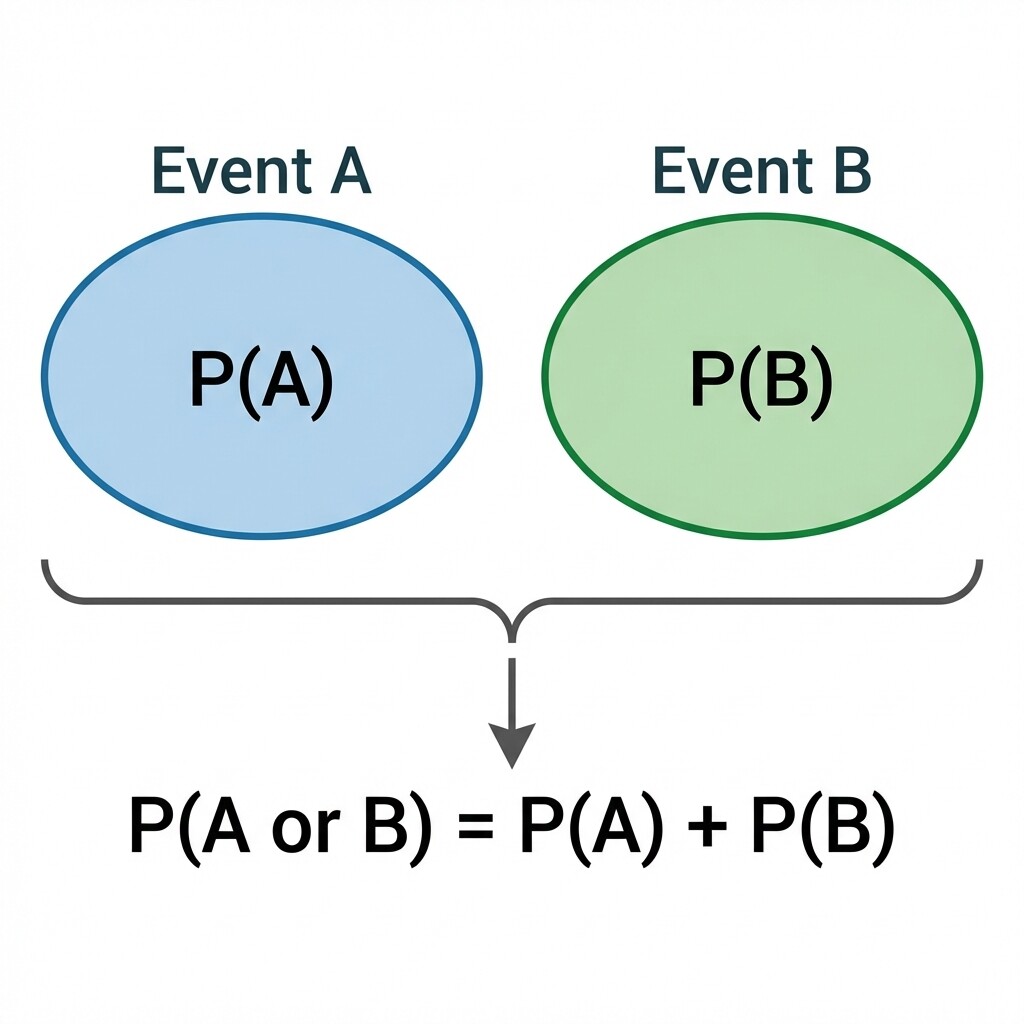
When events A and B are mutually exclusive, the probability that one or the other occurs is:
P(A or B)=P(A)+P(B)
That's it. No subtraction, no extra correction — just add the two individual probabilities together.
This rule extends naturally. If you have three or more mutually exclusive events, you keep adding:
P(A or B or C)=P(A)+P(B)+P(C)
The only requirement is that none of the events share any outcomes with each other.
Let's look at the reasoning behind the rule with a concrete example. Imagine a standard 52-card deck. Define two events for a single draw:
Event A: drawing a heart (13 cards)
Event B: drawing a spade (13 cards)
No card is both a heart and a spade, so these events are mutually exclusive. The favorable outcomes for "heart or spade" are exactly the 13 heart cards plus the 13 spade cards. Because no card appears in both groups, we can safely combine them:
P(heart or spade)=5213+5213=5226=21
Think of it like two boxes of items on a table with no item appearing in both boxes. To count the total items, you simply add the contents of each box. If even one item sat in both boxes, plain addition would count it twice — that is the problem that arises with overlapping events, but we will save that topic for a later lesson.
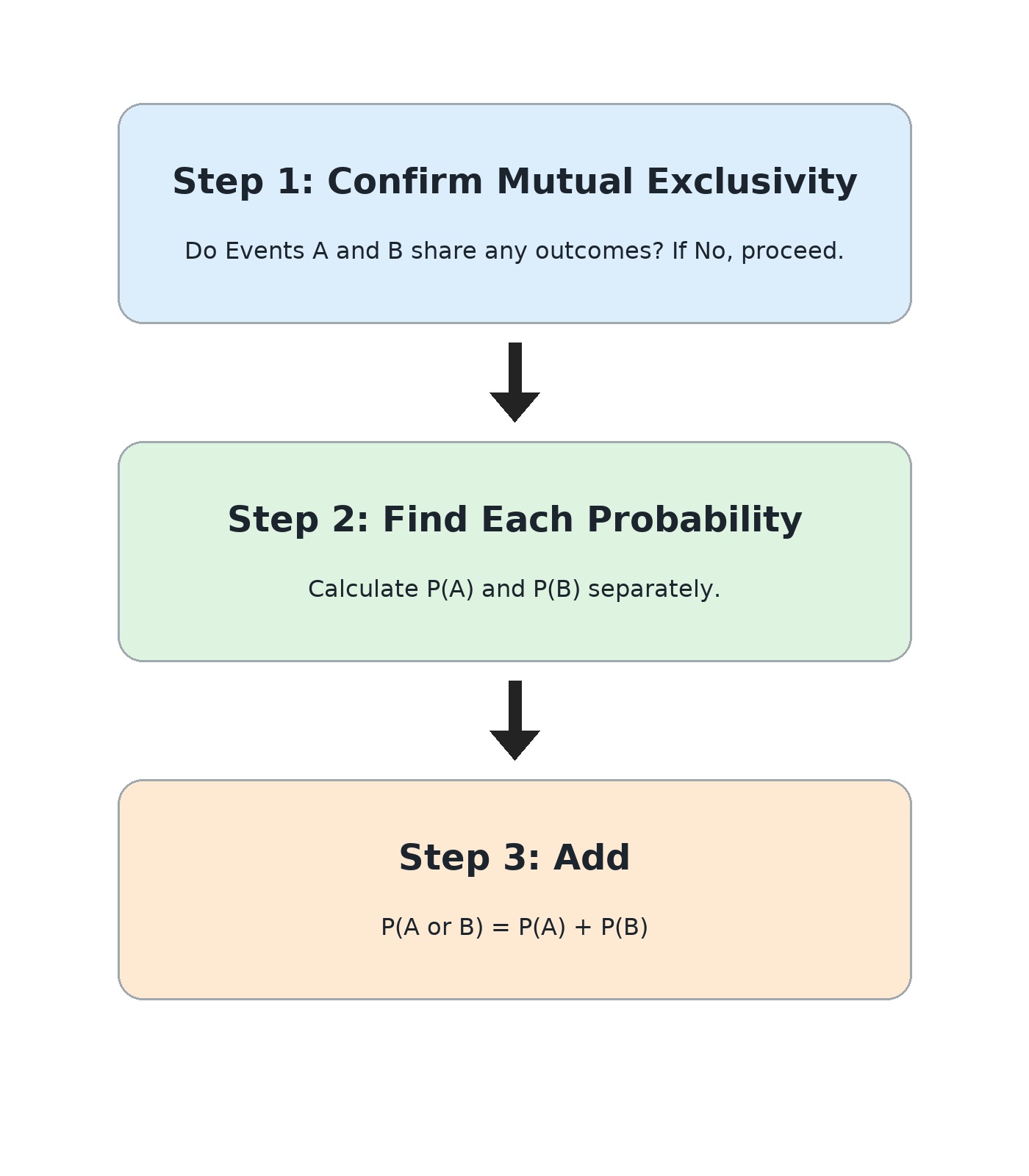
Whenever you face an "or" probability question and suspect the events are mutually exclusive, a short checklist keeps you on track:
Confirm mutual exclusivity. Verify that the two events share no outcomes (use the shared-outcome test from lesson one).
Find each individual probability. Calculate P(A) and P(B) separately.
Add. Combine them: P(A or B)=P(A)+P(B).
Let's walk through an example using this checklist. A bus stop is served by four routes with the following probability distribution for which route arrives next:
Route
Probability
Route 10
0.40
Route 15
0.25
Route 22
0.20
Route 37
0.15
What is the probability the next bus is Route 15 or Route 37?
Step 1: A single arriving bus can only be one route, so "Route 15" and "Route 37" are mutually exclusive.
Step 2:P(Route 15)=0.25 and P(Route 37)=0.15.
Step 3:
P(Route 15 or Route 37)=0.25+0.15=0.40
There is a 40% chance the next bus is one of those two routes.
Suppose a marketing team tracks how new leads enter the sales pipeline. The breakdown looks like this:
Lead Source
Probability
Organic search
0.35
Paid ads
0.25
Referrals
0.20
Trade shows
0.20
Each lead is attributed to exactly one source, so any two source events are mutually exclusive. What is the probability that the next lead comes from organic search or referrals?
P(organic or referrals)=0.35+0.20=0.55
There is a 55% chance the next new lead arrives through one of those two channels. Notice how the "exactly one source per lead" condition is what guarantees mutual exclusivity and makes the simple addition valid. Whenever a scenario tells you each outcome belongs to exactly one category, you can be confident the addition rule applies directly.
A few mistakes tend to surface when learners first apply this rule:
Skipping the mutual-exclusivity check. The formula P(A)+P(B) only works when the events share no outcomes. If you add probabilities for overlapping events, your answer will be too large because some outcomes get counted twice.
Getting a result greater than 1. A probability can never exceed 1. If your sum goes above 1, double-check whether the events are truly mutually exclusive and whether the individual probabilities are correct.
Confusing "or" with "and." The addition rule answers "What is the chance that at least one of these events occurs?" It does not tell you the chance both happen together. For mutually exclusive events, the probability of both occurring on the same trial is 0.
In this lesson you learned that when two events are mutually exclusive, calculating P(A or B) is as straightforward as adding their individual probabilities. The formula works precisely because the events share no outcomes, so no result gets counted twice. You also practiced a clear three-step approach — confirm mutual exclusivity, find each probability, and add.
Now it is time to put the addition rule into action! In the upcoming practice tasks you will apply the formula to scenarios ranging from card draws and payment methods to marketing channels and bus routes, building both speed and confidence with every problem. You will also have the chance to explain why the rule works in your own words, which is the best way to lock in your understanding.