Identifying Mutually Exclusive Events
Introduction
Welcome to Combining Events with Addition, the second course in your probability learning path! In this first lesson, we kick off the course by tackling a question you need to answer before doing any "or" probability math: Can these two events happen at the same time?
In the previous course you built a solid foundation with single-event probabilities, complements, counting outcomes, and sample spaces. Now it is time to combine events, and the word "or" will be at the center of everything we do. Before we can reach any formula, though, we need a reliable way to tell whether two events can or cannot occur together. That skill — identifying mutually exclusive events — is the focus of this lesson and the gateway to every calculation that follows.
Events and Outcomes: A Brief Refresher
What Are Mutually Exclusive Events?
Two events are mutually exclusive if they cannot both occur on the same trial. In set language, their outcome sets have no overlap — there is no single outcome that belongs to both events.
Consider a single coin toss. The event "heads" and the event "tails" share zero outcomes. If the coin lands heads, it did not land tails, and vice versa. These two events are mutually exclusive.
Now think about drawing one card from a standard 52-card deck. The event "drawing a heart" and the event "drawing a queen" are not mutually exclusive, because the queen of hearts belongs to both events. One single draw can satisfy both at once.
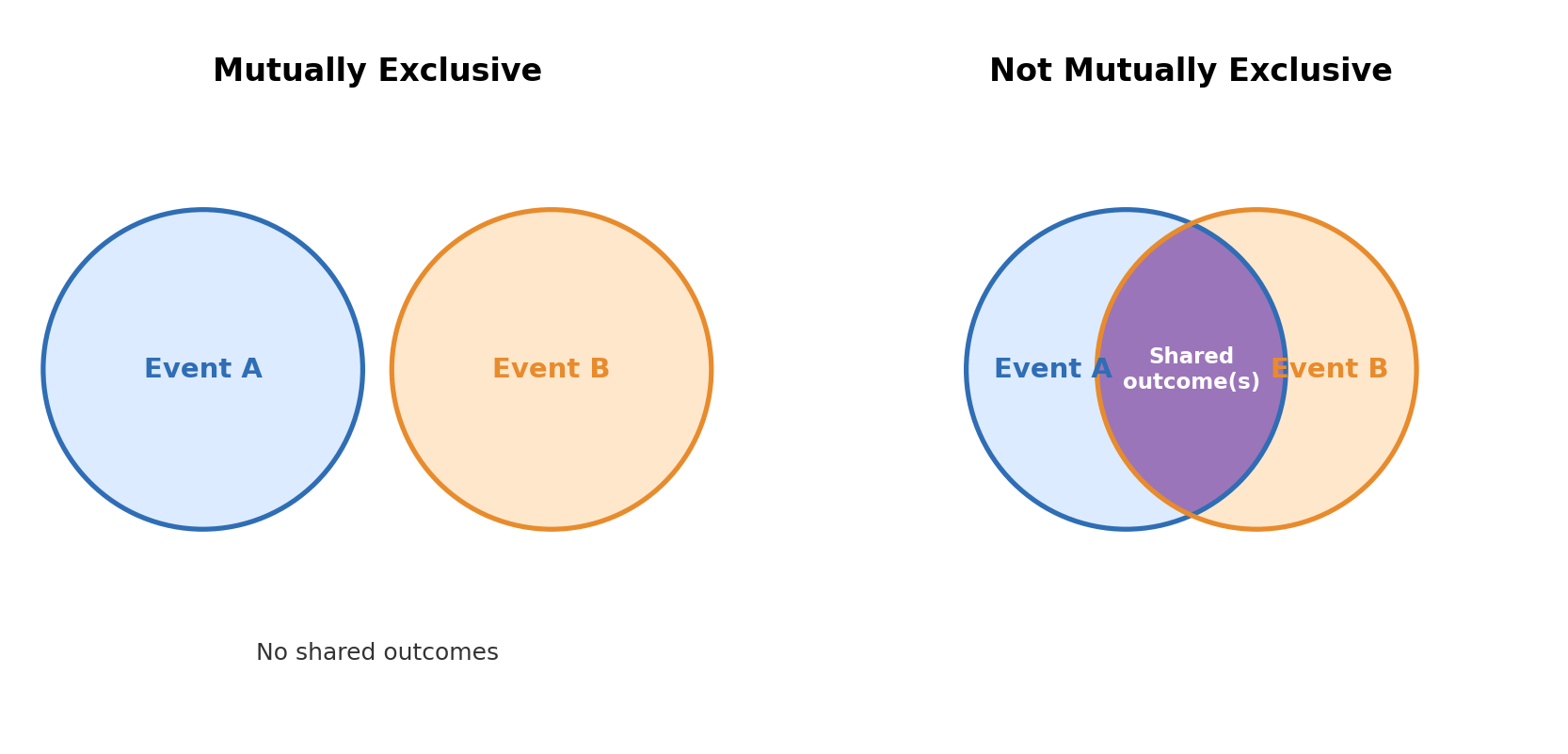
The left diagram above shows two circles that do not touch — no shared outcomes, so the events are mutually exclusive. The right diagram shows two circles that overlap, representing events that can happen together.
The Shared-Outcome Test
Identifying mutually exclusive events boils down to one practical question:
Is there any single outcome that belongs to both events?
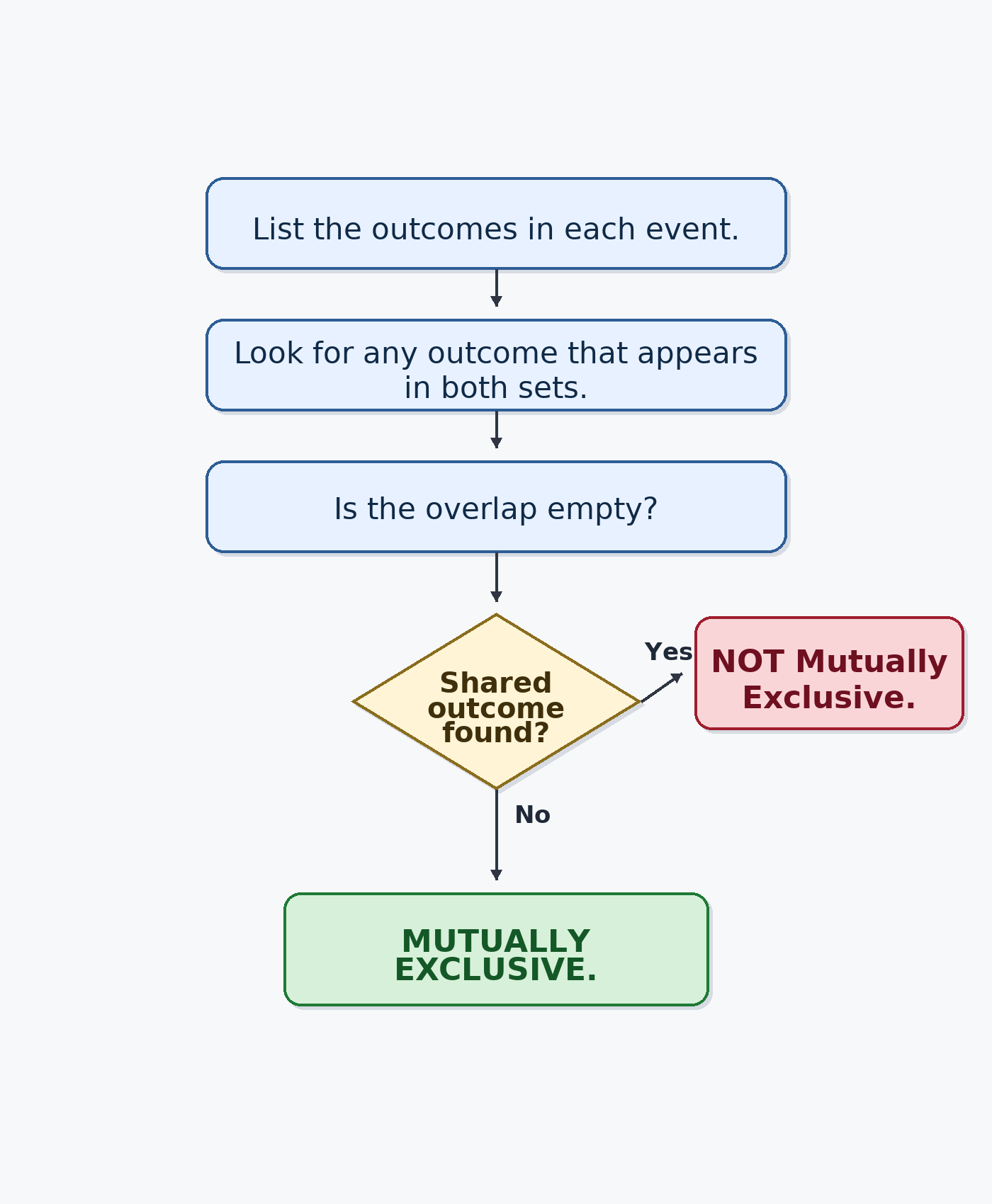
Here is a three-step process you can follow every time:
- List or describe the outcomes in each event.
- Look for overlap — check whether any outcome appears in both sets.
- Decide — if the overlap is empty, the events are mutually exclusive; if even one shared outcome exists, they are not.
Let's apply this to a workplace example. Suppose a company logs each support ticket by the day it arrives. Consider these two events for a randomly chosen ticket:
| Event | Outcomes |
|---|---|
| A: "Arrived on a weekday" | Mon, Tue, Wed, Thu, Fri |
| B: "Arrived on a weekend" | Sat, Sun |
No day appears in both sets, so A and B are mutually exclusive. A single ticket cannot arrive on both a weekday and a weekend day.
Everyday and Business Examples
Why Classify Before You Calculate?
Conclusion and Next Steps
In this lesson you learned that two events are mutually exclusive when they share no outcomes, meaning they cannot both occur on the same trial. You also practiced a straightforward shared-outcome test — list the outcomes, look for overlap, and decide. Most importantly, you saw why this classification step must come before any "or" probability calculation, since the formula you will use depends on the answer.
Up next, you will put this skill to work with a set of hands-on practice tasks. These exercises will have you classifying event pairs across everyday and business scenarios — from payment methods and work schedules to department assignments — so get ready to test your new eye for overlap!
