Welcome back to Combining Events with Addition! You have reached the midpoint — lesson three of four — and the skills you built in the first two lessons are about to meet a much more realistic challenge. So far, everything has gone smoothly: you learned to spot mutually exclusive events and to add their probabilities with confidence. That worked beautifully because those events never shared outcomes. But most real-world situations are not so tidy.
What happens when two events can occur at the same time? That is exactly the question we tackle here. By the end of this lesson, you will be able to identify when two events overlap, describe what their shared outcomes represent, and explain why adding individual probabilities would overcount those shared outcomes.
Life Is Full of Overlap
In the first lesson, we stressed that mutually exclusive events have no outcomes in common. That property kept the math clean, but in everyday life, most pairs of events are not so neatly separated. Think about employees at a company: one event might be "the employee works in the marketing department" and another might be "the employee speaks Spanish." There is nothing preventing a marketing employee from also speaking Spanish, so these two categories can absolutely apply to the same person.
This is the norm rather than the exception. Customers can belong to multiple segments, students can satisfy more than one scholarship criterion, and a single playing card can match several descriptions at once. Recognizing when this kind of overlap exists is the crucial first step before choosing the right probability formula.
What Overlapping Events Look Like
Pinpointing the Overlap
Why Simple Addition Overcounts
Another Example
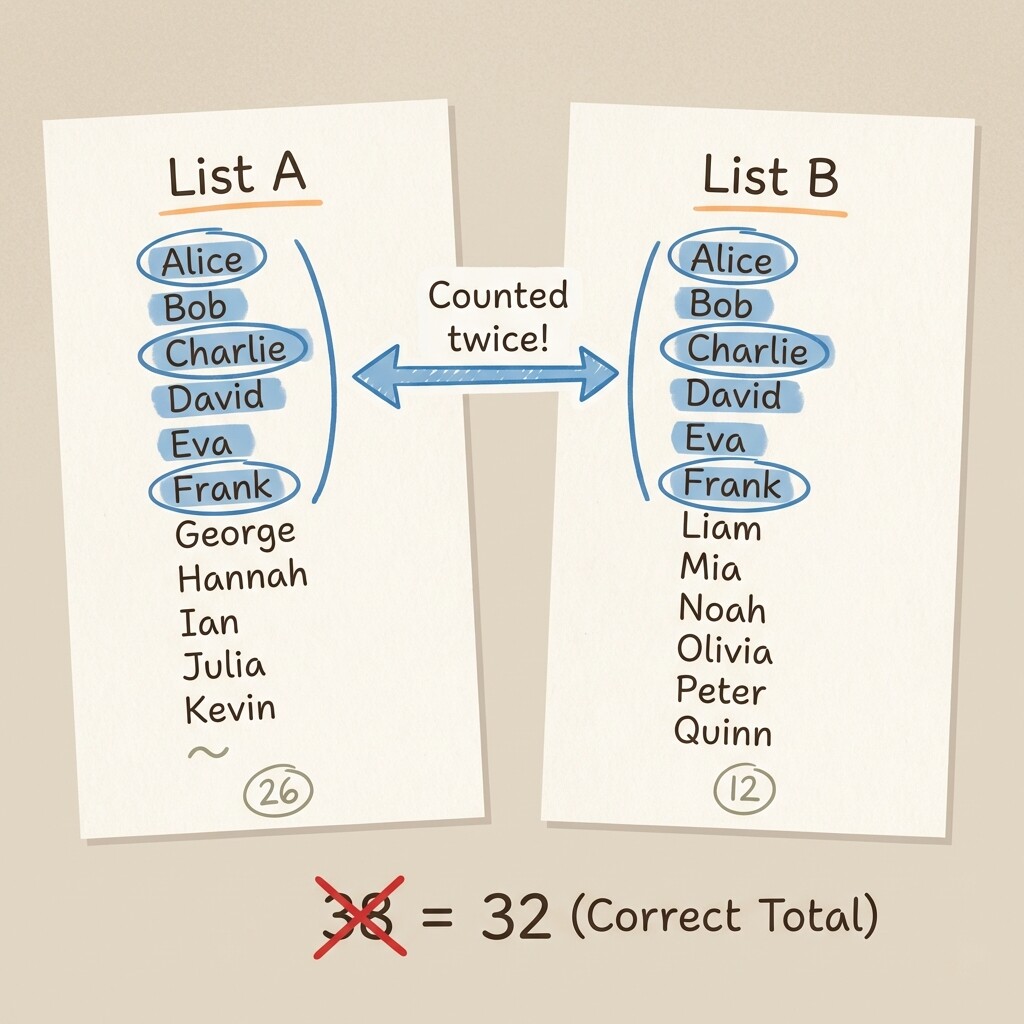
Think of it like two guest lists for a party. List A has 26 names and List B has 12 names, but 6 people appear on both lists. If you combine the lists without checking for duplicates, you will think 38 guests are coming when only 32 unique people were invited.
Overlap in a Business Context
Key Takeaways
Conclusion and Next Steps
In this lesson you moved beyond the tidy world of mutually exclusive events and explored what happens when two events share outcomes. You can now identify overlapping events, pinpoint exactly which outcomes sit in both groups, and explain why simple addition produces an inflated result. These ideas form the bridge between the basic addition rule from the previous lesson and the general formula coming up next.
Now it is time to put your overlap-detection skills to the test! The practice tasks ahead will have you classifying event pairs as overlapping or mutually exclusive, hunting down shared outcomes in card draws and customer databases, and explaining the double-counting problem in your own words. Jump in and see how sharp your eye for overlap has become!
Be a part of our community of 1M+ users who develop and demonstrate their skills on CodeSignal
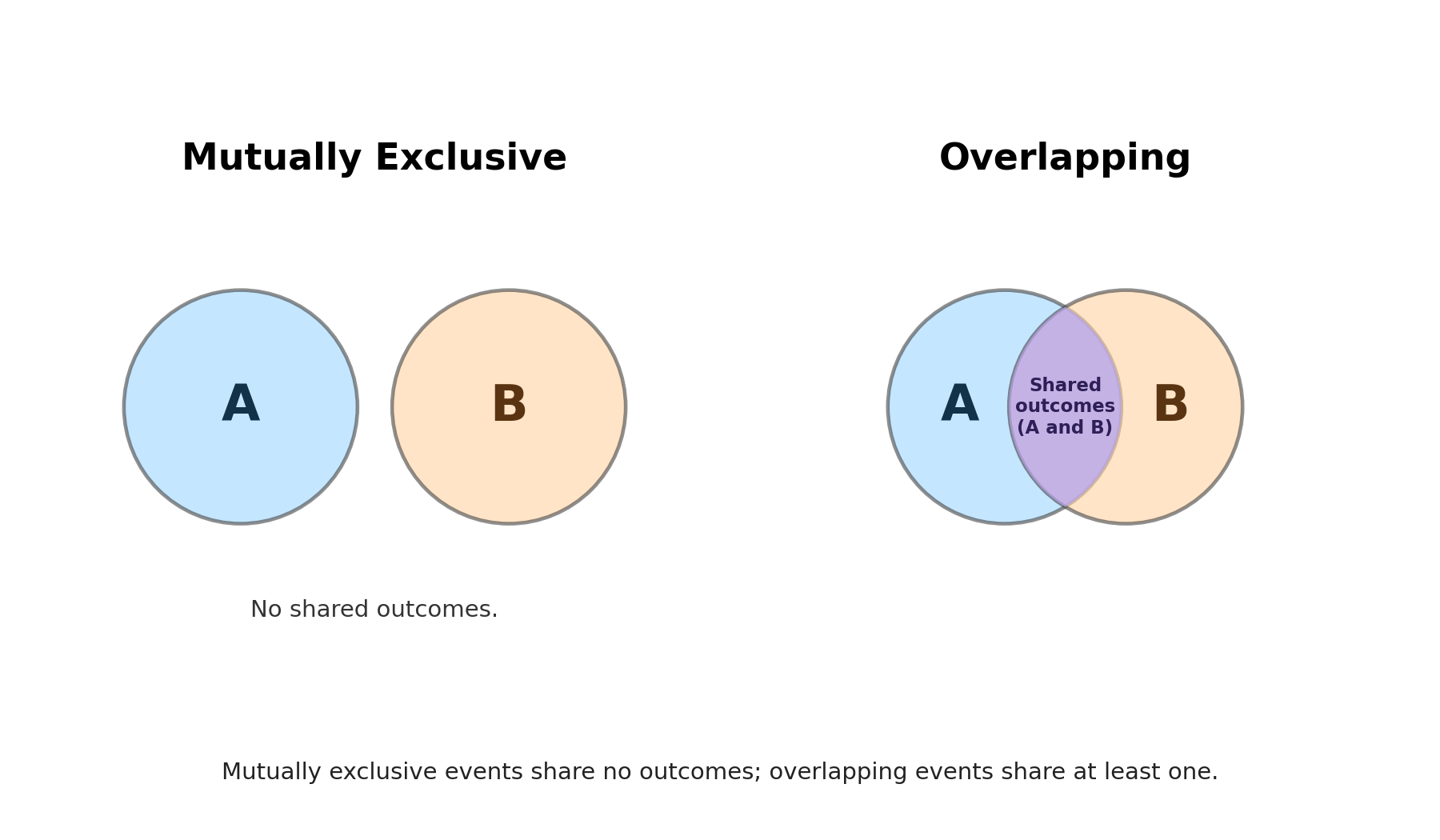
Two events are overlapping (also called non-mutually exclusive) when at least one outcome satisfies both events simultaneously. If you can find even a single outcome that belongs to event Aand event B, the events overlap.
Here is how overlapping events compare with the mutually exclusive events you already know:
Feature
Mutually Exclusive
Overlapping
Shared outcomes
None
At least one
Can occur together?
No
Yes
Simple addition works?
Yes
No (overcounts)
Consider a standard 52-card deck. Define two events for a single draw:
Event A: the card is red (26 cards)
Event B: the card is a face card (12 cards)
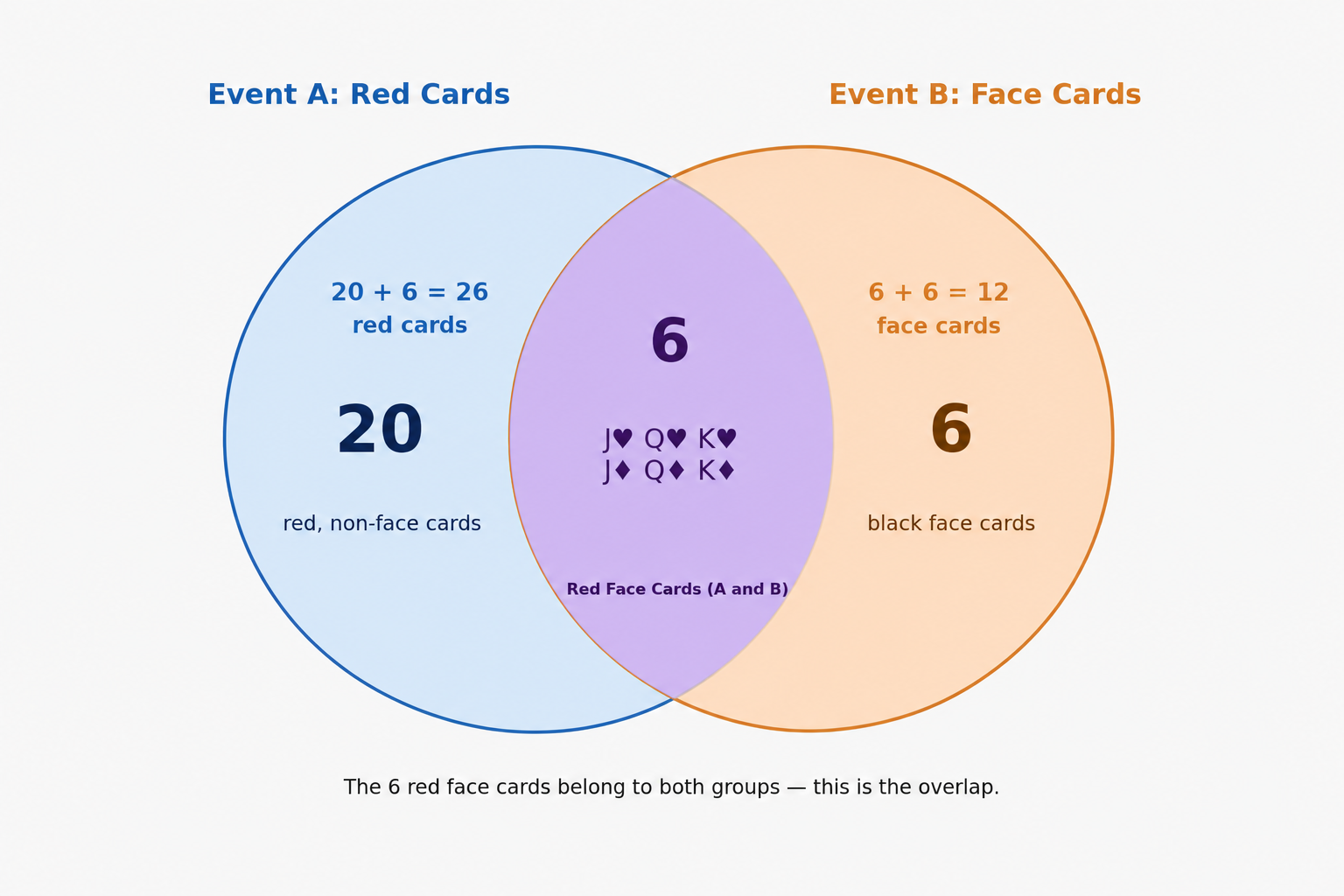
Can a card be both red and a face card? Absolutely — the jack, queen, and king of hearts plus the jack, queen, and king of diamonds are all red face cards. Because those 6 cards satisfy both descriptions, events A and B overlap.
Once you know two events can happen together, the next step is to identify exactly which outcomes sit in both groups. This shared set is often written as A and B (or A∩B in formal notation). It contains every outcome that makes both events true at the same time.
Returning to our card example, let's lay out the overlap clearly:
Event A (red cards): all 26 hearts and diamonds
Event B (face cards): J, Q, K in each of the four suits (12 cards total)
Both A and B (red face cards): J♥, Q♥, K♥, J♦, Q♦, K♦ (6 cards)
Those 6 cards are the overlap. They belong to the red-card group and to the face-card group. Whenever you need to find shared outcomes, simply ask: "Which specific outcomes satisfy both event descriptions?" List them out, and you have your overlap.
Here is where the previous lesson's formula runs into trouble. If we tried to use plain addition for our overlapping card events, we would get:
P(A)+P(B)=5226+5212=5238
But let's count the actual cards that are red or a face card. The 26 red cards already include the 6 red face cards, and the 12 face cards also include those same 6. Adding 26+12 counts those 6 cards once in the red group and then again in the face-card group, giving us 38 instead of the true count of 32 unique cards.
Correct count=26+12−6=32
The simple sum 5238 is too large by exactly 526, which is the probability of the overlap. This is the double-counting problem: every shared outcome inflates the total by one extra count.
Let's see how this same idea plays out in a workplace setting. Suppose a software company surveys 200 customers and records two attributes: whether the customer has a Premium subscription and whether the customer is based in the West region. The results look like this:
80 customers have a Premium subscription
50 customers are in the West region
20 customers are both Premium subscribers and in the West region
Now define two events for a randomly selected customer: Event A is "the customer has a Premium subscription" and Event B is "the customer is in the West region." These events clearly overlap because 20 customers satisfy both descriptions.
If we naively add the counts, we get 80+50=130. But those 20 customers who are Premium and West would be counted twice. The true number of customers who are Premium or in the West (or both) is:
80+50−20=110
As a probability for a randomly selected customer:
P(A)+P(B)=20080+20050=200130=0.65
That 0.65 overstates reality. The correct probability is 200110=0.55. The difference of 0.10 comes entirely from the 20 double-counted customers (20020). Recognizing the overlap is what protects us from reporting an inflated number to stakeholders.
Before moving on, let's gather the main ideas from this lesson into one place:
Two events overlap when at least one outcome belongs to both events.
The overlap (A and B) is the specific set of outcomes shared by both events.
Adding P(A)+P(B) without adjusting for overlap counts shared outcomes twice, producing a result that is too high.
The amount of the overcount equals exactly P(A and B).
Spotting the overlap and understanding why it causes double-counting is essential groundwork. In the next lesson, you will turn this understanding into a formula — the general addition rule — that corrects the overcount and gives you the accurate probability.