The GROW Coaching Model
Welcome to the Course
You're about to step from manager into leader territory. The earlier courses gave you self-awareness, a read on your team, and tools for feedback and conflict; this one is about what happens when you stop directing tasks and start developing people, through coaching, deliberate growth plans, hard underperformance calls, and the kind of resilience that holds up through reorgs and crunch.
By the end of this course, you'll be able to:
- Apply the GROW model to coach direct reports toward their own clarity and commitment
- Co-create development plans built on stretch assignments, mentorship, and exposure rather than course catalogs
- Diagnose underperformance as a skill or a will issue and design fair, time-bound improvement plans
- Communicate organizational change in ways that reduce threat response and build genuine buy-in
- Implement workload, autonomy, and recognition levers that prevent burnout and build long-term resilience
This first unit teaches the GROW coaching model, the foundation everything else in the course builds on.
Coaching vs. Managing: Choosing the Right Hat
Coaching and managing are different jobs, and confusing them is the most common mistake new managers make. Managing is directing tasks: you have the answer, the deadline matters, and you tell the person what to do. Coaching is developing people: the answer lives inside them, the timeline is the conversation, and your job is to ask, not tell.
Both are legitimate. Both are necessary. The mistake isn't choosing one over the other; it's wearing the wrong hat for the moment. When a junior engineer needs to ship by Friday and doesn't know how the deploy pipeline works, coaching her through Socratic questions wastes everyone's time. When a senior IC is wrestling with whether to pursue management, telling her what you'd do robs her of the only thing that will make the answer stick.
The signal is usually obvious if you look for it. Urgency, capability gap, or a clear right answer means you put on the managing hat. Ambiguity, a values question, a development moment, or someone wrestling with their own thinking means you put on the coaching hat. And when you swap hats, name it out loud. A line as simple as For the next thirty minutes I want to coach, not direct. Is that what you came for? resets the conversation and tells your report what posture to bring.
The G and R: Goal and Reality Questions
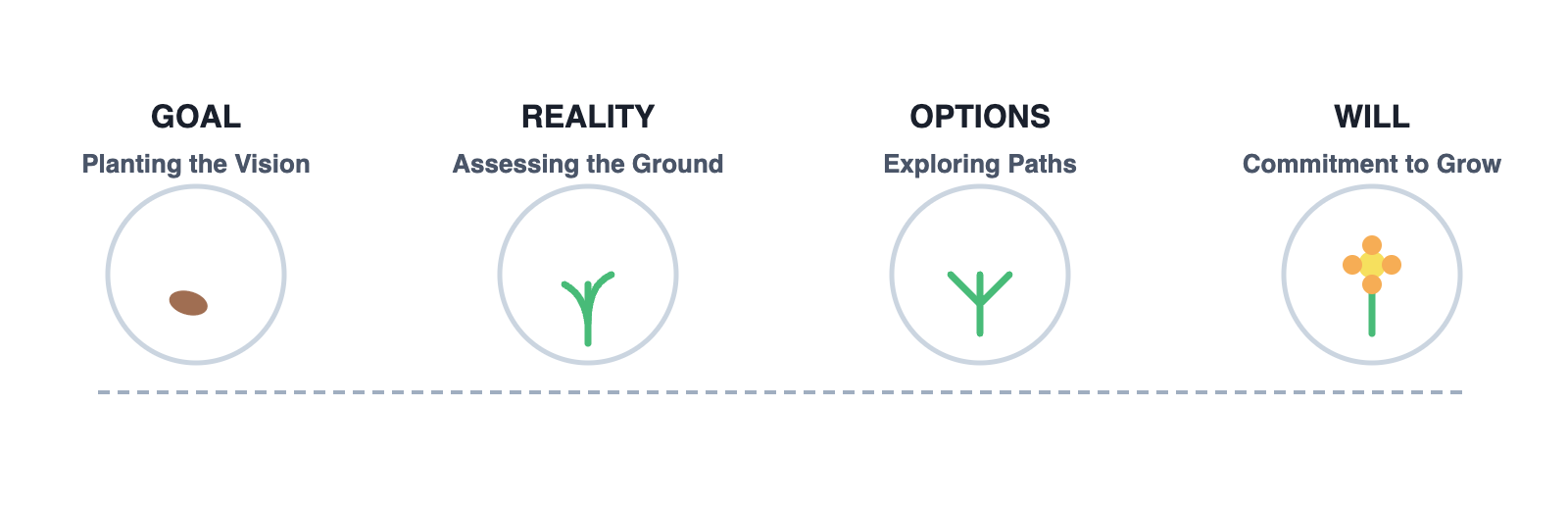
Once the coaching hat is on, GROW gives you a structure: Goal, Reality, Options, Will. The first half (Goal and Reality) is where most coaching conversations live or die. Done well, your coachee surfaces clarity she didn't have walking in. Done poorly, you spend forty minutes leading her toward your preferred answer dressed up as her insight.
The discipline here is the open-ended question. A Goal question is open when it doesn't anchor on a title, track, or obvious path. "Do you want to go into management?" is closed; it presumes the categories. "What would success feel like day to day, six months from now?" is open. "What's the version of success you'd be slightly embarrassed to say out loud?" is even better, because it bypasses the socially acceptable answer.
Reality questions follow the same rule. You're not collecting a status report; you're surfacing what's actually true now (energy, evidence, constraints) without judgment. "What's giving you energy lately, and what's draining it?" beats "How are things going?" by a mile. And then you wait. The hardest part of coaching is the silence after a real question.
- Jessica: I want to keep growing, have impact, the usual.
- Nova: That's the version I'd give in a skip-level too. What's the version you wouldn't say out loud yet?
- Jessica: ...Honestly? I don't know if the depth work I built my career on still energizes me. I haven't admitted that.
- Nova: Say more about when the energy shifted.
Notice what the manager did not do: rescue her, agree, or redirect to options. One curious follow-up and a held silence pulled out the real material.
The O and W: Options and Will
The second half of GROW converts insight into action. Options is brainstorming mode: you're helping your coachee generate multiple paths before evaluating any of them. The trap here is jumping to the first plausible idea, often because both of you find true brainstorming uncomfortable. Push past it: "Give me three more before we evaluate any of them." Resist adding your own option until she's built the menu herself.
Will is the commitment moment. What will she do, by when, and how committed is she? The confidence check is non-negotiable. Ask On a scale of 1 to 10, how committed are you? and treat anything below a 7 as a signal, not a failure. Follow up with "What would move it from a 6 to an 8?" That's where the real plan gets built. A coachee who walks out at a 6 doesn't execute; one who renegotiates the commitment to a 7 or 8 does.
The test of any of this is whether it holds up live, with a real person whose answers you can't predict. The single takeaway: coaching is restraint. You ask one more question before you suggest, and you trust silence to do work you'd normally fill with words. From here you'll move through a quick pattern-spotting exercise on when to wear which hat, then a roleplay where you run the Goal and Reality halves of a real career conversation, and finally a roleplay where you bring it home with Options and Will. Try this in your next 1:1 today: ask one open question, hold the silence for a full five seconds, and see what shows up.
