Individual Development Planning
The Individual Development Plan
Coaching opens up clarity; the Individual Development Plan (IDP) is what turns that clarity into a year of deliberate growth. Most managers either skip the IDP entirely (because the company template is dreadful) or hand a teammate a Google Doc and ask them to fill it in. Both approaches fail for the same reason: development isn't a form, it's a contract between what your report wants, what the team needs, and what the company will actually make room for. This unit shows you how to build that contract, design experiences that move the needle, and keep the plan alive past week three.
Co-Creating an IDP That Actually Aligns
A real IDP has five named components, and you co-create every one of them. Aspirations capture where the person wants to head over twelve to eighteen months: not a title necessarily, but a shape of work and impact. Strengths name what they already do well that the next role would lean on. Gaps are honest, specific, and ideally already named in calibration or feedback (vague gaps like "executive presence" don't survive contact with reality). Experiential actions are the assignments, pairings, and exposure that close the gaps. And accountability cadence is how the two of you will keep checking in.
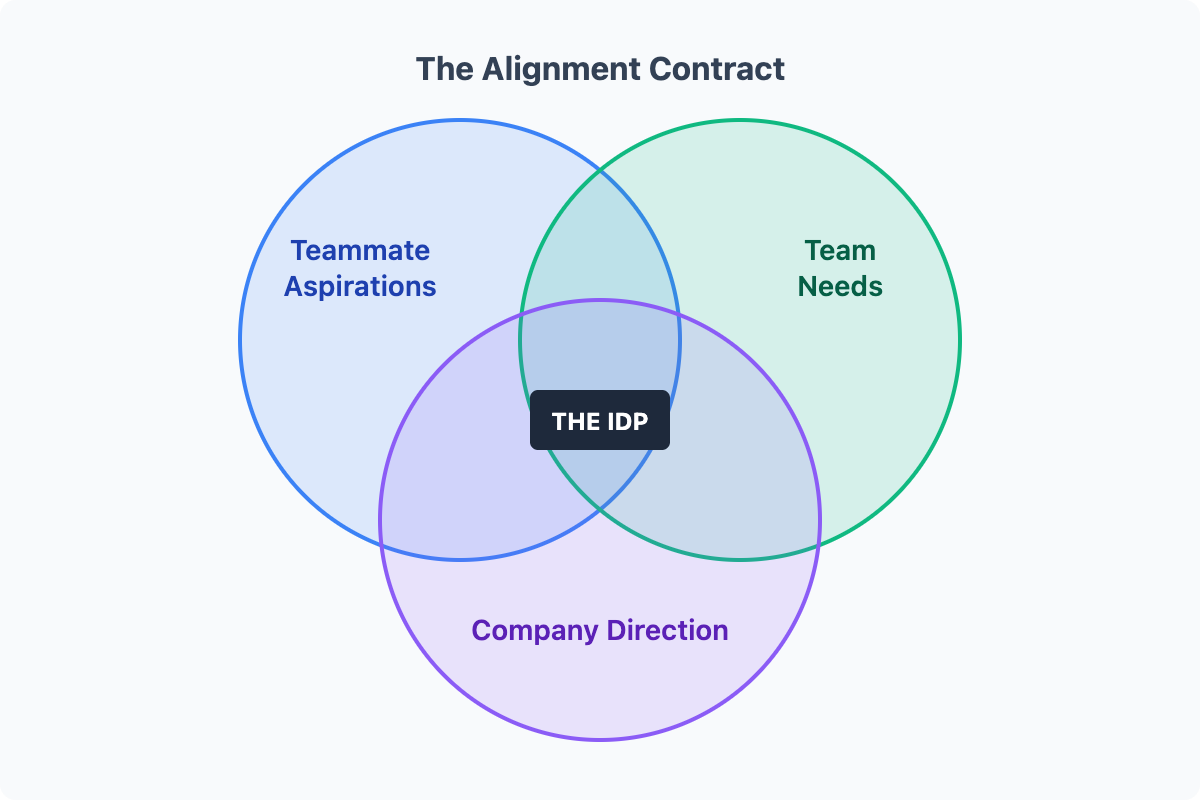
The co-creation part is non-negotiable. If you draft the IDP and hand it over, it becomes your plan that they execute reluctantly. If they draft it alone, it becomes a wish list disconnected from where the team is actually heading. The job is to bring the team and company context (where the work is going, what scope is opening up, what calibration evidence is missing) and let them bring the aspiration and the energy. The plan has to align all three: their growth, the team's needs, and the company's direction. When one leg is missing, the IDP collapses inside a quarter.
The following interaction demonstrates how to steer a report from a passive list of courses toward identifying real-world work that serves as calibration-grade evidence:
- Ryan: I want to go for senior next cycle. I've put together a list of courses to take.
- Nova: Let's back up. What does senior look like to you, day to day, that's different from now?
- Ryan: Owning a bigger architectural area, probably. Influencing across teams.
- Nova: Good, those are two of the three gaps from your last calibration. So the question isn't what to learn, it's where you'll demonstrate them. Which work coming up next quarter could carry one of those?
- Ryan: ...Honestly, I hadn't mapped it that way.
Notice the move: a course list became a map of evidence. The aspiration is his; the alignment to team work is yours.
Designing Experiential Development
Most growth doesn't come from training. The rough rule of thumb (and it's roughly right) is that around 70% of development happens through challenging assignments, 20% through relationships and mentorship, and 10% through formal learning. So when your report's IDP is 90% LinkedIn Learning, you have a redesign on your hands.
Experiential development comes in three flavors, and a strong IDP uses all three. Stretch assignments are real work, slightly above the person's current operating level, where the gap shows up in the doing: leading the architectural review for a new surface, owning a cross-functional initiative end-to-end, running the planning meeting their skip-level usually runs. Mentorship pairings are deliberate access to someone who has the capability the person is building: a senior IC two levels up, a peer manager who runs strong calibrations, an exec who'll spend an hour a quarter. Exposure opportunities put your report in rooms they wouldn't normally be in, like a quarterly review, a customer escalation, or a strategy offsite as a contributor rather than an observer.
Each item should pass a single test: could this show up as evidence in a calibration committee? "Took an Udemy course on stakeholder management" cannot. "Led the pricing sync for eight weeks and presented the recommendation to the VP" can. And every stretch carries a trade-off worth naming aloud: time, risk, comfort. If the assignment doesn't cost something, it probably isn't stretching.
Keeping the Plan Alive in 1:1s
Most IDPs die quietly somewhere around week four. The fix is structural: make the IDP a standing agenda item in your 1:1s, not a quarterly ritual. Two to three times a month, walk through each experiential commitment briefly. Is it tracking? What's slipping? What did they learn this week that updates the plan?
When something has gone quiet (and something always does), resist accepting "it's been busy" as an answer. That's the surface; the real blocker is usually access, scope clarity, or confidence. Ask one more open question: "What's actually getting in the way?" Then co-update in real time. Keep, modify, or replace the commitment based on what you both now know. The plan is a living document, not a contract you enforce.
The discipline here is the same one from the GROW unit: co-ownership, not management. The moment you start running the plan for them is the moment they stop owning it. Your job is to ask the question that makes the next move theirs.
The single takeaway: an IDP is a co-authored alignment of aspiration, team need, and company direction, expressed through experiences that produce calibration-grade evidence. Before this becomes real, you'll first run a quick recall check on the IDP framework's components, then draft the experiential section of a real plan you could hand to a direct report, and finally sit inside a 1:1 where one commitment has quietly stalled and the conversation has to surface what's actually wrong without taking the plan out of their hands.
