Questions That Build Ownership
🧩 Questions That Build Ownership
You've met the Goal-Reality-Options-Will sequence for structuring a developmental conversation. That structure is only as good as the thinking that fills it, and that thinking has to come from your report, not from you. This lesson zooms in on the smallest and hardest move in coaching: the questions you ask, and the space you leave after them. Ask well, and people start solving their own problems. Ask poorly, and you quietly train them to bring every problem back to you.
By the end of this lesson, you will have learned to:
- Tell open, leading, and closed questions apart, and know what each one does to ownership.
- Use paraphrasing, silence, and clarifying questions to keep a person thinking out loud.
- Build a reusable coaching question bank organized by the GROW stages.
❓ Open, Leading, and Closed Questions
Most managers believe they ask questions. Fewer notice that many of those "questions" are really answers in disguise. Three kinds are worth telling apart:
| Question type | What it does to ownership | Example |
|---|---|---|
| Closed | Answered in one word; shuts thinking down | "Did you finish the report?" |
| Leading | Hides your answer inside it, an instruction wearing a question mark | "Don't you think you should escalate?" |
| Open | Starts with what or how and hands the thinking back, with no hidden answer | "What options do you see here?" |
The leading question is the sneaky one. It's an instruction wearing a question mark: your report hears the "right" answer, nods, and walks away no more capable than before. You feel collaborative; they feel managed.
Here's a simple test you can run on yourself in the moment: if you already know the answer you're hoping to hear, you're probably about to lead, not ask. The discipline is to ask questions you genuinely don't know the answer to, and let the person surprise you.
👂 Listening So They Keep Talking
A good question is only half the move. What you do in the ten seconds after you ask it decides whether the person opens up or shuts down. That short stretch of silence right after your question is where their thinking either starts or stalls, so how you handle it matters as much as the question itself.
Three quiet tools carry that moment. Think of them as a simple Listen-to-Draw-Out framework you run every time you ask a real question:
- Paraphrase — briefly reflect back what you heard, in your words: "So the piece slowing you down is the handoff between teams." It proves you're listening and lets people hear their own thinking played back so they can examine it.
- Sit in the silence — the hardest one. After a real question, wait. The pause that feels unbearably long to you is thinking time for them; rush to fill it and you steal the very moment where ownership forms.
- Ask a clarifying question — "What do you mean by stuck?" or "Can you say more about that?" These slow the person down enough to see the pattern they've been rushing past.
Watch the framework in action. Here, Emily is in a 1:1 with Marcus, one of her reports, who is stuck on a recurring error and wants her to just hand over the fix:
- Marcus: I'm stuck on this recurring error in my report. Can you just tell me what to change?
- Emily: Before I do, walk me through what happens right before the error shows up.
- Marcus: Well, it's usually after I pull the numbers…
- Emily: After you pull the numbers.
- Marcus: Yeah. And, huh, I think I skip the reconciliation step when I'm rushing. That's probably it.
- Emily: So what do you want to try first?
Trace the framework through that exchange. Emily started with a clarifying question, "walk me through what happens right before," then paraphrased one phrase back, "after you pull the numbers," and then let a silence sit. She never handed over the answer, even though she likely knew it, and Marcus found the diagnosis himself. That "huh" is the sound of ownership arriving.
🏦 Build Your Question Bank
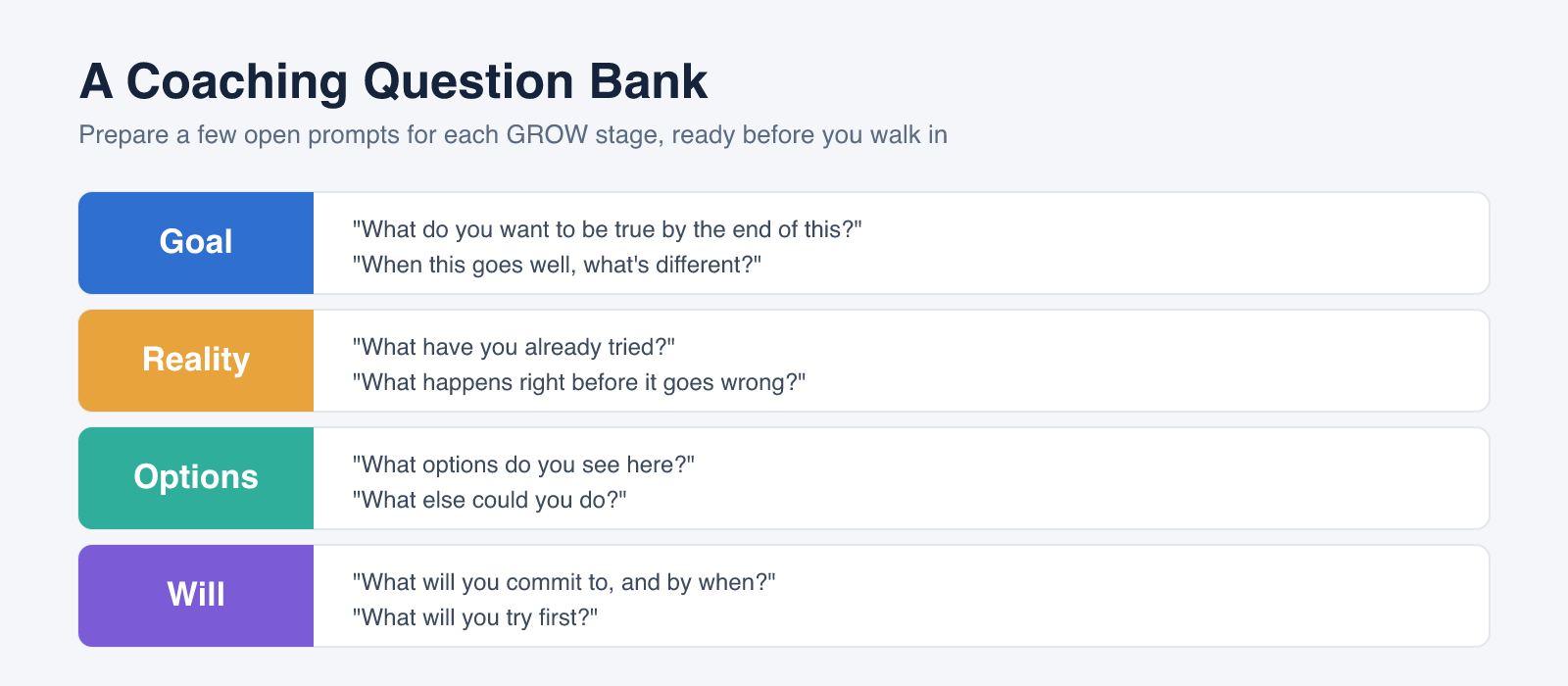
Good coaching questions rarely arrive on cue. Under pressure, the answer is right there and the sharp question isn't, so you reach for the answer. The fix is to prepare the questions in advance. A coaching question bank is a short, reusable set of open prompts organized by the four stages of the GROW model, Goal, Reality, Options, and Will, so the next question is always ready.
Having the bank is only half of it. The other half is knowing how and when to use it:
- Match the question to the stage you're in. Open with Goal and Reality prompts to understand what they want and where things stand, move to Options once the picture is clear, and save Will for the end to lock in a step. A Will question like "What will you commit to?" asked before the goal is clear just rushes them.
- Ask one question, then stop. Deploy a single prompt and let the Listen-to-Draw-Out framework work, so paraphrasing and silence do their job before you reach for the next one.
- Rewrite any leading question as an open one. Keep the open version next to the leading one it replaces, so "Don't you think you should escalate?" becomes "What are your options for handling this?"
- Close on their words, not yours. End with a question that confirms a next step the person generated. If the plan is genuinely theirs, they'll say it back without prompting.
The one thing to carry out of this lesson: your questions build ownership only when they don't already contain your answer. Next you'll do a quick quiz to lock in open, leading, and closed. Then you'll put it to the test in a live coaching dialogue, and finally you'll design your own question bank to keep at hand. So before you get there, sit with this: how many of the "questions" you asked this week were really instructions in disguise?
