Adapting Your Coaching Dial
🎚️ Adapting Your Coaching Dial
In the last lesson you trained yourself to hold back: ask open questions, let silence stretch, and resist the pull to hand over the fix. That discipline matters, but it isn't the whole story. So here's an honest question worth sitting with: is "ask, don't tell" always the right move? Picture a report who genuinely has no idea how to do the task in front of them. You ask, "What options do you see?" and they just stare back, because they don't have any yet. Pure questions don't build ownership there; they build panic. Coaching isn't a single setting you switch on. It's a dial you turn.
By the end of this lesson, you will have learned to:
- Turn the coaching dial between directive and collaborative based on a person's competence.
- Coach the anxious expert by separating proven skill from a first-time confidence gap.
- Re-diagnose competence and commitment as the evidence shifts mid-project.
↔️ Directive vs Collaborative Coaching
Coaching, as you've been practicing it, is a way of drawing out someone's own thinking. What changes from person to person is how much scaffolding you offer while you do it:
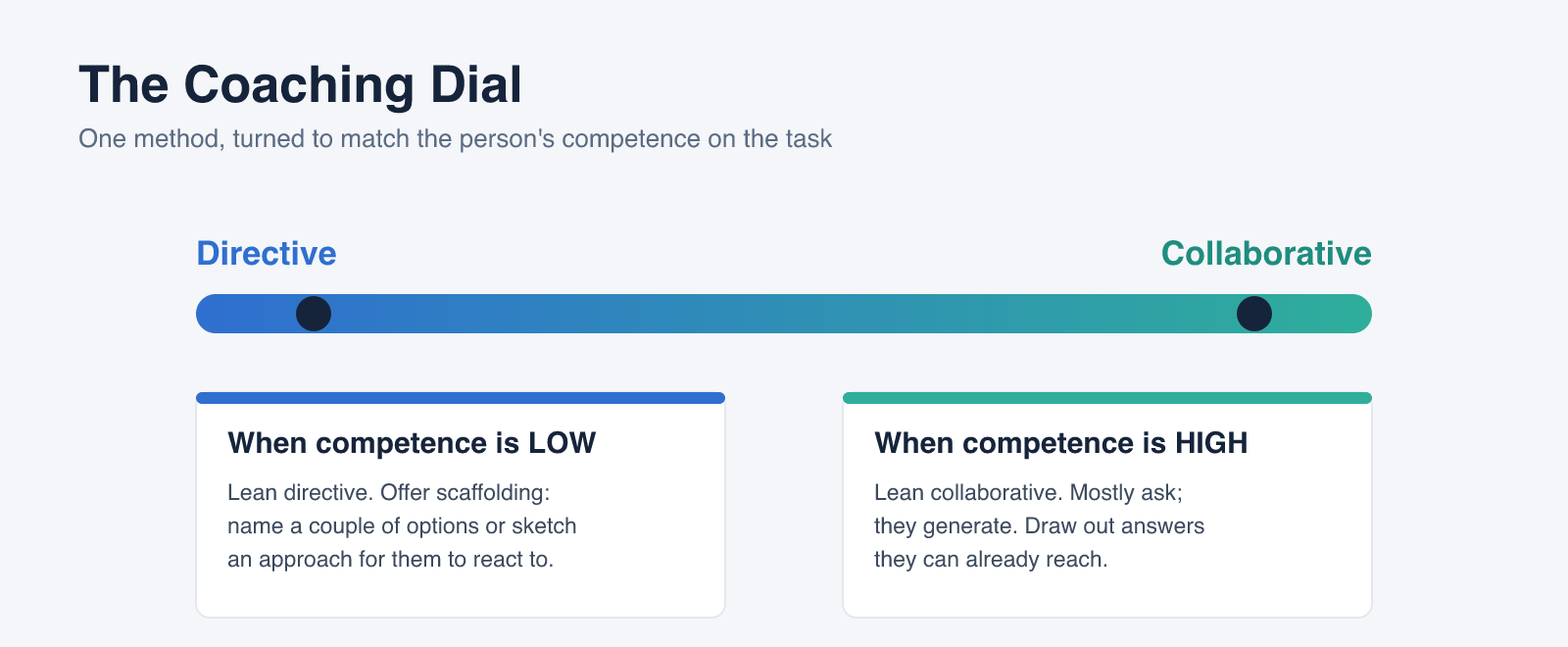
The person's competence will decide which way to turn the dial. When competence is low, lean directive. A person can't choose from options they don't have yet, so you supply scaffolding: name a couple of ways people usually handle this, or sketch the shape of a good approach, then ask them to react and pick. They are still thinking and still choosing; you're just giving that thinking something to push against. When competence is high, lean collaborative. They already hold the raw material, so mostly ask and let them generate the answer. Donating a solution they could have reached themselves only signals that you don't trust the skill they've already proven.
Notice this dial is not the same as "telling." Even at its most directive, coaching keeps the person thinking and choosing. You're adjusting how much support the thinking needs, not whether their ownership counts.
😰 The Anxious Expert
Now the case that trips up almost every manager. Someone is genuinely skilled at the underlying work but facing a first-time, high-stakes version of it: their first board presentation, their first cross-team meeting, their first big client review. Their competence is high; their confidence for this occasion is low. And here's the trap: anxiety looks a lot like incompetence, so your instinct is to over-direct, to start coaching an expert like a beginner. What happens next? They deflate. You've just signaled that you don't trust the very skill they've spent years building.
The move is to split the person into two parts. Where their expertise is real, stay collaborative and draw it out so they hear their own competence. Add light structure only to the part that is genuinely new. And treat the confidence gap as its own thing, an emotion to steady, not a skill to teach.
Let's see this in practice. Here, Nova coaches Victoria, one of her strongest analysts, who knows her financial model cold but is dreading her first-ever investor Q&A:
- Victoria: I know this analysis cold. But it's my first time in an investor Q&A, and I keep imagining them tearing it apart.
- Nova: You do know it cold, so let's leave the analysis alone. What's actually new here for you?
- Victoria: The live questions. I can't predict what they'll throw at me.
- Nova: That's the unfamiliar part, then. Which questions worry you most?
- Victoria: The ones about my assumptions.
- Nova: Then let's map the three they're most likely to press and how you'd walk through each. That structure is the part you need; the rest is already yours.
Notice Nova stayed collaborative on the content Victoria owns and added structure only for the new part, the live Q&A, while naming the fear instead of brushing past it.
🔄 When the Diagnosis Moves
Here's the last thing worth unsettling: your read on someone is not a label you stamp once and file away. Competence and commitment both move, sometimes in opposite directions, sometimes inside a single week:
- A strong rehearsal raises your evidence of competence, nudging the dial toward collaborative.
- A brutal round of surprise questions the next day dents confidence, nudging it back toward support.
Two shifts, opposite directions, same person. The quiet mistake is running last week's plan on this week's reality because re-diagnosing takes effort.
So re-diagnose whenever the evidence changes: new performance data, a setback, a compressed deadline, a jump in stakes. Then turn the dial to match. And remember that adding support is not the same as taking the work back. You can steady someone's nerves and add a little structure for the unfamiliar part while leaving them fully in ownership of the task.
The one idea to carry out of this lesson: coaching is a single method with a dial. You turn it toward structure when task competence is low or the situation is new, toward collaboration when competence is proven, and you re-turn it every time the evidence moves. Next comes a quick self-check on whether a moment calls for structure or questions, then a live conversation with an anxious first-time expert, and finally a written reassessment as the ground shifts under you. Before any of that, sit with one question: the last time you over-directed someone, was it because they couldn't do the task, or because their nerves made you forget that they could?
