Leading the Whole Team
🧠 Leading the Whole Team
Every step of this path has met you one person at a time: diagnose this report, coach that one, delegate to another — neat and orderly on paper. But here's the thing about a real Tuesday: it's anything but neat. You're running six different situations before lunch, and the tempting shortcut is to pick one comfortable style and spray it across everyone. So this final lesson asks one question of you: can you hold several different diagnoses in your head at once, and still act on each one cleanly?
By the end of this lesson, you will have learned to:
- Diagnose each report on the specific task in front of them, not slot them into a category.
- Defend a differentiated leadership plan to a skeptic without reaching for favoritism.
- Write an end-to-end plan that ties every style choice to task-specific evidence.
🗂️ Holding Several Diagnoses at Once
Notice what your brain wants to do when it scans a whole team. It wants to rank people: your stars, your solid middle, your worry. But you learned at the very start that competence and commitment are read per task, never per person. The same report can be a self-reliant owner on one assignment and a rattled first-timer on another in the same week. So the honest question is never "who is strong?" It is "what does this person need on this specific task right now?"
The tool that keeps you honest across a team is the Integrated Adaptive Leadership Sequence. Run this loop once per person, per task:
- Diagnose the person on the specific task.
- Select the matching leadership style.
- Decide whether and how to delegate.
- Establish outcomes and checkpoints.
- Coach through the Goal-Reality-Options-Will sequence.
- Reassess as the evidence changes.
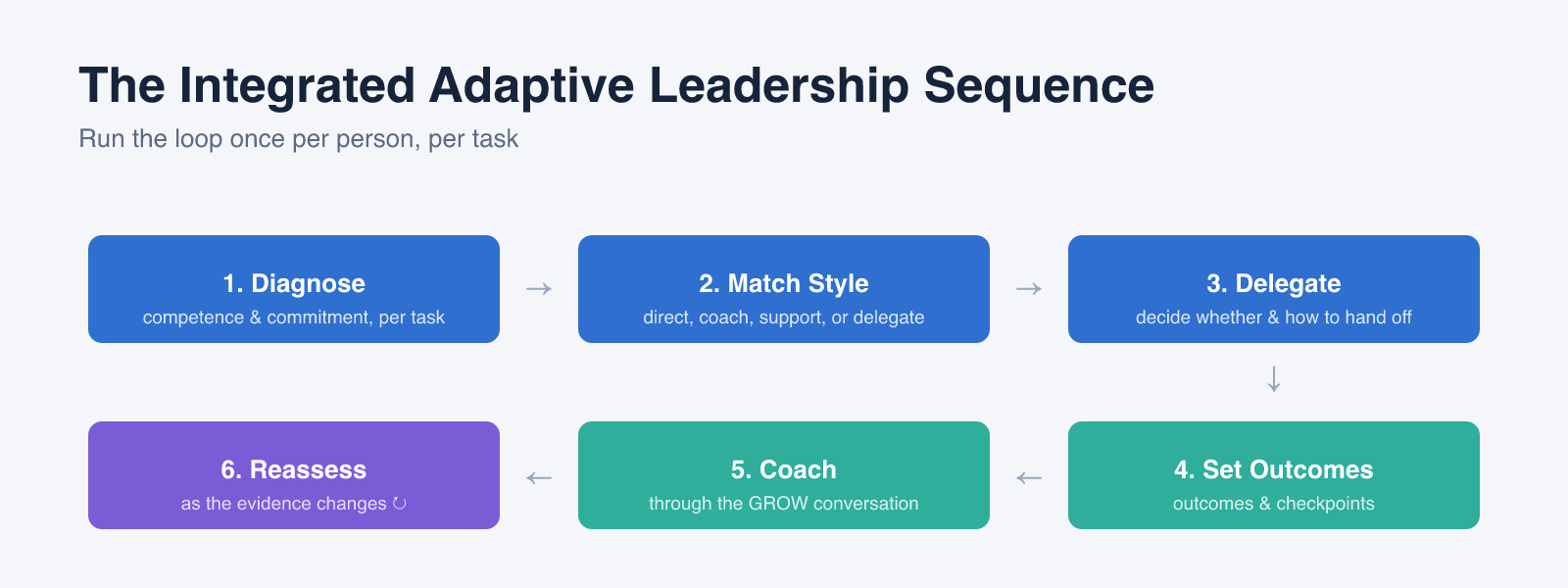
What falls out the other side may feel uncomfortable: you might be directing one report, supporting another, and delegating to a third all in the same afternoon. If that looks inconsistent to you, sit with the discomfort for a second, because someone is about to say it out loud.
⚖️ "Isn't It Fairer to Treat Everyone the Same?"
That's the challenge, and it sounds reasonable until you look underneath it. Treating everyone identically is not fairness; it is convenience wearing fairness as a costume. Real fairness is giving each person what the task evidence says they need to succeed and to grow, and being able to explain that difference without reaching for how much you like them, their reputation, or who is easiest to ask. When you can tie every differentiated choice to task-specific evidence and to delivery risk, you are not playing favorites. You are protecting results.
Let's see that defense in action. Here, Chris is challenged by Ryan, a colleague who's convinced that one consistent standard would be fairer to everyone:
- Ryan: Why are you closely directing one person and letting another run their whole project unsupervised? Isn't one standard fairer?
- Chris: The standard is the same for both: each gets what the task evidence says they need. One has never done this task before, so direction protects the deadline. The other has delivered it four times, so hovering would only slow them down.
- Ryan: And "supporting" the quiet one isn't just you avoiding a hard conversation?
- Chris: Fair push. They're proven on the work but disengaged, so I'm drawing their ownership back out. But if the commitments keep slipping, I escalate. I don't coach forever.
Watch what Chris does there: every choice is anchored to task evidence, and the genuinely fair point gets conceded instead of defended. That last line matters most, and it names the thing we cover next.
✍️ Writing It Down Forces Honesty
It's easy to fool yourself when the plan lives only in your head. Writing an end-to-end plan, one entry per report, exposes the gaps fast: Where is my evidence? What is this person's authority level? What exactly would make me change course?
Use a simple One-Report Plan template for each person. For every report, write one line under each field:
- Diagnosis — their competence and commitment on this specific task, with the evidence behind your read.
- Style — the leadership style that evidence calls for (direct, coach, support, or delegate).
- Delegation and authority — what you hand off, and the decisions they own.
- Outcomes and checkpoints — the result you're after, and when you'll check in.
- Coaching approach — the GROW questions you'll use to keep ownership with them.
- Reassessment triggers — the specific evidence that would make you turn the dial.
Filling in every field forces you to justify each choice on paper, where a vague or favoritism-driven decision has nowhere to hide.
One more piece keeps this from turning soft. The Escalation Check is your reminder that when the evidence shows repeated missed commitments, unmanaged risk, or a persistent refusal to own the work, you shift from developmental support to firmer accountability: reset expectations, increase direction, narrow authority, reassign, or move into formal performance management as warranted. Do not mistake avoiding a hard conversation for patience. Adapting your style is generous; letting a problem run because confrontation is unpleasant is not.
Here's the whole path in one line: you diagnose per task, match your style to the evidence, delegate and coach accordingly, and keep re-reading as things move, including knowing when support has run its course. What sits ahead now is the real test of all of it. First a quick pattern-spot to place several reports and pair each with a style, then a live conversation where you defend a differentiated plan to a stakeholder who thinks consistency is fairer, and finally the written plan that ties it all together. Before you start, sit with the question your skeptic will ask: if someone demanded you justify why two of your people are led completely differently this week, could you answer with evidence, or only with instinct?
