Structuring Coaching Conversations
📣 Welcome to the Course
Welcome to Coach for Ownership and Adaptation! As a manager, sooner or later, a report will walk into your 1:1 stuck on something. Your instinct may be to solve it, hand over the answer, and move on. But this course is about the harder, more valuable move: running conversations that build people who can solve the next problem without you.
Note that "coaching" in this context is different from the leadership style of coaching. In this course, coaching is a developmental conversation method that draws out a person's own thinking. Same word, different job, so make sure to keep the two apart.
This first lesson gives you the backbone every good coaching conversation shares: a simple four-part sequence. By the end of this lesson, you will have learned to:
- Structure a developmental conversation using the Goal-Reality-Options-Will sequence.
- Move a person from a vague goal to a concrete step they own, through questions rather than answers.
- Capture the conversation so the commitment actually sticks.
⚠️ Why Fixing Quietly Backfires
Here's a question worth sitting with: when a report brings you a problem and you solve it on the spot, what have you actually taught them? Usually one thing, that the way to handle a problem is to bring it to you. Solving feels generous, and it is fast, but it slowly trains dependence. The report leaves relieved, and no more capable than they walked in.
Coaching flips that. Instead of supplying the answer, you supply the structure that helps someone find their own. That structure is the Goal-Reality-Options-Will Coaching Sequence, often called the GROW model, and it moves through four stages in order.
🪴 The Four Stages of GROW
You move through the four stages in order, and each one has a distinct job:
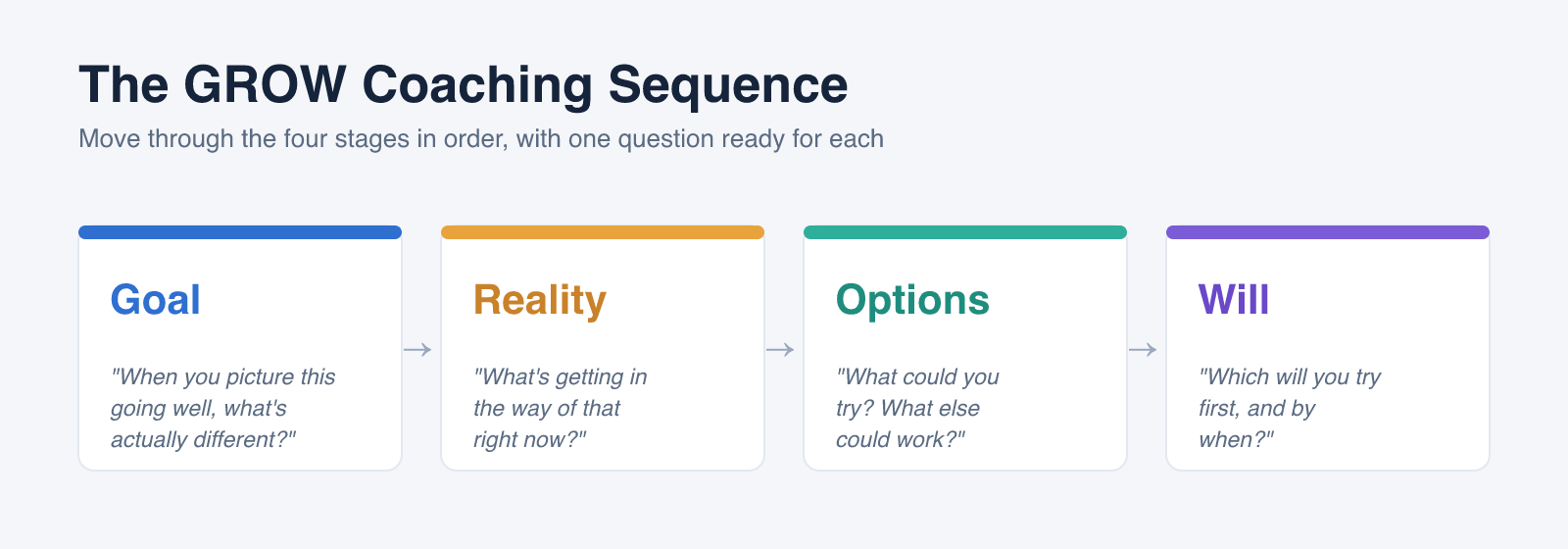
Goal is the first stage, and it is about naming what the person actually wants out of this conversation, and beyond it. You ask where they are trying to get to and what "better" would look like, so the aim becomes something concrete rather than a vague wish.
Reality is the honest look at where things stand right now. Here you draw out the facts, what they have already tried, and what is genuinely getting in the way, so the plan is built on the real situation instead of an idealized one.
Options is where the person generates possible paths forward, in their own words, before you offer any of yours. You ask what they could try and what else might work, because an option they generate is one they will actually own.
Will is the commitment: the specific action they choose, own, and attach a timeframe to. You ask which option they will try first and by when, so the conversation ends with a concrete step that belongs to them, not a to-do list from you.
Notice what the sequence is doing. It resists your urge to jump straight to "here's what you should do," which skips the goal and reality steps entirely and hands over an option that isn't theirs. The order matters because a person can't own a solution to a problem they haven't clearly named.
💬 From a Vague Goal to an Owned Step
Most reports don't arrive with a crisp goal. They arrive with a fog: "I want to be more organized," "I need to get better at presentations." Your job in the goal and reality stages is to turn that fog into something concrete enough to act on.
Let's see this in action. Here, Chris is coaching one of his reports, Dan, who has come to their 1:1 with a fuzzy goal about managing his time. Watch how a few questions do the work that advice can't:
- Dan: I want to get better at managing my time.
- Chris: What do you mean by better? What would you change?
- Dan: I'd protect two hours each morning for analysis instead of losing them to email.
- Chris: So what's getting in the way of that right now?
- Dan: I open my inbox the second I sit down, and suddenly it's 11.
- Chris: What's one thing you could try this week that changes that first move?
- Dan: Block the first two hours before email. I'll start tomorrow.
Notice that Chris never gave an instruction. He moved Dan from a vague goal to a real one, surfaced the reality, drew out an option, and landed on a committed step, all through questions. And because the plan is Dan's, Dan is far more likely to actually do it. That is the whole point: the will has to be theirs, in their words, with a timeframe attached.
📝 Capture It So It Sticks
A good coaching conversation that no one remembers is a coaching conversation that didn't happen. So a good habit to build is documenting it, not for a file somewhere, but so both of you can hold the person accountable to what they chose.
The useful thing is that the four stages give you a ready-made structure for the record:
- Before the conversation, jot the questions you plan to ask at each stage, so you walk in prepared to draw out rather than tempted to tell.
- After the conversation, capture where it actually landed: the clarified goal, the reality you surfaced together, the options they generated, the specific action they own, and a checkpoint to revisit it.
As you write, ask yourself one honest question: did the options come from them, or did I smuggle mine in? If the plan reads like your idea in their handwriting, the ownership never transferred.
The single takeaway of this lesson is that your value in these moments is the structure and the questions, not the answer. That feels counterintuitive when you could just say it, which is exactly why it is worth practicing. Next you'll do some quick pattern-spotting by sorting real coaching questions into Goal, Reality, Options, or Will. Then you'll run a live conversation that turns a vague goal into an owned step, and finally you'll document a coaching conversation end to end. As you go, keep one question in mind. When is drawing out the answer worth more than giving it?
