Briefing Decisive Choices
Briefing Decisive Choices 📢
Last time you learned to set deadlines that force decisions. But what happens after you decide? When the hour arrives and you actually decide, the next failure mode kicks in: you make the call in your head, then explain it badly, and someone hands it back to you for reconsideration. This lesson closes that gap with a five-line decision capsule and a two-minute spoken version of it — not to justify the call, but to make it land as settled the first time you say it.
After this lesson, you will have learned how to:
- Draft a five-line decision capsule using context, choice, why, next step, and owner, ensuring the why is only one sentence and the next step excludes the word "because"
- Deliver the five lines aloud in under two minutes, stating the choice in the past tense and returning to the capsule when someone probes for a reversal
- Judge a peer's capsule on clarity, confidence, and actionability, then coach exactly one repaired line and make them say it back
📝 Draft the Five-Line Decision Capsule
The decision capsule is a fixed five-line record of a call you've already made. It's like a snapshot of your choice that can easily fit on a Post-it, compact but containing everything needed to understand what happened.
A capsule only works if the lines stay in the same order and each one does exactly one job, so the format carries the clarity instead of you improvising in the moment. The five lines:
- Context: What situation triggered this decision?
- Choice: What did you decide?
- Why: Your main reason for this choice.
- Next Step: What happens immediately after.
- Owner: Who's responsible for execution.
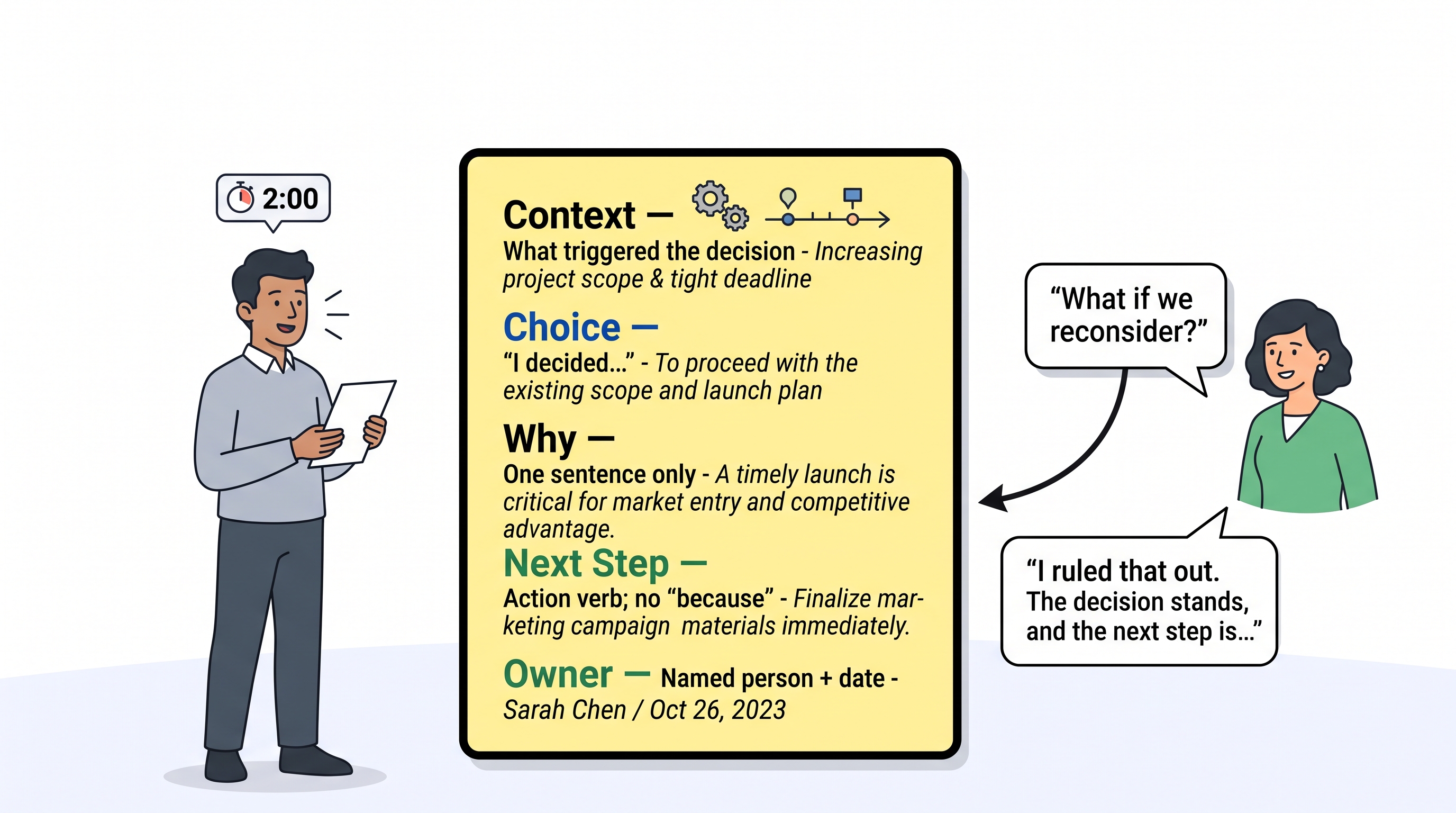
There are two traps to watch out for:
- Why is where overthinkers try to justify themselves, weighing every option and airing every doubt, when the line only allows one sentence. One sentence forces you to name the deciding factor and stop.
- Next Step goes the other way: people write a reason instead of an action. "Because the reporting window closes Friday" is a reason. "I'll email the finance lead tonight to confirm the cutoff" is an action. Watch for the one word that gives it away. If your next step contains "because," you've written the why line twice.
Let's see the two traps in action. Chris has decided, but his why line is sprawling and his next step is really a reason wearing an action's clothes. Jessica makes him rewrite both.
- Chris: We're over budget by $4k. I've dropped the second workshop. We looked at trimming catering, we talked about pushing the date, and honestly the sponsor was never that attached to it anyway, so on balance —
- Jessica: Stop. That's too many reasons. Which one actually decided it?
- Chris: Dropping the second workshop was the only line item we could cut without touching delivery.
- Jessica: That's your why. What's the next step?
- Chris: Because the venue needs notice before the end of the week.
- Jessica: That's another reason. What do you do?
- Chris: I call the venue today to cancel the second slot. And I own the reschedule conversation with the sponsor by Friday.
Notice what did not change. Chris never revisited the decision itself — the second workshop stayed cut. Jessica only fixed the two lines that were doing the wrong job. The why went from a survey of everything he'd considered to the one factor that settled it: it was the only line item he could cut without touching delivery. And the next step went from an explanation to something with a verb in it — he calls the venue today, and he owns the sponsor conversation by Friday. Same call, three sentences shorter, and now it's something a room can act on.
Brief the Choice as Settled ⏱️
A decision briefing isn't a discussion — it's a clear announcement. You're informing people about what you've decided and why, not asking for permission or second opinions.
Speak the five lines in order from top to bottom, keeping each one to a single sentence, and keep the whole briefing under two minutes. The goal is to be clear rather than exhaustive, and the clock enforces that: two minutes is plenty for five sentences and not nearly enough to over-explain or defend the call. Rehearse it aloud once before you deliver it to reveal weak spots and build your confidence.
The past tense is the most important part of the delivery, because it signals that the decision is already made: "I decided" or "I have chosen", not "I think maybe we should". As soon as you frame a choice as a preference, you invite the kind of debate you were trying to avoid and hand the final call right back to the room. Your word choice tells the listener whether you truly own the outcome or are still wavering.
Expect people to probe your logic, and know the difference between answering a clarifying question and reopening the decision. If someone floats a reversal or questions your rationale, hold the line by returning to your capsule. You can acknowledge the alternative without entertaining a change: "I ruled that out because of the delivery date. The decision stands, and the next step is still the venue call today."
🎯 Coach Exactly One Repaired Line
When you hear someone else's capsule, judge it on three things and nothing else:
- Clarity — were all five lines present and distinct, or did why and next step collapse into each other?
- Confidence — was the choice stated as settled, or floated for approval?
- Actionability — is there a named person, a specific action, and a date?
Then coach one improvement, and only one: the highest-impact one. Your instinct will be to list all five problems, which produces enthusiastic agreement and zero change. Usually the single fix is the choice line or the owner line, because everything downstream depends on those two landing.
Make the repair in three moves, in this order. Quote the hedge back verbatim so they hear what they actually said, model the repaired line out loud so they hear the grammar, and then make them say it themselves. The last move is the one people skip, and it's the one that sticks, because a line you've spoken once is a line you can speak again in the room that matters. Here's the sequence run on a vague owner line:
| Move | What you say | Why it works |
|---|---|---|
| 1. Quote the hedge | "You said: we should probably get someone from ops to pick this up." | Their words, not your paraphrase — no room to argue about what was meant. |
| 2. Model the repair | "Try: Marin owns the migration checklist and starts Monday." | They hear the grammar: named person, specific action, date. |
| 3. Make them say it | "Now say it back." | Speaking it once makes it available under pressure. |
The takeaway is that a decision nobody can act on hasn't been made, and hedged grammar is the most common way a good call goes unmade. The capsule doesn't improve your judgement, it stops a decision you've already reached from dissolving the moment you open your mouth. Next, you'll run a quick matching check, pairing real statements with the right capsule line to see whether you can separate why from next step under pressure, then you'll deliver a capsule live and coach someone through theirs. Write your five lines down now, before the clock starts.
