Setting Decision Deadlines
Welcome to the Course 🎉
Welcome to Closing and Communicating Decisions! Ever notice how some decisions drag on for weeks? You weigh options endlessly, but nothing moves forward. This paralysis costs more than just time. In this course, you'll learn to turn private choices into clear commitments, deliver confident two-minute briefings, and improve your decision process through simple reviews and focused sprints. This lesson starts with the first step: replacing a soft intention with a deadline that is genuinely hard to renegotiate.
By the end of this lesson, you will have learned how to:
- Distinguish a decision deadline from a completion deadline to prevent logistical delays from reopening a choice
- Structure a hard deadline using an exact time, a starting trigger, and a backup plan that guarantees a result
- Remove "hedges" from your commitment to ensure firm accountability with a witness
📅 The Anatomy of a Hard Deadline
A date in your private calendar is easy to move. A deadline becomes harder to renegotiate when another person knows about it.
A key behavioral force makes this work: Commitment. Once you state an intention to a named person, you feel pressure to act consistently with what you said. A deadline you keep to yourself has no witness, so nobody notices if it moves.
Loss aversion can add extra motivation: people tend to feel a loss more sharply than an equivalent gain. You can optionally attach a small, meaningful forfeit to missing your decision deadline—for example, “If I haven’t recorded my choice by Friday at 3 p.m., I’ll pay my witness $10.” Choose a consequence you can safely afford and agree on it with your witness in advance. The forfeit makes delay costly; it does not replace the backup rule that closes the decision.
Effective decision deadlines have three parts: a specific date, a clear trigger (when you'll sit down to decide), and a backup plan if you miss it. The backup plan should close the decision rather than create another delay. Choose a simple rule you will actually follow, such as selecting the current front-runner, choosing the lower-risk option, or flipping a coin between two acceptable choices. "I'll decide by Friday" is weak because it leaves the time, trigger, and outcome undefined. "I'll decide Friday at 3 p.m., right after my afternoon meeting, and if I don’t, I'll flip a coin" is strong because the decision has a clear moment and a guaranteed ending.
Natalie has been postponing a decision about whether to pursue a certification. Milo helps her replace a vague window with a specific date, a clear trigger, and a backup plan.
- Milo: Have you figured out when you’re going to decide about the certification?
- Natalie: By the end of the month. Definitely.
- Milo: The end of the month is a window. When will you actually sit down and make the call?
- Natalie: Fair point. Thursday the 28th at 8 p.m., right after dinner. I’ll sit down with my notes and decide.
- Milo: And if 8 p.m. comes and you’re still stuck?
- Natalie: Then I’ll go with my current front-runner and enroll.
- Milo: Okay, that sounds like a real deadline.
Natalie’s first answer sounded firm, but “by the end of the month” still left room for delay. She made it stronger by naming the exact time she would sit down to decide and choosing a backup plan that would close the decision if she remained stuck.
Decision Date vs. Completion Date ⏰
One reason deadlines fail is that the choice gets bundled with all the chores that come after it. "I'll have enrolled by Friday" is a completion deadline. It includes making the decision, finding your documents, filling out the application, and submitting payment. If the website crashes or you can’t find your credit card, the task stays unfinished — and suddenly the decision feels open again. This is an invisible renegotiation: a problem with the paperwork becomes a convenient reason to delay the choice.
To prevent this, separate the decision from the paperwork. A decision deadline closes the choice: "I'll decide yes or no by Friday at 3 p.m." Once you record a clear yes or no, that deadline is met. A separate completion deadline covers what happens next: "If I decide yes, I’ll submit the forms by Monday at noon." A missing document might delay the application, but it doesn’t undo the decision you already made.
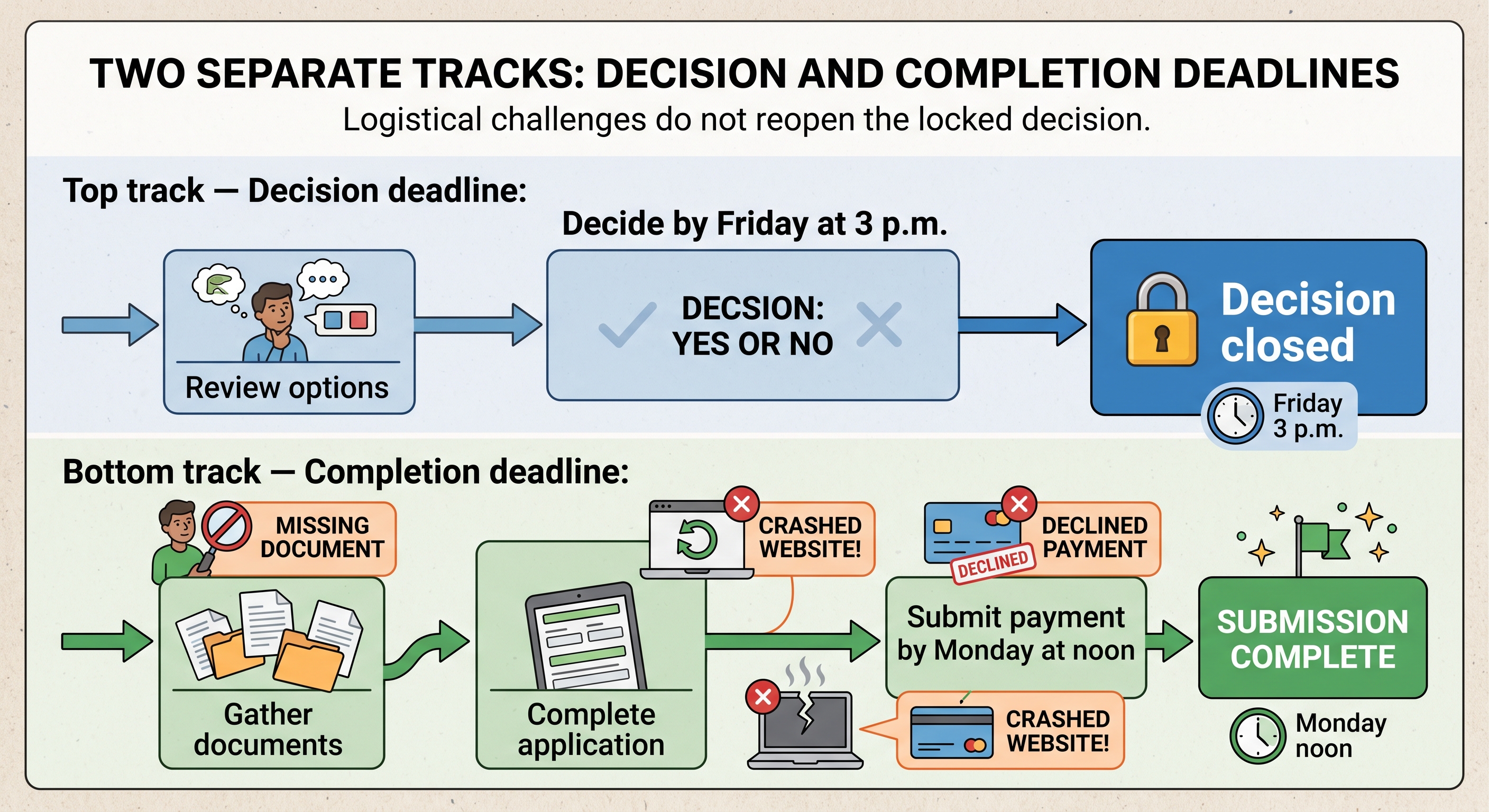
Sometimes new information really does justify moving a deadline, but ordinary inconvenience doesn't. Before changing the date, ask: Would this new information materially change my choice, or does it just make delaying feel reasonable? A changed price, a new job offer, or important medical advice might affect the decision. A busy afternoon, one more article, or the feeling that you’re not quite ready probably won’t. If the information wouldn’t change your choice, keep the deadline and follow your backup plan.
🗣️ Drafting the Deadline Statement
To make a deadline stick, state it without "hedges" — small words that create an exit. Phrases like "I'll try to," "unless work gets busy," or "roughly by" signal that the deadline is still negotiable. Each hedge gives you permission to move the deadline as soon as deciding feels uncomfortable. Replace it with a direct commitment: "I’ll decide by Monday at 3 p.m." This does not mean ignoring a genuine emergency; it means refusing to treat ordinary stress or inconvenience as a reason to delay.
Use this four-part template to lock in your commitment:
- The Choice: "I will decide whether to accept or decline the role..."
- The Date: "...by Monday at 3 p.m."
- The Trigger: "After my 2 p.m. meeting, I'll sit down for an hour to review my list."
- The Backup: "If I’m still stuck at 3 p.m., I’ll choose the more reversible option."
If you share this with a witness, ask them to point out any hedges they hear. A deadline holds when there is a specific hour, a clear starting trigger, and a backup plan that guarantees a result.
A decision closes when a firm deadline and a backup rule close it, not when you finally feel certain. Define the choice, set an exact date, time, and trigger, choose a backup that guarantees an outcome, and share the commitment with a named witness. In the practices ahead, you’ll apply this to real decisions: separating decision deadlines from completion deadlines, drafting hedge-free commitments, and asking a witness to hold you accountable for making the call.
