Understanding Random Selection
Introduction
Welcome back to Choosing Samples You Can Trust! You have reached lesson four of six, so you are well past the halfway mark. Over the last three lessons, we explored what makes a sample representative, how convenience and voluntary-response sampling introduce bias, and how an incomplete sampling frame can quietly exclude entire groups before selection even begins.
All of those lessons focused on what can go wrong. Now it is time to look at what a trustworthy selection method actually looks like. In this lesson, we will define random selection, pin down exactly what makes it different from casual or convenient choices, and learn to tell genuinely random methods apart from methods that only seem random.
The Everyday Meaning vs. the Statistical Meaning
In daily conversation, people use the word "random" loosely. Someone might say, "I randomly bumped into a friend at the store," or "I just randomly picked a restaurant." In those cases, "random" really means unplanned or without much thought.
In statistics, random has a much more precise meaning. It does not mean careless or haphazard. It means that a deliberate chance mechanism controls the selection. Understanding this distinction is the key to everything that follows, because a method can feel unplanned and still be deeply biased, while a properly random method follows a careful, structured process.
What Random Selection Means
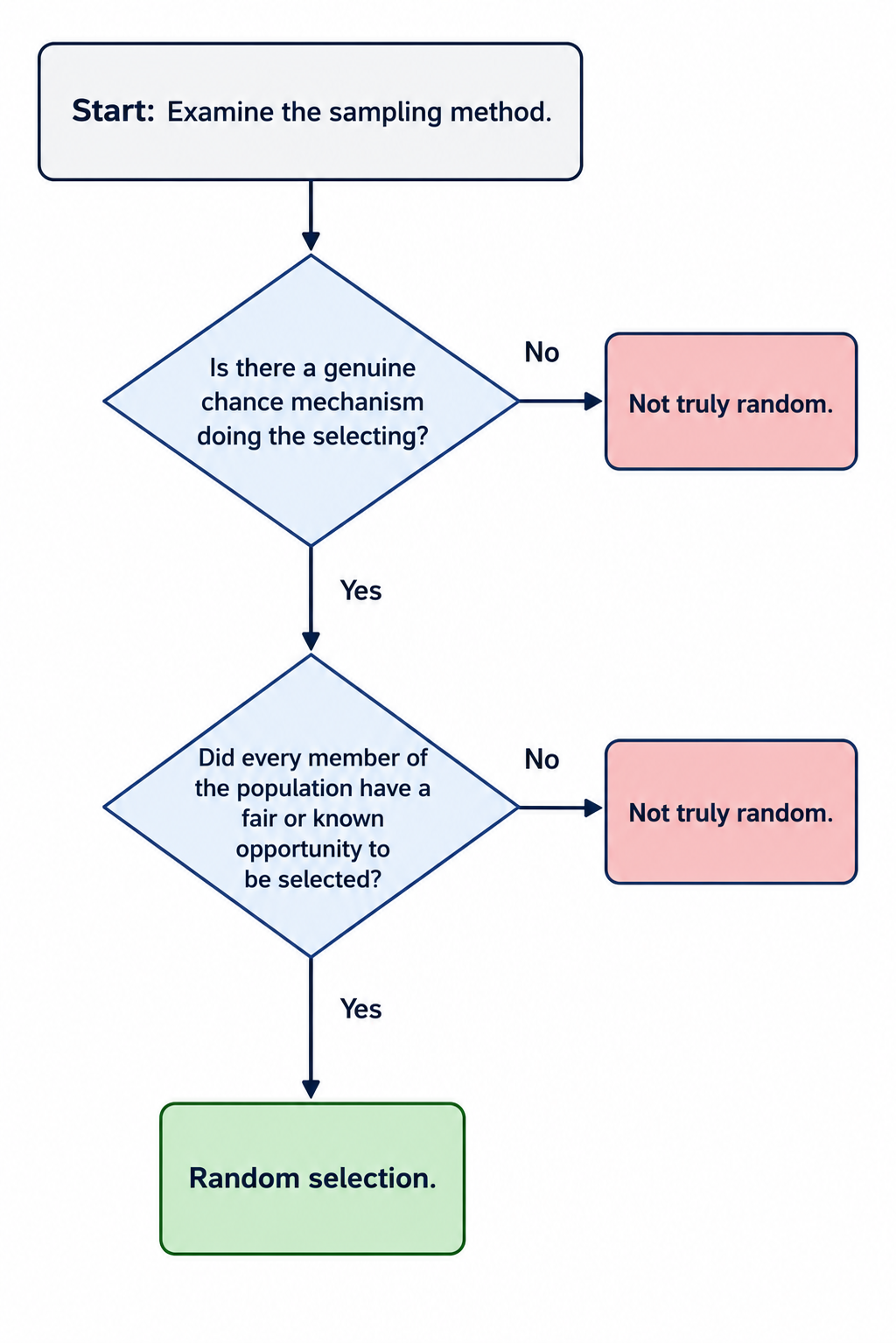
A selection method is random when two conditions are met:
- A chance process (not personal judgment) determines who gets chosen.
- Every member of the population has a fair or known (positive) opportunity to be selected.
Both conditions must hold at the same time. If a researcher flips a coin to decide between two volunteers, there is a chance process at work, but the rest of the population never had any opportunity at all. That method fails the second condition. Similarly, if a teacher looks around a classroom and tries to pick students "without thinking about it," every student might technically be present, but no genuine chance mechanism is guiding the choice. That fails the first condition.
The phrase fair or known opportunity deserves a closer look. It does not require that every person has exactly the same probability of being chosen, although equal probability is the simplest and most common case. It means that we can state, before the draw, what each member's chance of being selected is, and that this chance is a known, non-zero value. In other words, no one's chance is zero simply because of where they happen to be or how easy they are to reach.