Incomplete Sampling Frames
Introduction
Welcome back to Choosing Samples You Can Trust! You are now on the third of six lessons in this course, which means you have already built a solid foundation. So far, you know how to judge whether a sample mirrors its population on the characteristics that matter, and you have seen how convenience sampling and voluntary-response sampling each favor certain groups over others. Both of those biases come from how individuals are selected.
In this lesson, we turn to a different source of trouble: the list or source a researcher uses before any selection happens at all. Sometimes, the problem is not who the researcher picks or who volunteers. The problem is that entire groups never had a chance to be picked in the first place, because they were missing from the source. By the end of this lesson, you will be able to spot when a sampling source quietly leaves people out and explain exactly how that gap pushes conclusions in a misleading direction.
The List Behind Every Sample
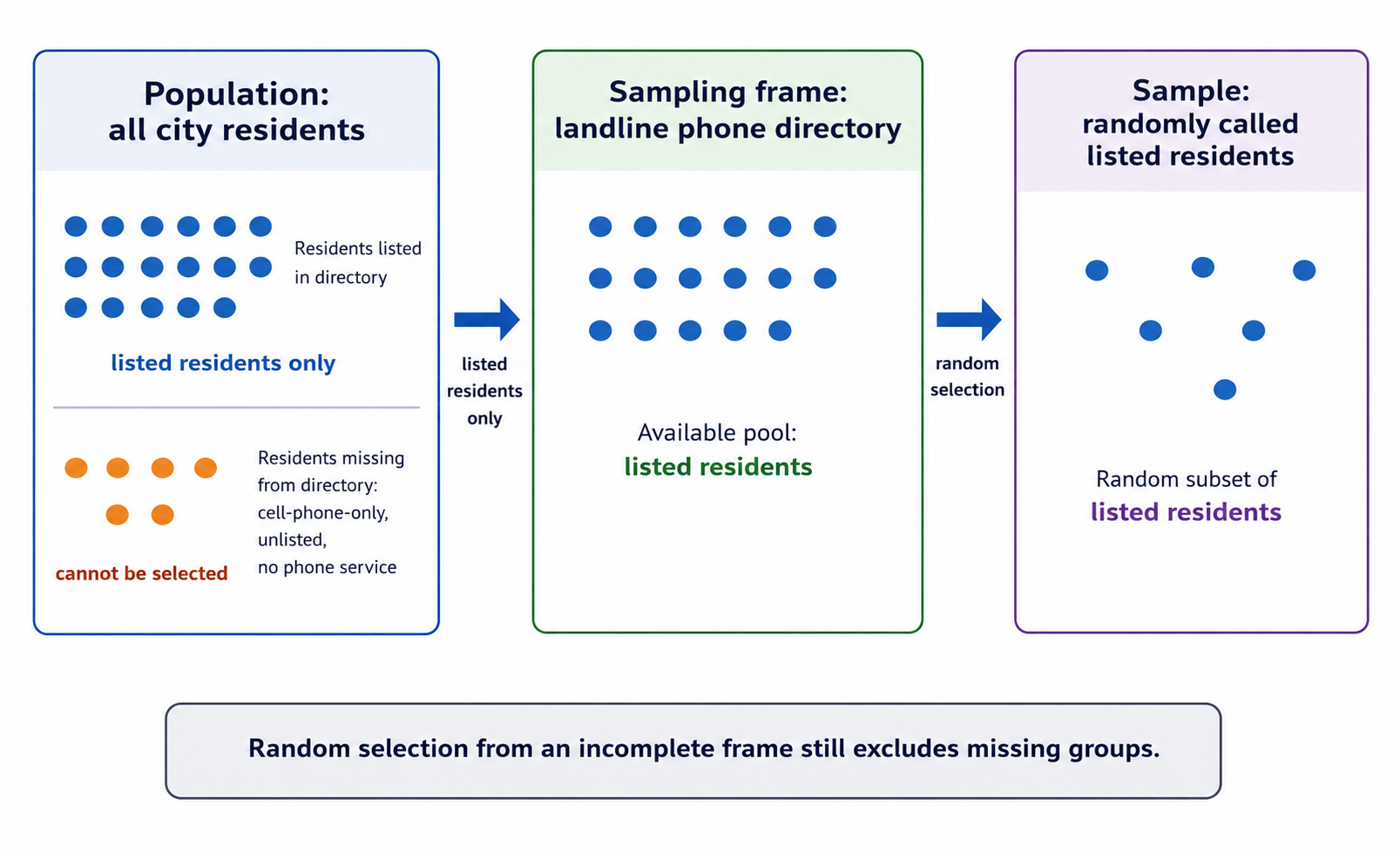
Before a researcher can choose individuals for a sample, they need some kind of list or source to choose from. If you want to randomly pick students from a school, you probably start with the school's enrollment roster. If you want to survey residents of a city, you might use a phone directory, a voter registration file, or a mailing list.
This starting list matters more than most people realize. In the previous lesson, you saw that convenience sampling and voluntary-response sampling create bias through the selection process itself. But what if the selection process is perfectly fair, yet the list it draws from is missing people? That is exactly the type of bias we will explore now.
What Is a Sampling Frame?
The technical term for the list or source used to draw a sample is the sampling frame. It is the practical tool that defines who can possibly be selected. A sampling frame can take many forms:
- A phone directory
- An email subscriber list
- A membership roster
- A database of registered voters
- A list of street addresses
Ideally, the sampling frame should include every member of the population we want to study. When it does, any well-designed selection method can reach the full population. But in practice, many sampling frames fall short. They cover most of the population while quietly leaving out specific groups. That gap between the population and the frame is where a new kind of bias creeps in.