Recognizing Biased Samples
Introduction
Welcome back to Choosing Samples You Can Trust! In the first lesson of this course, you learned how to judge whether a sample is representative by checking if it mirrors the population on the characteristics that matter. That skill told you what to look for. Now, in this second lesson, we are going to explore why samples go wrong in the first place.
Specifically, we will examine two common sampling shortcuts that seem perfectly reasonable on the surface but quietly push results in a misleading direction. By the end, you will be able to recognize convenience sampling and voluntary-response sampling, explain why each one produces a biased sample, and describe which groups end up over-represented or under-represented as a result.
The Selection Method Matters
A representative sample mirrors the population on the characteristics relevant to our question. So what causes a sample to fall short of that standard?
Often the culprit is surprisingly simple. The problem is not bad luck or a small sample size — it is the method used to choose who ends up in the sample. When the selection method systematically favors certain people over others, the resulting sample is biased. The word systematically is key here: it means the distortion is not a one-time accident but a built-in feature of the method that will occur every time it is used. In this lesson, we will look at two of the most common ways this happens.
Convenience Sampling
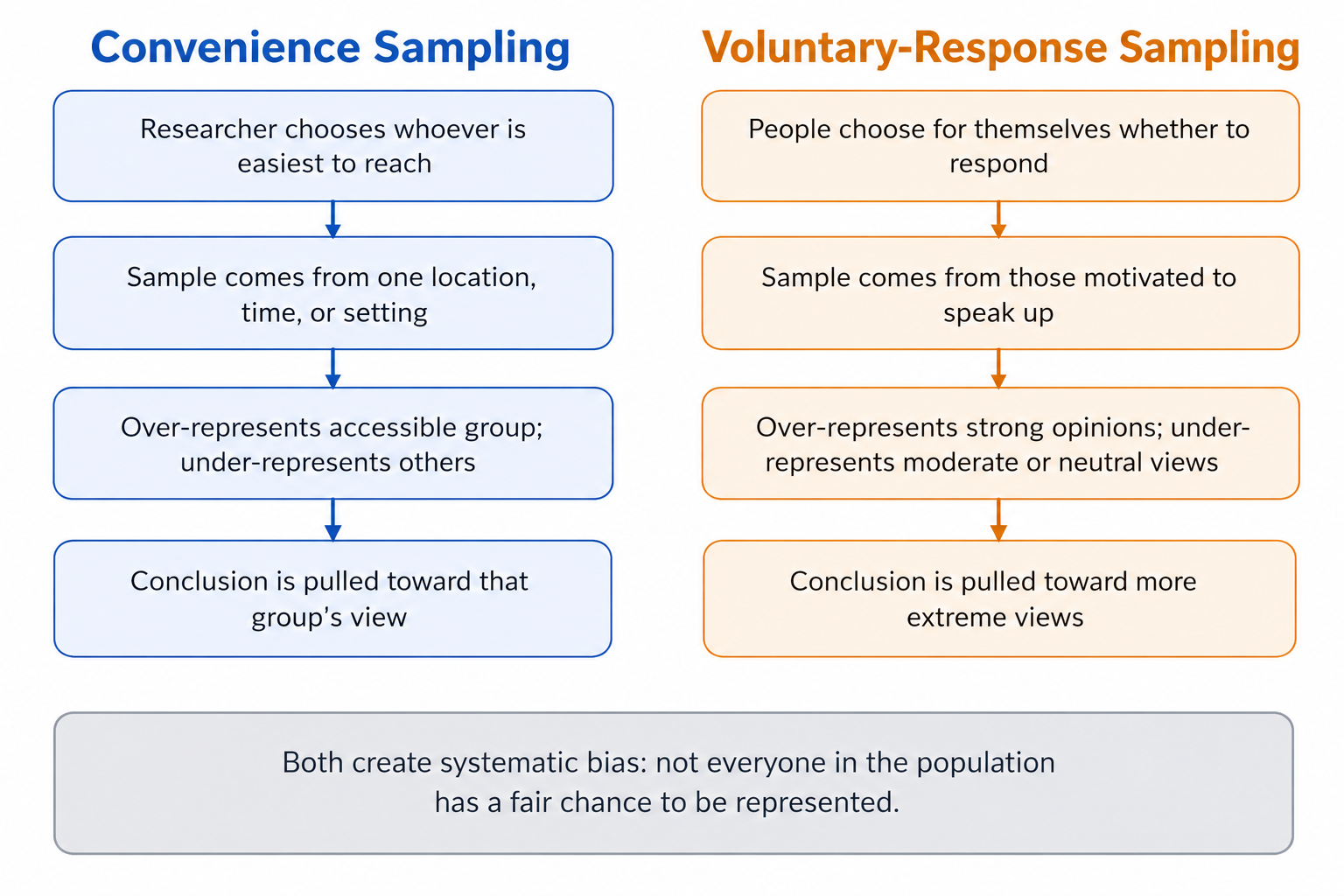
Convenience sampling means selecting individuals who are easiest to reach or most readily available. The researcher does not attempt to cover the full population. Instead, they grab whoever happens to be close by.
Here are a few everyday examples:
- A teacher wants to know how all parents at her school feel about the new homework policy, so she asks the five parents she sees at morning drop-off.
- A reporter wants to gauge public opinion about a new park, so he interviews shoppers at the store across the street.
- A company wants to learn what all employees think about remote work, so the manager surveys only the people sitting in the nearest office.
In every case, the sample is built around ease of access rather than around capturing a fair cross-section of the population.