Why Randomness Reduces Bias
Introduction
Welcome back to Choosing Samples You Can Trust! You are now on lesson five of six, just one step away from wrapping up the course. So far, we have built a solid toolkit: you can judge whether a sample is representative, spot the bias lurking in convenience and voluntary-response samples, catch coverage gaps in a sampling frame, and tell genuinely random methods apart from imposters.
With all of that groundwork in place, one big question remains: why does random selection actually help? We know it involves a chance mechanism and gives every member a fair opportunity to be chosen. But what is it about leaving the decision to chance that tends to produce better, more trustworthy samples? That is exactly what this lesson will answer.
From Definition to Explanation
Knowing what random selection is was an important first step, but defining a tool is not the same as understanding why it works. Think of it this way: knowing that a fire extinguisher contains a special chemical is useful, but understanding why that chemical puts out flames gives you real confidence in reaching for it.
This lesson makes the same move, from the what to the why. Once we see exactly how randomness counteracts the biases we have been studying, the case for using it becomes much stronger, and we will be able to explain that case in our own words.
What Systematic Bias Actually Does
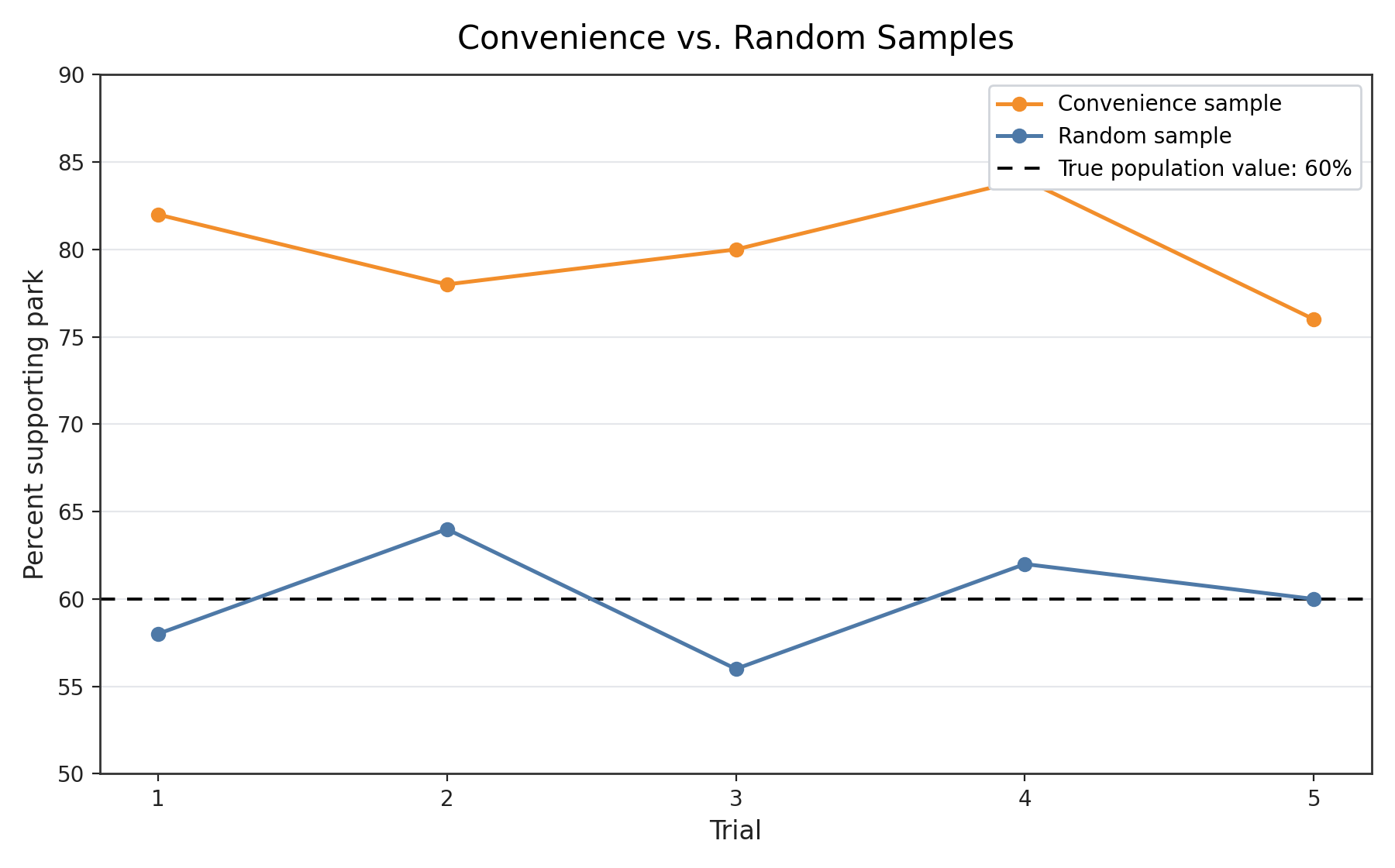
Before we can appreciate the cure, we need a crisp picture of the disease. As you may recall from earlier lessons, systematic bias means a sampling method consistently pushes results in one direction. It is not a one-time fluke; it is a pattern that repeats every time the same flawed method is used.
Consider a company with 1,000 employees, where 60% work in-office and 40% work remotely. If a researcher surveys employees by walking through the office building, the sample will over-represent in-office workers every single time. It does not matter how many times the researcher repeats this approach. The method itself favors one group over another, so the error always leans the same way.
This is the core problem with convenience and voluntary-response sampling: the direction of the error is predictable and persistent.
Why Chance Breaks the Pattern