Strategic Networking and Research
Strategic Networking and Research
Over the previous three lessons, you built a layered understanding of industries, roles, compensation, and organizational culture. You now have frameworks for analyzing growth trends, benchmarking pay, and weighing the ROI of credentials. But research is only as powerful as your ability to gather firsthand intelligence and organize it into an actionable system. This final unit brings your skills full circle. You will learn to conduct informational interviews that surface deep insights, build a research repository to keep findings accessible, and translate raw data into clear next steps. As a People Manager, you know the best decisions combine data with human conversation—this unit applies that principle to your own career.
The informational interview is a structured conversation designed to reveal the Hidden Curriculum—the unwritten norms and day-to-day realities that desk research cannot provide. It is not a job pitch; it is a tool for understanding the reality of an industry or role from the inside.
Begin by identifying subjects one to two levels above your target role or those who recently transitioned into the field. LinkedIn is your primary tool—search by title and industry, looking for mutual contacts to make introductions. If you must send a cold message, specificity is vital. Avoid vague requests like "picking your brain." Instead, demonstrate that you have done your homework: "I'm a People Manager exploring HR analytics, and your transition from generalist to analytics lead is exactly the path I'm researching—would you have 20 minutes for a conversation?"
During the interview, use open-ended questions to probe for specifics. Instead of asking "Do you like your job?", try "What does a typical Tuesday look like from morning to end of day?" Instead of "How did you get into this field?", ask "What skill from your previous career turned out to be most valuable in your current role?" For People Managers, questions about whether leadership views the people function as a strategic partner or a support role can surface critical cultural insights.
To see what this looks like in practice, consider the following exchange between two People Managers, where one is conducting an informational interview with the other about a potential career move into HR operations leadership:
- Natalie: Thanks so much for making time today. I've been researching senior HR ops roles and noticed you made the jump from a generalist People Manager position about two years ago. I'd love to understand what a typical day actually looks like for you now.
- Dan: Sure. Honestly, it's less about employee relations conversations and more about systems, data, and process design. On a given day I might spend the morning reviewing workforce planning dashboards, then the afternoon redesigning our onboarding workflow with the HRIS team.
- Natalie: That's really helpful. What skill from your generalist background turned out to be most valuable once you moved into ops?
- Dan: Stakeholder management, without question. The technical tools I had to learn on the job, but knowing how to get a skeptical VP to buy into a new process—that came straight from my years managing up as a People Manager.
- Natalie: That's encouraging because I feel strong there. Last question—is there anyone else on your team or in your network you'd recommend I speak with to get a different angle on this kind of role?
- Dan: Absolutely. Let me introduce you to someone on our people analytics team—she came from a completely different background and could give you a great perspective on the data side.
Notice how Natalie asks questions that are specific and open-ended, steering the conversation toward day-to-day realities and transferable skills rather than surface-level impressions. She listens rather than pitching herself, and she closes by asking for a referral—turning one conversation into another. This is exactly the kind of disciplined, curiosity-driven approach that makes informational interviews so valuable.
Listen more than you talk. At the close, always ask two things: "Is there anyone else you'd recommend I speak with?" and "Would it be all right if I followed up with you down the road?" This expands your network exponentially and keeps the relationship alive. Finally, send a thank-you message within 24 hours referencing a specific takeaway to show genuine engagement.
Creating a Systematic Career Research Repository
Without a system to capture your findings, your research becomes a scattered collection of notes and browser tabs. A career research repository provides a single, structured place where every piece of intelligence lives.
Your repository can be a simple spreadsheet or a Notion database. What matters is consistency. At a minimum, track: Company Name, Role Title, Source, Key Findings, Culture Notes, Compensation Data, Credential Requirements, Contact Name, and Next Step. Logging research in real time prevents information decay—the loss of nuanced details—and comparison paralysis. When all findings are in one place with consistent fields, you can sort and filter to see which roles match your culture preferences and skill set. Apply the same operational rigor to your career as you would to employee records or team development goals.
Turning Research Findings into Actionable Insights
The final skill in career research is synthesis. Review your repository for convergence—places where multiple sources point in the same direction. If job postings and interview contacts both emphasize data literacy, closing that skill gap is a clear priority. If the organizations you admire most value collaborative leadership, that informs both your target list and your personal branding.
Translate these patterns into a prioritized action list. Each action should be specific and time-bound. Instead of "Learn analytics," write: "Enroll in a people analytics course by month-end to address the gap identified in 70% of target postings." For example, your list may look like:
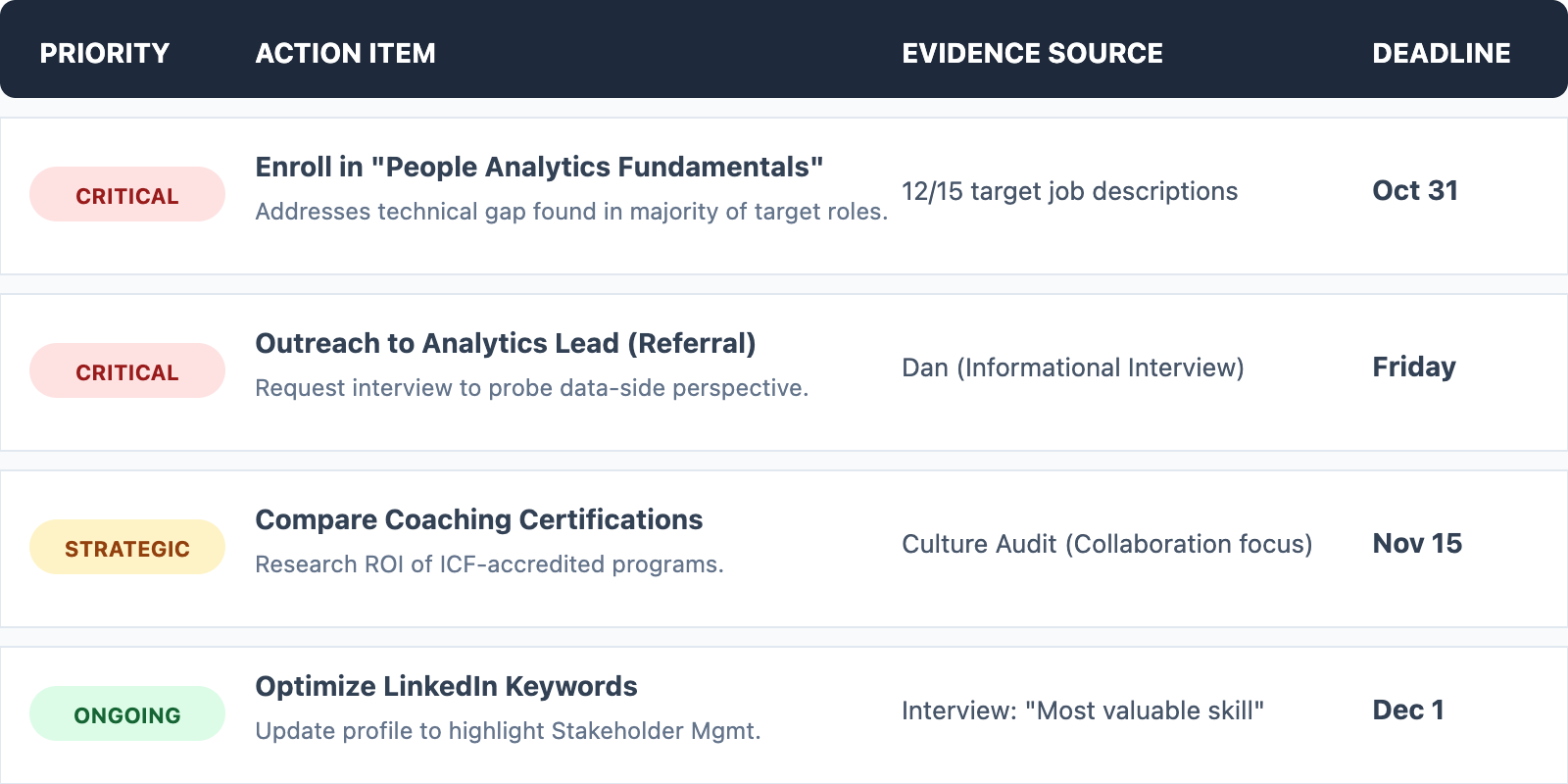
Treat your research as a living process. Set a monthly checkpoint to review your repository, update entries, and refresh your action list. The professionals who maintain this system do not just research careers—they manage their exploration with the same data, structure, and accountability they bring to their daily work.
Coming up next, you will put your informational interviewing skills into practice in a role-play exercise aimed at uncovering the day-to-day realities of a role in your target industry.
