Assessing Culture and Credentials
Assessing Culture and Credentials
You have learned to decode tasks and benchmark pay. Now, you must evaluate the organization itself. This unit focuses on assessing organizational culture, determining the ROI of additional education, and uncovering the "unwritten rules" of a company. As a People Manager, you shape culture daily; now you must become intentional about assessing the culture that will shape your long-term career satisfaction.
Every organization has a stated culture and an actual culture. Public materials like mission statements and culture decks provide the official narrative, but these are only meaningful if they are reflected in daily operations. To bridge the gap between what a company says and what it does, you must perform cultural due diligence.
The following diagram illustrates the contrast between the public-facing narrative and the behavioral evidence you must uncover to see the full picture:
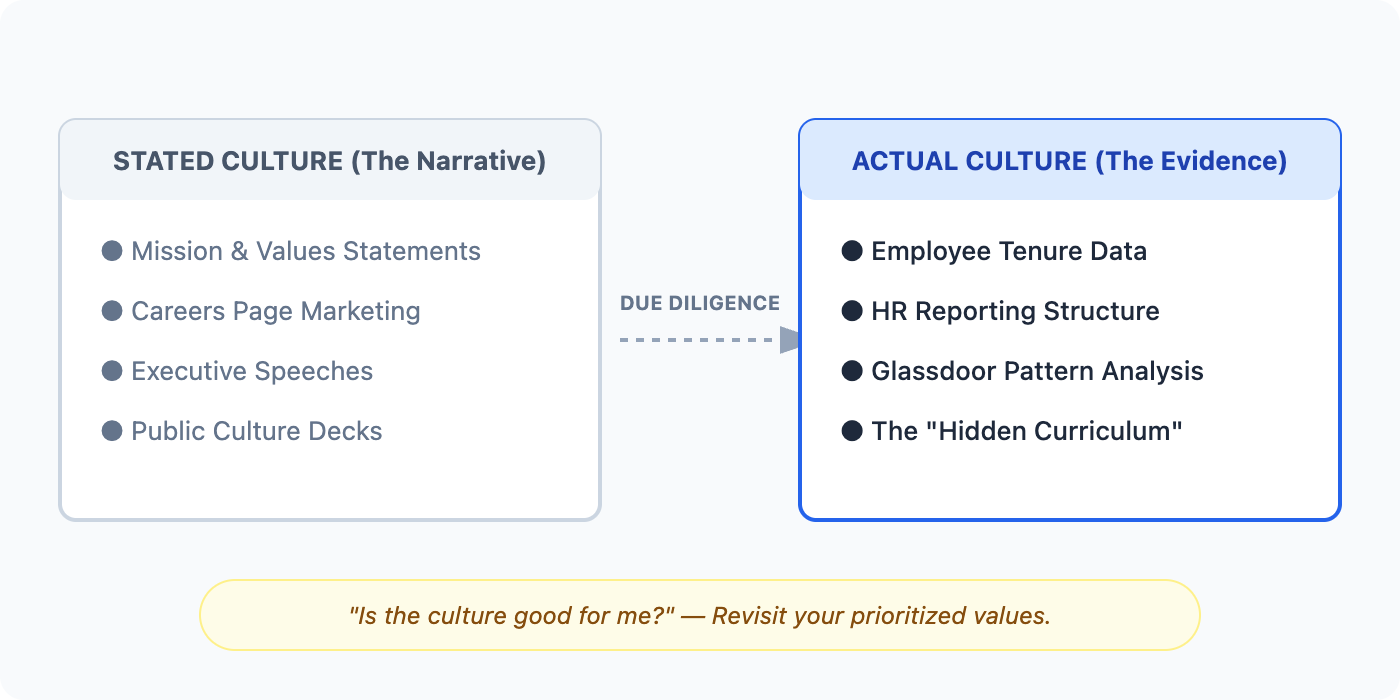
To move beyond marketing, look for behavioral evidence. Glassdoor reviews reveal recurring themes, and LinkedIn tenure data shows if employees actually stay or if there is a "revolving door" in specific departments. For People Managers, pay close attention to the HR function's status: a Chief People Officer who sits on the executive team sends a different message about organizational priorities than an HR department reporting three levels below the CEO.
To see how this kind of investigation plays out in practice, consider this exchange between two People Managers discussing a potential opportunity:
- Natalie: I'm really excited about this Director of People role. Their careers page talks about radical transparency and employee empowerment—it feels like exactly the kind of place I want to lead a team.
- Ryan: That sounds promising on paper. But did you look at the Glassdoor reviews or check the tenure data on LinkedIn?
- Natalie: I skimmed a few reviews. They were mixed, but every company has some disgruntled employees, right?
- Ryan: Sure, but look for patterns, not outliers. When I was researching my current company, I noticed that eight out of ten reviews from HR staff mentioned having no voice in strategic decisions. That was a red flag I almost ignored because the values page sounded so good.
- Natalie: That's a fair point. I did notice the People team there doesn't seem to have anyone at the VP level—HR reports into the CFO's organization.
- Ryan: And that tells you something the mission statement never will. The structure reveals whether they actually treat people strategy as a leadership priority or just say they do.
Notice how Ryan pushes Natalie to move past the appealing language on the careers page and look for structural and behavioral evidence instead. The reporting line of the HR function, the patterns in employee reviews, and the tenure data all paint a more reliable picture than any values statement. This is the discipline that separates surface-level research from genuine cultural due diligence.
The ultimate question is: "Is this culture good for me?" Alignment means the way the organization makes decisions, resolves conflict, and handles failure matches what you need to do your best work.
Assessing Educational ROI: Degrees vs. Certifications
When you encounter education requirements, you must calculate the return on investment (ROI) based on your specific career trajectory. Graduate degrees (MBA, Master's in Organizational Development) require significant time and money ($30,000 to $100,000+). Their ROI is highest when they open strictly closed doors or provide a high-value network essential for executive roles.
Certifications (SHRM-CP, PHR, or specialized data credentials) are faster, cheaper, and more targeted. To decide your path, audit 15 to 20 job postings for your target roles and tally the requirements. If a specific certification is preferred in 80% of postings but a Master’s appears in only 20%, the certification is the higher-leverage investment for immediate advancement. Always weigh the upfront cost against the projected salary uplift and the speed at which you want to transition.
Identifying the "Hidden Curriculum" of Target Companies
Beyond what a company publicly states, there exists a "Hidden Curriculum"—the informal rules, norms, and competencies that are never posted on a careers page but are essential for success. This includes understanding how decisions are truly made and which behaviors are actually rewarded at promotion time.
To uncover these, conduct informational conversations with current or former employees. These dialogues allow you to read between the lines of official policy. Ask probing questions: "What surprised you most about working there in the first six months?" or "How are promotion decisions really made in your department?" Look for structural clues as well: a company that only promotes from within has a different hidden curriculum than a fast-scaling startup where the average VP tenure is two years. Identifying these unspoken rules protects you from joining a role that looks perfect on paper but feels wrong in practice.
Coming up next, you will put these skills to work in a role-play where you evaluate whether a specific credential is the right investment for your goals.
