Reframing Goals as Identity
Reframing Goals as Identity Statements
You've now got a habit mapped into four stages. Before you pick which habit to build, there's one more piece to put in place: what the habit is for. Most people answer that with a number ("read 12 books"), and numbers are surprisingly weak fuel. This unit shows you the swap that makes a habit stick, and how to spot the fake version of it.
Reframing an Outcome Goal into an Identity Statement
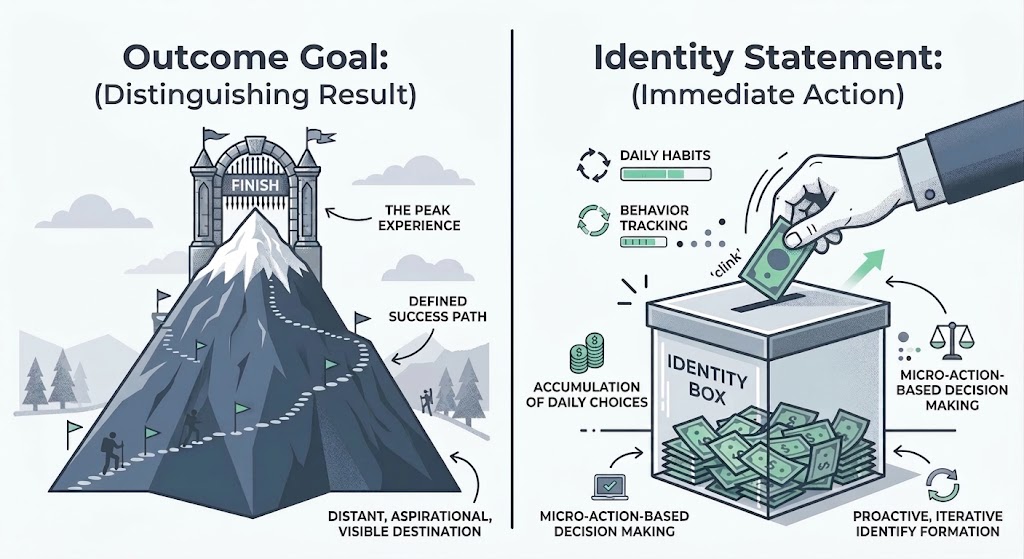
An outcome goal describes a result you don't have yet: read 12 books, lose 20 pounds, protect two hours of focused work a day. It sits in the future and it has a finish line, which means every day before the finish line feels like falling short.
An identity statement describes who you are right now: "I am a reader." "I am someone who protects their attention." Same territory, completely different pressure. Notice what changes when you make the swap. The outcome goal asks you to grind toward something distant. The identity statement asks you to act like the person you already claim to be, today, in whatever small way is available.
Here's the practical move. Take your goal and ask: what kind of person produces this result as a byproduct? Someone who reads 12 books a year is a reader. Someone who gets two focused hours is a person who protects their attention. Then state it in the form "I am a ___." Use the present tense.
The most common near-miss is a goal wearing an identity costume. "I am someone who wants to read more" is a wish, not an identity. "I am someone who will read 12 books" is the same goal with extra words. Strip out "wants to," "will," "is trying to," and "more." If the sentence can't survive that, it wasn't an identity statement.
Designing Small Actions That Cast Credible Votes
Once you've claimed an identity, the question becomes: why would you believe it? You'd believe it the way you believe anything about yourself, through evidence. Every time you perform the behavior, you cast a vote for that identity. Not a decisive vote. One vote. The identity wins by accumulating them.
This is why the actions need to be small and immediate. A vote you can only cast next Monday, or after a purchase arrives, isn't a vote yet. Reading one page tonight is evidence. Buying a book you plan to start eventually is not.
- Dan: My goal was to read 12 books. As an identity, I guess: I am someone who wants to read more.
- Nova: That's the wish, not the identity. Cut "wants to" and "more."
- Dan: I am a reader.
- Nova: Good. So what will you have done by 10 p.m. tonight that proves it?
- Dan: Ordered the book I've been meaning to get to.
- Nova: That's shopping. What would a reader do at 10 p.m. with a book already in the house?
Notice Nova's test: not "is it ambitious," but "will it have happened tonight, and does it count as evidence." That's the whole standard.
Evaluating Whether a Habit Supplies Believable Evidence
Now you can screen any proposed habit with one question: does this supply believable evidence that the identity is already true?
Two failure modes catch most people:
-
- Preparation disguised as action: researching, buying, subscribing, organizing. These feel productive because they cost effort, money, and anticipation. But a new app proves you can install an app. It casts no vote.
-
- A habit that's too vague to count as evidence at all. "Read more in the evenings" leaves you unable to say at bedtime whether you did it. If you can't tell whether the vote was cast, it wasn't.
So ask three things of any candidate: Could I do it today, without buying or arranging anything? Would a stranger watching me say "that person is a reader"? And will I know clearly, tonight, whether it happened? A habit that clears all three is real evidence. Anything else is a plan about a plan.
Here's the takeaway worth holding onto: you're not chasing a result, you're accumulating proof about who you are, and the smallest action you can genuinely repeat tonight beats the impressive one you'll start on Monday.
Next comes a quick sorting exercise where you'll separate true identity statements from the near-misses that are really goals or wishes in disguise. Watch for the words "wants to," "will," and "more" as you go: they're the tell.
