Selecting Your Keystone Habit
Auditing Routines and Selecting a Keystone Habit
You now have an identity statement and a sense of what counts as evidence for it. What you don't have yet is a clear picture of your actual day. Most people pick a habit based on what sounds good, not on what their existing routine can absorb. This unit fixes that: first you'll look at what's already running, then you'll pick one thing to build.
Conducting a Habit Audit Across Morning, Work, and Evening
The Personal Habit Audit is a log, not a judgment. You take three windows of your day (morning, work, evening) and write down every recurring behavior you can spot. For each one, you record four things: the cue that starts it, the response you actually perform, the reward you get from it, and a verdict of serve, undermine, or neutral against the identity statement you claimed.
Do this over a normal day, not an ideal one. And log the small stuff, because the small stuff is what your day is made of: checking your phone before your feet hit the floor, the second coffee at 10:40, the tab you open when a task gets boring, the couch-and-remote sequence at 9 p.m.
The verdict column is where it gets useful. Most behaviors are neutral, and that's fine. What you're hunting for is the handful that quietly undermine the identity you claimed, and the handful that already serve it. Here is how to approach the audit:
- Jessica: Let’s look at your evening. What’s the first thing that happens after dinner?
- Dan: I usually clear the plates, then I head straight to the couch and the TV goes on. I guess the cue is just sitting down.
- Jessica: What do you get out of that? What's the reward?
- Dan: It’s the signal that the day is officially over. But I feel like I'm undermining my goal to be a reader by losing two hours to Netflix.
- Jessica: Don’t worry about fixing it yet. Just log the couch as the cue and "winding down" as the reward. We need an honest map of your routine before we try to change it.
Notice Jessica doesn't ask Dan to change anything yet. An honest cue is worth more right now than a good intention.
Evaluating Options Against the Keystone Criteria
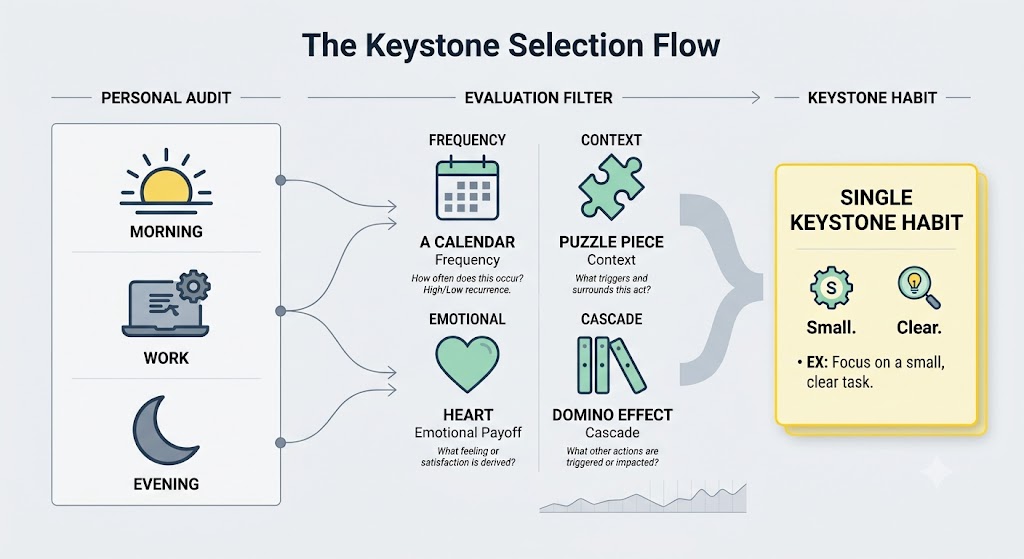
Your audit will surface several habit options. To compare them, evaluate each against the Keystone Criteria:
- Frequency: How often does the cue naturally occur? A cue that fires every single day is superior to one that only fires once a week.
- Context: How easily does the behavior fit into your existing routine? You want a habit that slots in without requiring you to rearrange your entire life.
- Emotional Payoff: How strongly does the behavior satisfy a craving? If a habit feels like a chore with no immediate reward, it likely won't survive the first month.
- Cascade: How many other behaviors does this one improve? For example, laying out your clothes at night (one habit) improves your morning speed, your commute stress, and your professional appearance.
Score each option roughly (low, medium, high) and write one sentence of justification per criterion. "High frequency" means nothing on its own. "High frequency, because the cue is sitting down on the couch, which happens seven nights a week" is a defensible score.
Applying the One-Habit Decision Matrix and Defending the Choice
Using the One-Habit Decision Matrix
The hard part is picking which one. The One-Habit Decision Matrix works in three steps: score each habit against the Keystone Criteria, then weight those scores by clarity and smallness, then select the single highest scorer.
| Habit Option | Impact (Keystone Criteria) | Small & Clear? | Decision |
|---|---|---|---|
| Read 1 page | High | Yes | Build Now |
| 20-min Yoga | High | No | Queue for later |
| Journaling | Medium | No | Queue for later |
Imagine comparing "Read 1 page" against "20-minute workout." Both might have high Frequency and Cascade scores. However, "Read 1 page" wins the matrix because it scores higher on Clarity (it’s binary—you did it or you didn't) and Smallness (you can do it even when you are exhausted).
That weighting step is what separates two habits that look equally good. Clarity means you'll know tonight whether you did it. Smallness means it's so easy that a bad day doesn't beat it. A high-cascade habit that's vague or effortful loses to a modest one you can't fail.
When someone pushes you to start three at once, the defense is arithmetic, not modesty. Three habits split your attention three ways and each one competes for the same limited cue slots and energy, so you lower the odds on all three instead of banking one certain win. Park the runner-ups in writing, with a note that they're queued, not abandoned.
Your day is already full of cues; your job is to claim the best one for the smallest habit you can't fail. Before you finalize your choice, you'll complete a drill matching evaluation questions to the Keystone Criteria. This ensures you can score your options accurately in the memo that follows and defend that choice in your upcoming conversation.
