Mapping The Habit Loop
Mapping the Habit Loop
Last time you learned to ask what starts a behavior. Now you'll take that apart properly, because "what starts it" is only the first of four moving parts. Every habit you have, good or bad, runs through the same four-stage sequence, and once you can name all four in a real behavior of your own, you can see exactly where to intervene.
Identifying Cue, Craving, Response, and Reward
The Habit Loop has four stages, always in this order: Cue, Craving, Response, Reward.
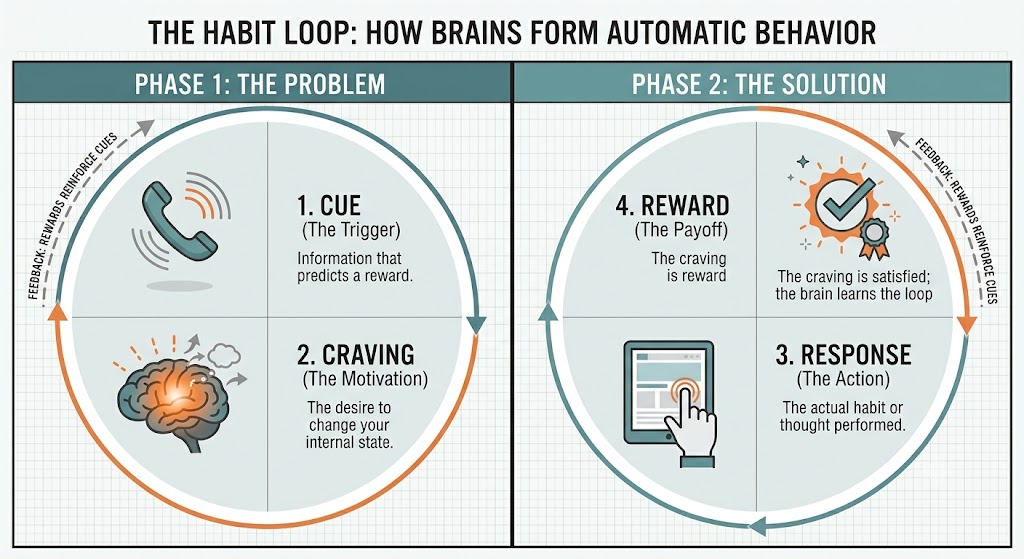
The cue is the trigger that starts the behavior. It's observable: something you could point at on video. Your phone buzzing. Sitting down on the couch. Walking past the kitchen counter.
The craving is the motivational pull that follows the cue. Crucially, you never crave the behavior itself. You crave a change of state: to feel less bored, less tense, more stimulated, more settled. No craving, no action. The cue only matters because of what it predicts.
The response is the behavior you actually perform. Unlocking the phone and opening Instagram. Not "relaxing," not "unwinding": the specific physical thing you do.
The reward is the payoff that satisfies the craving. It does two jobs: it delivers the change of state you wanted, and it teaches your brain that this cue is worth noticing next time. That second job is why the loop repeats. Every time the reward lands, the connection between cue and response gets a little stronger.
Take a simple example. The cue is your laptop pinging with a new email. The craving is relief from the low hum of wondering what it says. The response is switching tabs and reading it. The reward is that the wondering stops. Nothing dramatic, and that's exactly why it happens forty times a day.
Analyzing One of Your Own Recurring Behaviors
Now do it on yourself, and be stricter than feels necessary. Pick a behavior you repeat almost daily, then answer four questions in order: What physically happened in the ten seconds before it started? What change of state was I after? What exactly did I do? What did I get that satisfied the craving?
The mistake almost everyone makes is answering with a story instead of an observation. "I scroll because I'm tired" is a story. "I sat down on the left end of the couch, my phone was on the armrest, and my thumb was moving before I'd finished exhaling" is an observation you can work with.
To see how this distinction works in practice, look at this coaching conversation between Jessica and Dan. Dan is trying to figure out why he spends an hour scrolling every night, but he keeps getting stuck on vague, emotional descriptions rather than observable triggers.
- Jessica: So what's the cue for the evening scrolling?
- Dan: Being tired, I guess. End of a long day.
- Jessica: Tired is a state, not a trigger. What happened in the ten seconds before your thumb moved?
- Dan: I put my plate in the sink, walked into the living room, and sat down. Phone was already on the arm of the couch.
- Jessica: That's a cue. And the craving underneath it, what change of state were you after?
- Dan: Something to fill the gap. The house goes quiet and I don't want to sit in it.
Notice Jessica doesn't accept the first answer. She asks for what a camera would have seen, then separates the trigger from the pull it creates.
Diagnosing the Load-Bearing Stage and the Missing One
Once all four stages are on the page, two diagnostic questions do most of the work.
First, for a habit you want to stop: which single stage is doing the most to keep it alive? Sometimes it's an unmissable cue (the phone in your line of sight). More often it's a reward that lands within a second of the response, which is very hard to beat. Name the load-bearing stage and you know where the leverage is.
Second, for a habit you keep failing to start: which stage is missing entirely? Wanted habits usually fail because there's no cue at all (you're waiting to remember) or no reward you can feel today (reading one page delivers nothing immediate, so nothing teaches your brain to repeat it). A behavior with three of four stages doesn't limp along. It doesn't start.
A habit isn't one thing you either do or don't do—it’s a four-link chain, and you can only fix the link you’ve actually named. In the upcoming practices, you will first complete a matching exercise to differentiate these stages in common scenarios. Then, you'll map one of your own behaviors to find its load-bearing link. Finally, you’ll test your diagnostic skills in a conversation simulation to help a peer debug their own loop.
