Habits Versus Motivation
Welcome to the Course
Most people who fail at a new habit don't fail because they're lazy. They fail because they built a plan that quietly required them to feel motivated every single day, and no one feels motivated every single day. This course teaches you the alternative: designing behavior so it runs on its own, one habit at a time.
By the end of this course, you'll be able to:
- Distinguish a behavior that runs automatically from one that still needs a fresh burst of effort
- Map any recurring behavior onto the four-stage habit loop: cue, craving, response, reward
- Reframe an outcome goal into an identity statement you can cast daily votes for
- Conduct a habit audit across your morning, work, and evening routines
- Select one small, high-leverage keystone habit and defend that choice under pressure
This first unit starts with the most useful distinction in the whole course: the difference between a habit and a decision you keep making over and over.
Telling an Automatic Habit from a One-Off Effort
Here's the test. Ask yourself: did I have to decide to do this?
A habit is a behavior that starts on its own when something in your environment triggers it. You don't debate it. Brushing your teeth before bed, checking your phone when it buzzes, putting your seatbelt on when you sit in the car. Something happens, and the behavior follows. No deliberation, no pep talk.
A one-off behavior is different. It happens because you consciously chose it in that moment, and it will need another conscious choice tomorrow. Going to the gym on a Tuesday because you felt guilty about the weekend is a decision. Doing it again Wednesday is a second, separate decision. Nothing carried over.
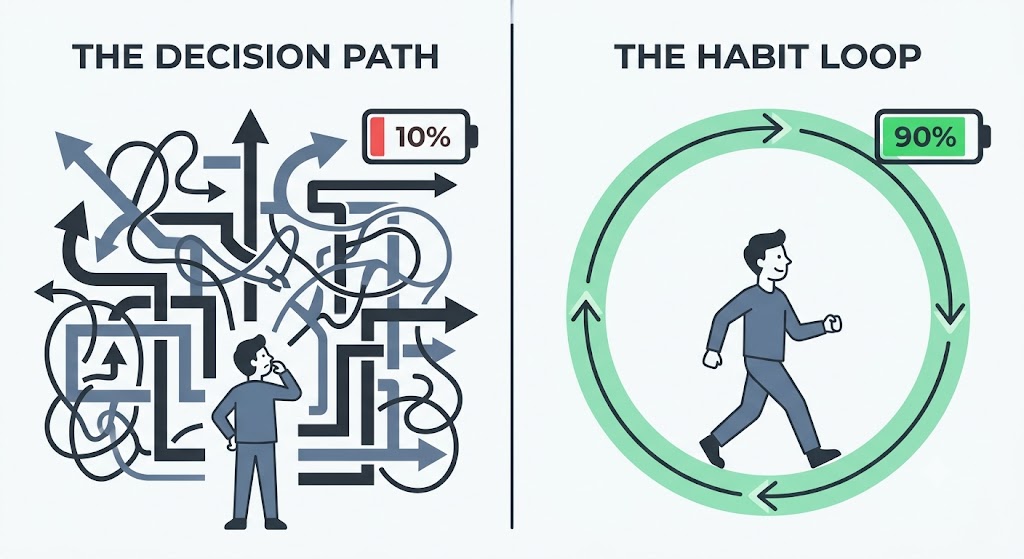
The practical difference is cost. Habits are cheap because your brain has offloaded them. Decisions are expensive, and you have a limited supply of them per day. So when your plan requires ten fresh decisions before 7 a.m., you're not building a habit. You're running an eleven-day sprint on a fuel tank that empties.
Diagnosing Why an Abandoned Plan Kept Demanding Motivation
Now take a plan you've already abandoned. Instead of asking "why did I quit?", trace the plan step by step and mark every point where it needed you to want it.
To understand how this looks in practice, consider this conversation between Dan, who is struggling to make running a permanent part of his morning, and Jessica, who is helping him audit his process.
- Dan: I went for a run four days in a row last week and then just stopped. I feel like I lost my momentum.
- Jessica: Those four days are a great start, but let’s look at the "how." What made you actually get out the door on Monday?
- Dan: I just decided to. I set an alarm and talked myself into it because I want to get fit.
- Jessica: And Tuesday through Thursday?
- Dan: Same thing. I had to convince myself each morning.
- Jessica: That's the core of the issue. You didn't "fail" on day five; you just ran out of the energy required to make a fresh decision. You successfully ran four times, but you were making four separate, high-effort choices. We need to move running from a "choice" you make to a "response" to a trigger so it doesn't feel like a negotiation every morning.
Notice what Jessica is doing. She isn't discrediting Dan’s four-day streak; she’s identifying that the behavior was still running on "decision fuel" rather than "habit automation."
Do this concretely for your own plans. A 6 a.m. gym plan looks like one behavior, but it's a chain: the alarm goes off, you decide whether to get up, you find your clothes, you locate your gym bag, you decide whether to eat first, you drive, you park, you choose what to do inside. Each of those links either runs on its own or asks for a fresh push. Most plans fail at the very first link, because the trigger is an alarm you can silence rather than something that already reliably happens.
That's the diagnosis you want: not "I lack discipline," but "three specific links in this chain required conscious effort every morning, and no part of the plan was attached to anything that already happens in my day." That verdict is useful, because you can redesign a chain. You can't redesign a character flaw.
Making the Case for Systems over Willpower
Sooner or later someone will tell you this is all overthinking, that you just need to want it more. Here's how to answer without insulting their motivation.
Start by granting the point: motivation is real and it works. It's just unreliable, and unreliable inputs produce unreliable outputs. Then get concrete about the three things you can change instead:
- The Cue: Ensure the behavior is triggered by something that already happens without fail (e.g., "After I pour my first cup of coffee, I will...")
- The Access: Reduce the friction so the desired behavior takes fewer steps than the competing one (e.g., putting running shoes by the door or charging your phone in another room).
- The Routine Design: Make the behavior small enough to survive your worst day, so it doesn't require a peak emotional state to complete.
When explaining this to others, argue from your own failure, not from theory. If you say, "Research shows willpower is a finite resource," you sound like you're lecturing. If you say, "I realized I quit my running plan on day eleven because I was forcing myself to find my socks in the dark, and that one tiny bit of friction was enough to make me give up," you are providing a relatable, mechanical explanation. This makes the conversation about solving a friction problem rather than judging someone's character.
The takeaway to hold onto: a habit is defined by what triggers it, not by how badly you want it.
Next, you'll head into a series of practices to sharpen this skill:
- A Self-Check Quiz to see if you can distinguish between automatic habits and effort-driven decisions.
- A Writing Exercise where you will audit a past failed plan to find the broken "links."
- A Conversation Simulation where you'll practice explaining the "systems over willpower" approach to a skeptical friend.
