Structuring Brand Guidelines
Structuring the Brand Guidelines Manual
By now you've made every individual decision: the visual system, the strategic color and type choices, the logo protections, and the voice standards. The problem is they live in scattered places, a strategy deck here, a color spec there, a Slack thread where you finally settled the voice. A teammate who needs to ship a landing page by Friday can't go hunting through five files to find them. This unit is about pulling all of it into one manual that anyone can open and execute from without you in the room.
Building the Core Sections Every Guide Needs
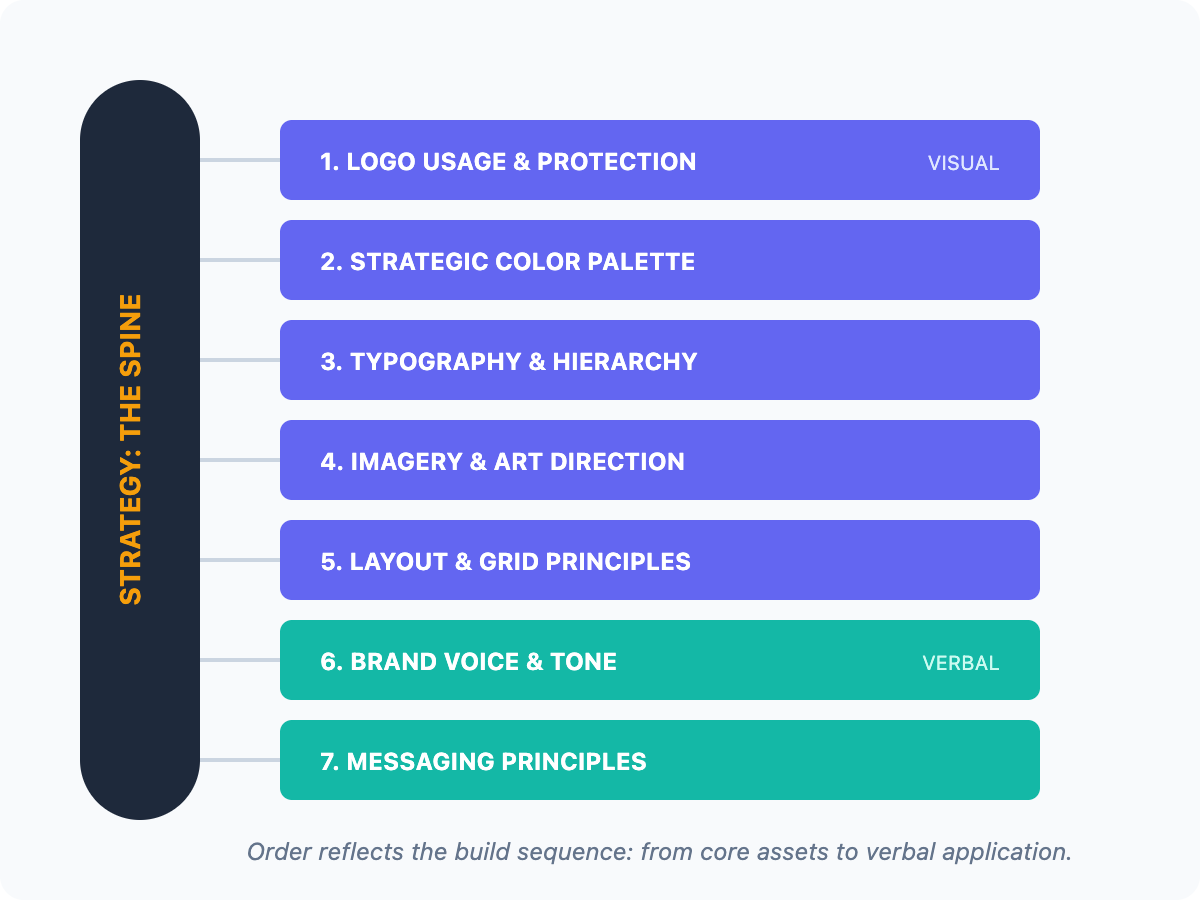
Every usable guide is built from the same backbone, the Brand Guidelines Core Sections: logo usage and protection, color palette, typography, imagery style, layout principles, brand voice and tone, and messaging principles. The first five govern how the brand looks; the last two govern how it sounds. Ordering matters here. Start with the logo, because it's the most-handled asset and the first thing a designer reaches for, then move outward through color, typography, imagery, and layout, which roughly follows the order in which someone actually builds a page or a piece of packaging. Voice and messaging close the manual, since copy usually gets written into a layout that already exists.
 The test of completeness is simple. Open the manual against any real touchpoint and ask whether it answers every question that touchpoint raises. A single social post needs the logo's minimum size, the palette, the type, the imagery style, and the voice. If your guide can't answer even one of those, it has a gap, and a gap is exactly where off-brand work slips through.
Synthesizing Standards Into One Coherent System
A common failure is a manual that's really just a stack of assets bolted together: a color page here, a logo page there, with nothing connecting them. The fix is to make the strategy visible at the top and let it run through every section. Open with the positioning and personality you established earlier, then write each visual and verbal rule as an expression of it, so the reader sees not only what the rule is but why it exists.
- Natalie: I've got the color page and the voice page done, but side by side they read like two different documents.
- Chris: What's at the top of each one?
- Natalie: Hex codes on one, do's and don'ts on the other.
- Chris: That's the gap. Put the personality line above both, then write each rule as proof of it. The blue is there because we're competence-led; the calm voice is there for the same reason.
- Natalie: So the strategy is the spine, and every section just hangs off it.
Notice that nothing about the rules changed; what changed is that each one now points back to the same strategic reason. So when your color section says the palette leads with a calm blue, the line on the page is "because our personality is competence and our promise is hassle-free," not "because it looks clean." That through-line is what turns seven sections into one system, and it lets a reader make a sound call on a situation your manual never anticipated.
Coaching Others to Apply the Guidelines
A manual only protects the brand if people actually use it, and most won't read it cover to cover. So your job doesn't end at writing it; it extends to teaching teammates and vendors to reach for it. When someone asks you a question the manual already answers, resist just handing over the answer. Point them to the exact section instead, so next time they check it themselves. That single habit is what scales consistency beyond you.
The biggest risk with external vendors is the confident assumption, the designer who "figures a brighter accent will pop on shelf" and quietly breaks the palette. Head it off by walking them through which sections govern their project before they start, and showing them how to self-check against each one. A vendor who learns to verify their own work saves you a review cycle and saves themselves a reprint.
A guidelines manual earns its keep when it's complete, when the strategy threads through every section as the reason behind each rule, and when the people using it can self-check without you. Next you'll lock in the core sections from memory in a quick recall check, then draft the structure and contents of a manual you could actually hand to leadership, and finally coach a vendor live through applying it. Start practicing the core move now: whenever you write or explain a rule, say its strategic reason in the same breath.
