Defining Leadership Promises
Defining Your Leadership Promises
You left the last unit with five excavated values and an honest list of where you don't yet live them. Here's the uncomfortable next question: a values list isn't a philosophy. Values tell people what you care about. A philosophy tells people what they can hold you to. The difference is whether your words make a promise specific enough to be broken.
Distinguishing Purpose, Values, Standards, Boundaries, and Growth Edges
So why isn't a clean list of values enough? Because "what I stand for" is only one of five questions a real philosophy answers, and it's the easiest one. The Leadership Philosophy Canvas forces the other four into the open: Purpose (why I lead at all), Values (what I stand for), Standards (the bar I hold), Boundaries (what I will not do), and Growth Edges (where I'm still developing).
Each does different work, and that's the point of separating them. Your Purpose answers "why lead at all," and it has to be yours: "to drive impact" could belong to anyone, which means it belongs to no one. Standards are observable bars, not feelings, the quality line you won't drop for yourself or the team. Boundaries are the lines you won't cross even when crossing them would be easier or more rewarded. Growth Edges are the one or two things you're genuinely still bad at, named without the humble-brag.
Notice which two managers skip. Almost everyone writes fluent Values. Almost no one writes a real Boundary or an honest Growth Edge, because those are the only two that cost something to put in writing. A value tells your team what to expect when you're at your best. A boundary tells them what to expect when you're under pressure. That second promise is the one they actually need.
Drafting a Concise Leadership Philosophy
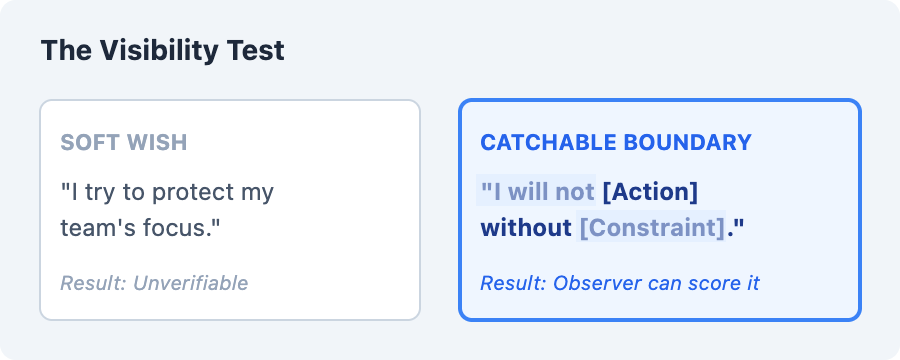
To make your philosophy actionable, you must distinguish between a Soft Wish and a Catchable Boundary:
- A Soft Wish is a vague, aspirational statement. It uses "safe" language like "I try to," "I aim to," or "I value." Because it lacks a specific threshold, it’s impossible for anyone to hold you accountable to it.
- A Catchable Boundary is a binary commitment. It defines a specific action or constraint that is observable by others.
The bridge between the two is the Visibility Test: Can a third party, without reading your mind, point to a specific moment where you either kept or broke this promise? If the action isn't visible to an outside observer, it's a wish; if they can "catch" you doing it or not doing it, it’s a boundary.
The draft is one page, and the audience is real: your team and your skip-level, not your journal. That constraint changes everything, because journal language ("I aspire to create a culture of belonging") dies on contact with people who watch how you actually behave. Carry the Values-to-Behavior translation through here: each value gets what it looks like, what it does NOT look like, and a visible habit.
Apply one test to every line: would your skip-level read this and recognize a specific human, or could any competent manager have written it? If it's the latter, it's still borrowed. Watch the Boundaries section hardest, because that's where drafts go soft. "I try to protect my team's focus" is not a boundary; it's a hope. "I will not commit my team to new scope without telling them why" is a boundary, because someone could catch you breaking it.
Inviting a Peer to Challenge Your Draft
Here's the problem you can't solve alone: you wrote the borrowed lines, so they sound true to you. You need a peer you trust, told explicitly to be ruthless, to catch what your own ear can't. The frame matters: ask for the real notes, not the polite ones.
- Jake: This boundary, "I try to protect my team's focus." That's not a boundary, that's a wish.
- Natalie: What do you mean? I do protect their focus.
- Jake: "Try to" means you'll bend it the first time a VP leans on you. What won't you do, no matter who's asking?
- Natalie: I won't commit my team to new scope without telling them why first, even when the VP is the one asking.
- Jake: That one I could catch you breaking. The first one I couldn't.
Watch what Jake did: he never argued that Natalie doesn't care about focus, he just made the line catchable. When a peer flags something, resist the three reflexes: explaining what you meant, re-polishing into fresh jargon, or conceding fast to end the discomfort. Instead, ask what they heard, sit with it, and either defend with a concrete example or rewrite it plainer on the spot.
The takeaway of this unit is simple and hard: a philosophy is only real where it can be broken, and Boundaries are where that gets tested. A few practices sit ahead. First a quick sort to check that you can tell a Standard from a Boundary from a Growth Edge, then you'll draft the one-page philosophy you could actually hand your team, and finally you'll walk it past a peer whose job is to find the borrowed lines. So before any of that: which line in your draft could a direct report actually catch you breaking, and which ones are just wishes?
