Aligning Philosophy with Decisions
Aligning Philosophy with Decisions
A philosophy reads beautifully on a page. The question this unit forces is simpler and harder: what happens when it costs you something? You've drafted your purpose, your values, your boundaries. None of that gets tested when the choices are easy. It gets tested the day two of your own values point in opposite directions and no option honors both. That's not a flaw in your philosophy. That's the moment it either does real work or turns out to be decoration. So here's the uncomfortable frame to carry through: a philosophy you've never had to pay for, you don't actually have yet.
When Two Values Collide
When you imagine "living your values," you probably picture a clean choice between the right thing and the easy thing. Real management rarely offers that. The hard calls are value against value: speed against fairness, one person's growth against the team's focus, transparency now against stability this week.
So evaluating alignment isn't a yes/no test of "does this honor my philosophy." It's asking which value the choice honors, which one it sacrifices, and whether you can live with that trade in the open. A decision is aligned not when it satisfies every value at once, but when you can name the value you're setting down and own that you set it down. The failure mode to watch for is the manager who insists the call somehow serves all their values. That isn't alignment. That's rationalization, and your team can smell it from across the room.
Running the Decision Alignment Check
This is where the analytical tool earns its place. The Decision Alignment Check gives you five moves to run before you commit. First, clarify the decision: what exactly are you deciding, and by when? Vague decisions produce vague rationalizations. Second, identify the affected stakeholders, including the easy-to-forget ones: your director, your future credibility, the person who isn't in the room. Third, name the value tension explicitly and in your own words, something like "developing this person" against "protecting the deliverables we already committed." Fourth, choose the action decisively, not a hedge that just defers the cost to later. Fifth, explain how the choice aligns with your philosophy, quoting your own stated values and boundaries, including the one you're knowingly trading away.
The whole exercise has one honest test. If you have to bend your philosophy to justify the action, then either the philosophy is wrong, the action is wrong, or you haven't been straight about the tension. A real philosophy can survive being applied to a hard call. A borrowed one can't.
Anchor, Not Shield
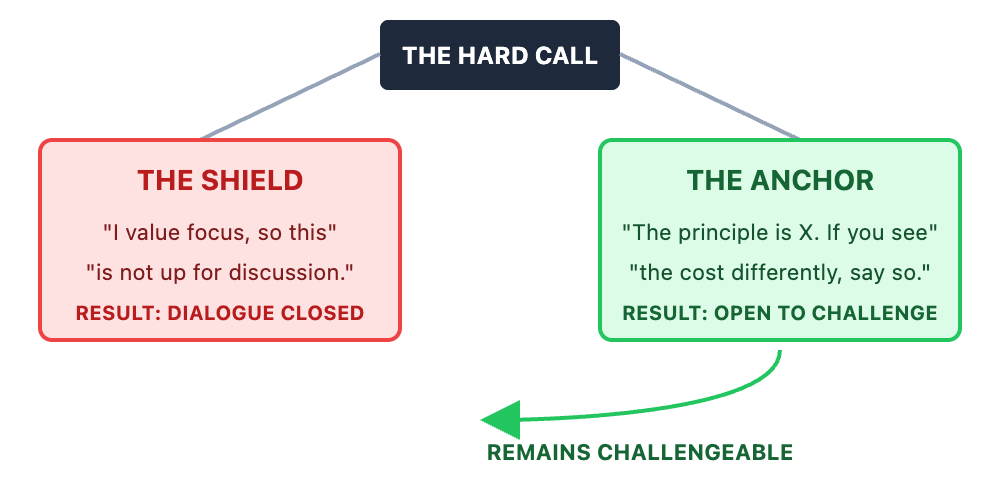 Running the check privately is only half the job. The other half is saying it out loud to the person who pays the cost. Here the danger is subtle: the same philosophy that clarifies your reasoning can quietly become a weapon. Used as an anchor, it shows the person the principle behind the call and stays open to challenge. Used as a shield, it ends the conversation: "I value team focus, so this isn't up for discussion." Same words, opposite move.
To see this distinction in action, consider how Jake handles the friction that follows a high-stakes refusal. When a leader cites their philosophy to a colleague, they are either inviting a deeper look at the trade-off or signaling that the case is closed. In the following exchange, notice how Jake uses his philosophy to provide a clear rationale without turning it into a conversation-stopper.
- Milo: So you turned down the exec workstream. That was the visible one.
- Jake: I did. I want to be straight about why: taking it would've blown the two deliverables we already committed, and "we don't quietly break commitments to chase exposure" is a line I'm not willing to cross this quarter.
- Milo: That sounds like you've decided, and you're telling me the principle so I can't push back.
- Jake: Fair. I'm not closing the conversation. If you think the exposure matters more than protecting those commitments, say so and we'll actually weigh it. The principle is where I started, not where I'm hiding.
Notice the tell: the anchor names the value and the cost and leaves the door open; the shield names the value precisely to shut the door.
The takeaway of this unit is sharp: a philosophy proves itself in the trade-off you'd rather not name, and saying the cost out loud is what separates an anchor from an excuse. Three practices follow: a quick read on whether a stated philosophy actually matches a hard call, then a memo where you run the Decision Alignment Check on a real trade-off of your own, then the live conversation where you deliver that call to the person it costs. So before any of it, sit with this: which of your values would you genuinely set down under pressure, and would you be willing to say so to the person who loses?
