Catch Your Inner Narrator
🎙️ Catching Your Inner Narrator
In the last lesson, you separated honest optimism from forced cheer and mapped out why the reps are worth it. Now you'll turn inward, to the running voice in your head that narrates events before you've had a chance to think. That narrator is fast, opinionated, and often unfair, and it can shape a whole afternoon before you notice it spoke. This lesson is about catching it in the act.
In this lesson, you will learn to:
- Name the four common thinking traps and spot which one is firing.
- Catch a harsh automatic thought and restate it fairly before you act on it.
- Freeze a charged moment in a three-part Self-Talk Snapshot.
🪤 Spotting the Four Thinking Traps
Your inner narrator is the instant commentary that fires the moment something happens: a curt reply, a meeting moved without warning, a number that came in low. The trouble is that it tends to fall into the same few ruts, called thinking traps. Learning their names makes them easier to spot, the same way you notice a pothole faster once someone has pointed it out.
There are four worth knowing:
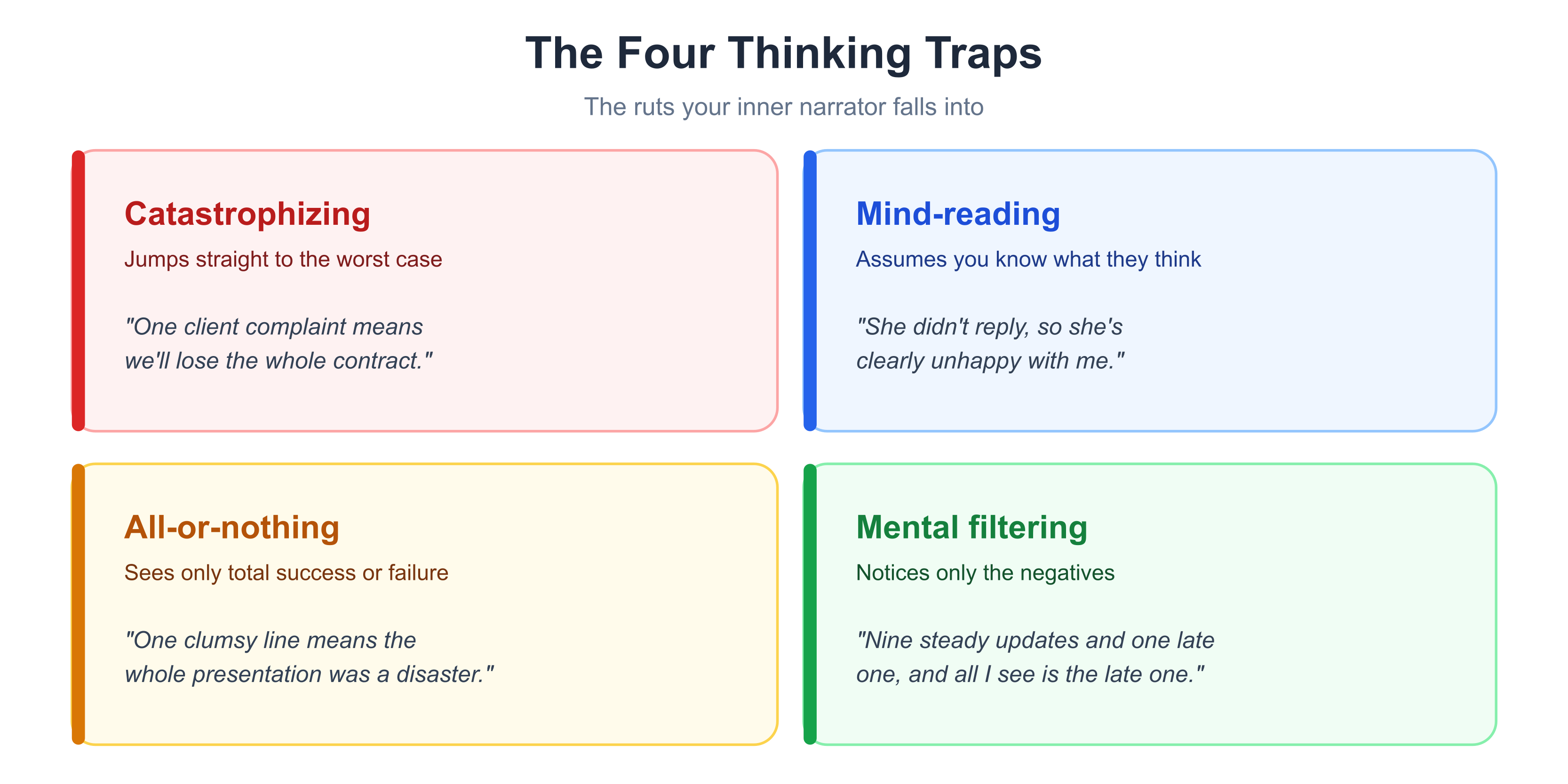
- Catastrophizing jumps straight to the worst case: one client complaint becomes "we're going to lose the whole contract."
- Mind-reading assumes you know what someone thinks: your director didn't reply, so "she's clearly unhappy with me."
- All-or-nothing sees only total success or total failure: one clumsy line in a presentation means "the whole thing was a disaster."
- Mental filtering notices only the negatives: nine steady updates and one late one, and all you can see is the late one.
Each trap follows the same shape: a trigger sets it off, the narrator produces a harsh line, and that line creates an effect on how you feel and what you do next. Picture a late status update landing in your inbox — that's the trigger. Mental filtering locks onto it and the narrator says, "this project is falling apart" — that's the line. Within minutes you're firing off tense messages the facts never warranted and the team's afternoon sours — that's the effect. Seeing the whole chain, trigger → line → effect, is the first real skill here, because once you notice it running you can break it at any point.
✋ Catching the Reaction Before You Reply
Here is the move that matters most: you catch the harsh first thought and say it out loud (or write it down) before you act on it. Naming it slows the whole thing down. The thought stops being invisible truth and becomes just a sentence you can look at, question, and restate more fairly.
That move has a name worth remembering: the Catch and Restate method. It runs in three quick steps:
- Catch the automatic thought and say it out loud or write it down, exactly as it fired.
- Name the trap it fits, so you can see it is a story rather than a fact.
- Restate it into a fairer read that still takes the situation seriously, and let that version drive your reply.
Let's watch that play out. Ryan is a positivity coach, and Meredith has just been stung by a blunt note from her regional director:
- Meredith: The regional director just replied, "This deck misses the point. Redo it." My gut said, "I'm going to lose this account."
- Ryan: Okay, that's the story your brain wrote in a split second. What did the email actually say?
- Meredith: That the deck misses the point and he wants a redo. Nothing about the account.
- Ryan: Right. So "I'm going to lose this account" is the worst case, not the fact. What's a fairer read?
- Meredith: He wants a clearer version by end of day. Annoying, but doable.
Notice that Meredith didn't argue the feeling away or pretend the note was pleasant. She simply separated what actually landed in her inbox from the story she stacked on top of it. That's the catch and restate move: name the automatic thought, spot which trap it is (here, catastrophizing), then restate it into something that still takes the feedback seriously but fits the facts. The restated version is what should drive your reply, not the panic that arrived first.
📸 Freezing the Moment with a Snapshot
Catching a thought in real time is hard at first, so it helps to freeze the moment on paper. A Self-Talk Snapshot is that same trigger → line → effect chain from earlier, written down after the fact when the moment moved too fast to catch live. You capture all three by recording the automatic thought word for word, however ugly. You're not fixing anything yet, just taking an honest photograph of what happened.
Resist the urge to tidy the thought up right away, because capturing it accurately matters more than making it sound composed. If you smooth the thought into something reasonable too soon, you lose the real pattern, and the pattern is what makes the trap catchable next time. A snapshot that reads "trigger: email calling my report 'sloppy'; thought: 'everyone thinks I'm careless'; effect: stomach drop, avoided replying for an hour" is far more useful than a tidy "I felt a bit off." The specifics are the point.
The heart of this lesson is simple: your first thought is a story, not a fact, and once you can name it you get to choose whether to act on it. Up next, you'll put this into practice: first a quick matching exercise to link narrator lines to their traps, then a live conversation where you catch a harsh reaction before it drives your reply, and finally a written Self-Talk Snapshot of a real moment of your own.
