Reframing Setbacks Into Action
🔄 Reframing Setbacks into Fair Next Steps
Last lesson you learned to catch your inner narrator: to notice the harsh first thought and name it before it drove your reply. But catching a thought and then just sitting with it doesn't help much on its own. This lesson gives you the move that comes next, a simple three-step reframe that turns a caught thought into a fairer read and, more importantly, into one small thing you can actually do.
In this lesson, you will learn to:
- Run the three-move Catch-Check-Choose reframe on an everyday setback.
- Split what's confirmed from what's only assumed, so a setback shrinks to its real size.
- Land on a fairer thought that ends in one doable step you can take today.
🎣 Catch, Check, Choose: The Three-Move Reframe
The tool here is called Catch-Check-Choose, and it does what it says:
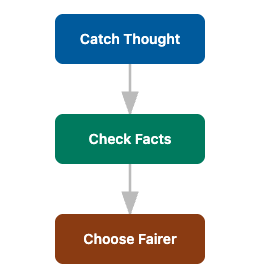
- Catch the automatic thought as it fires, the skill you already practiced.
- Check it against the facts by asking two plain questions: Is this fair? Is it 100% true?
- Choose a fairer, more helpful thought, one that still feels believable and points you toward a next step.
The reason it works is that it never asks you to lie to yourself. This isn't the forced cheer you learned to avoid back in the first lesson, the reflexive "it's all fine!" A good reframe names the hard thing honestly and still finds a foothold. Here's the shape of it in a quick coaching moment. Marcus is a positivity coach, and Victoria manages a branch that just had a staffing request bounced by head office:
- Marcus: I heard head office turned down your staffing request for now. That's a tough one to sit with.
- Victoria: My first thought was, "They don't trust how I run this branch."
- Marcus: Okay, you caught it. Is that 100% true, or the worst-case version?
- Victoria: Honestly, the note just said "revisit next quarter with updated numbers." Nothing about trust.
- Marcus: So what's a fairer read that still takes it seriously?
- Victoria: They want stronger numbers before they approve. I can pull the overtime data and resubmit Friday.
Notice Victoria didn't talk herself out of caring. She still wants the hire. She just swapped a story ("they don't trust me") for a read that fit the facts and handed her something to do.
🔍 Separating Confirmed Facts from the Harsh Story
The middle move, Check, is where most of the work happens, and the trick is to split what's confirmed from what's assumed. When a setback hits, your narrator blends the two together so fast they feel like one thing. Pulling them apart is what makes the difference.
Try it literally. Draw a line down the middle and ask, "What do I actually know for sure?" A late handoff gives you real facts on one side and free stories on the other:
| ✅ Confirmed | 💭 Assumed |
|---|---|
| The data is one day late | "The whole project's a disaster" |
| The review is tomorrow morning | "We'll get blamed" |
| The owner sent no explanation | "The client will walk" |
Everything in the right-hand column is a story your brain added for free. It might turn out to be true, but right now it's a guess wearing the costume of a fact. Once the confirmed column sits next to the assumed column, the setback usually shrinks back to its real size, which is smaller and far more manageable than the story claimed.
🧭 Choosing a Fairer Thought That Leads Somewhere
A reframe isn't finished until it points at an action. The Choose move has two jobs: it has to be believable, and it has to hand you one manageable next step, something small enough to do today. "Everything's fine" fails both tests. "The data's late, so I'll message the owner for an ETA and draft the review with placeholders" passes both. It respects the real problem and gives you momentum you can feel before the day ends.
A short journal entry is one of the simplest ways to practice this. A few ground rules keep it useful:
- Write the setback down in plain language, then run Catch, Check, Choose on it line by line.
- Be specific about what you actually know versus what you're only assuming.
- End every entry with one concrete next step, not a generic "just think positive" note.
If something ever feels genuinely heavy, take it to a trusted person instead.
The one idea to carry out of this lesson is this: a fair reframe names the hard thing honestly and still ends on one doable step.
Up next, you'll put this into practice: first filling in the missing moves to lock the framework in, then helping a teammate sort what's confirmed from what's only assumed after a late data handoff, and finally writing your own reframe into a short journal entry.
