Choosing Honest Optimism
📣 Welcome to the Course
Welcome to Build Positivity That Feels Real! As a manager, your mood sets the weather for the whole floor. When a target slips or a blunt email lands, your team reads your face before they read the numbers, and the energy you carry back into the room shapes how fast everyone recovers. This course is about building a kind of positivity that stays honest and useful under real pressure, not the forced cheer that makes people quietly roll their eyes.
This first lesson starts at the foundation: what honest optimism actually is, why it is a skill you can train, and the personal payoffs that make the reps worth it.
In this first lesson, you will learn to:
- Tell the difference between honest optimism and forced or toxic positivity in everyday moments.
- Make the case that positivity is a trainable skill, not a fixed personality trait.
- Map the personal payoffs that make the daily reps worth it.
🌤️ Honest Optimism vs. Forced Cheer
Picture a Monday where a key hire just resigned and your quarterly forecast is wobbling. One version of you says, "It's all good, stay positive, it'll sort itself out!" and moves on. Another version says, "Losing her stings, and the forecast is genuinely tight. What's one thing we can try this week?" Both sound upbeat. Only one is honest.
That second version is healthy optimism: it names the hard thing out loud, stays hopeful, and picks a next step. The first is forced positivity (sometimes called toxic positivity): it denies or dismisses the real feeling in the room, which quietly tells your people that their worry isn't welcome here. When you paper over a problem with cheer, you shut down the very honesty and problem-solving you need most.
The two are easy to mix up because both sound upbeat. The difference is what they do with the hard thing:
| ❌ Forced Positivity | ✅ Honest Optimism | |
|---|---|---|
| The hard thing | Denies or skips it | Names it out loud |
| The feeling | "Don't worry, it's fine" | "That stings, and it's real" |
| The next move | Move on, hope it sorts itself | Pick one concrete step |
| The message to your team | Your worry isn't welcome | We can face this together |
Let's see the honest version in action. Jessica is Milo's manager, checking in after the team missed its sales target two months running:
- Milo: We missed the number again. I don't even want to open the dashboard.
- Jessica: Yeah, missing it twice in a row is rough, no getting around that. But we do know what dragged it down this time.
- Milo: ...the delayed shipments, mostly.
- Jessica: Right. So that's one thing we can actually chase. Want to start there first thing tomorrow?
- Milo: Okay. That feels doable.
Notice what Jessica never said: "don't worry" or "it's fine." She named the rough part, then pointed to one concrete move. That gap, between dismissing the feeling and facing it while staying hopeful, is the whole difference.
💪 Positivity Is a Skill You Build
Here's a belief worth challenging early: the idea that some people are "just naturally positive" and the rest of us aren't. It feels true, because you can probably name the naturally cheerful person on your team. But treating optimism as a fixed trait lets you off the hook, and it's simply not how it works.
Positivity behaves more like a muscle than an eye color. It gets stronger with small, repeated reps and weaker when you never use it. You don't build it with one big pep talk or a motivational poster in the break room. You build it with tiny, repeatable habits:
- Naming one good thing while your coffee brews.
- Catching a harsh thought before it drives your reply.
- Crediting a teammate for real effort instead of rushing past the win.
That reframe matters for you as a general manager, because it means the calm, steady presence you admire in others is trainable, not inherited. And it means the person on your team who says "that's just not who I am" isn't stuck. They just haven't done the reps yet. Everything in this course is one of those reps.
🗺️ Mapping the Payoffs
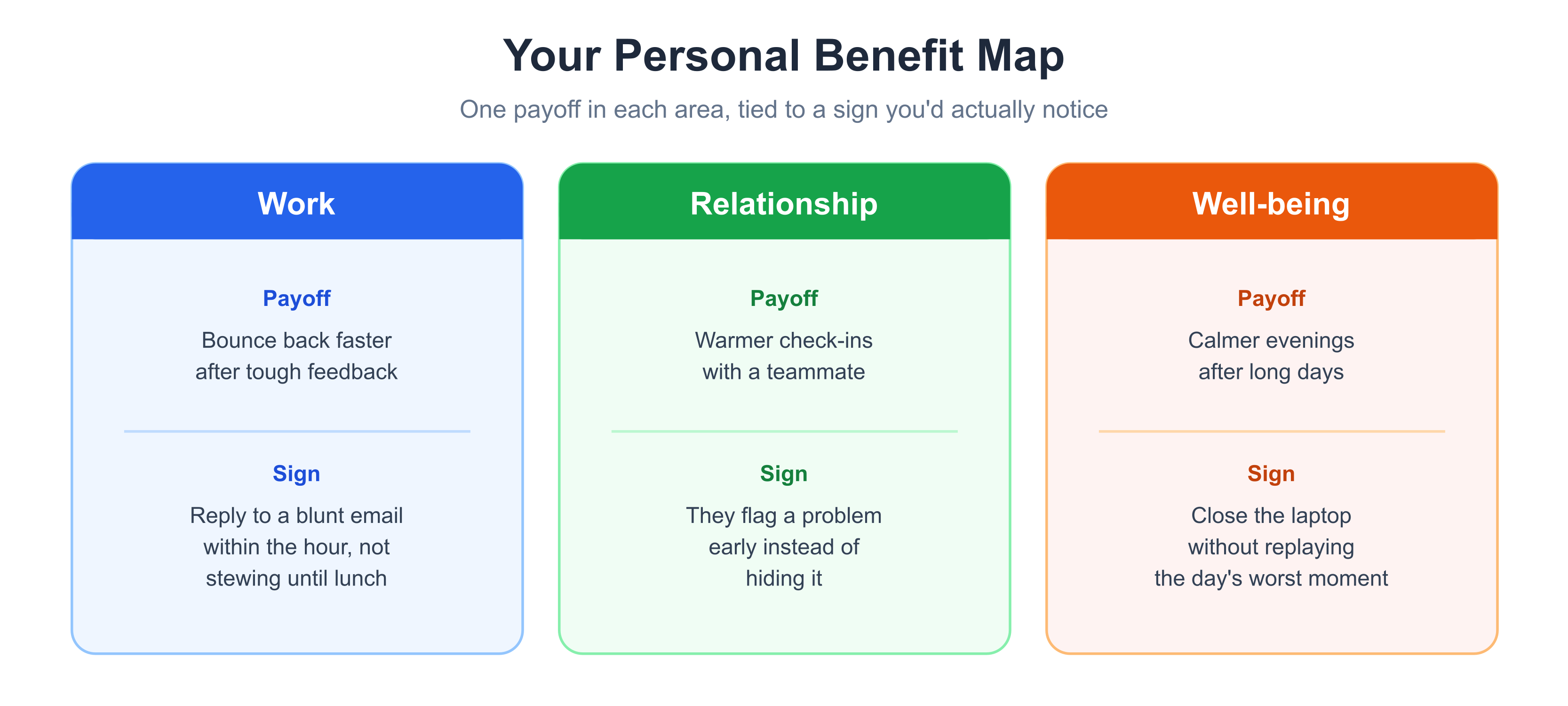
Reps only stick when the payoff feels real to you, so it's worth pinning down what you personally get out of this. A useful tool is a simple personal benefit map: one payoff at work, one in a relationship, one for your own well-being, each tied to an everyday sign you'd actually notice.
Keep each one concrete:
- At work, the payoff might be bouncing back faster after critical feedback, with the sign being that you reply to a blunt email within the hour instead of stewing until lunch.
- In a relationship, it might be warmer check-ins with a teammate, shown by them volunteering a problem early rather than hiding it.
- For well-being, it might be calmer evenings, visible in you closing the laptop without replaying the day's worst moment.
Skip vague hopes like "I'll be happier." A sign you can observe is what tells you the habit is paying off.
Honest optimism, then, is not pretending the hard thing away. It's naming reality, staying hopeful, and moving one step forward, and it's a skill you strengthen on purpose. You'll rehearse these moves in everyday peer moments first, a skeptical teammate or a blunt email, so the habit is steady before you're modeling it for the whole floor. Up next, you'll put this into practice: first a quick self-check to spot honest optimism versus forced cheer in the wild, then a live conversation where you make the case that positivity is trainable, and finally your own benefit map to write.
