Using Index Notation
Introduction
Welcome back to Breaking Numbers Into Primes! This is our fourth and final lesson in the course, so we are about to cross the finish line together. Over the past three lessons, we learned what prime factorisation means, built factor trees to split numbers into primes visually, and used repeated division to peel off prime factors one at a time in a tidy column. Every one of those techniques left us with a product of primes written out in full — for instance, for . Today, we learn a cleaner way to write that result using index notation (also called exponent notation), and we will practise moving back and forth between the two forms with ease.
Why a Shorter Notation Helps
Writing out every single prime factor is perfectly correct, but it can get long. For a number like , listing is manageable. But imagine a number whose factorisation contains six s, three s, and two s — writing all eleven factors in a row becomes tedious and hard to read at a glance.
Index notation solves this by grouping identical primes together and using a small raised number to say how many times each prime appears. It is like switching from spelling out "two, two, two, two, two, two" to simply saying "six twos." The meaning is identical; only the packaging is more compact.
You have likely seen this shorthand in other contexts already. Scientists write instead of , and computer engineers describe memory sizes using powers of like . The same idea applies here: whenever a factor repeats, an exponent keeps our work tidy and readable.
What Index Notation Looks Like
In index notation, each group of repeated prime factors is written as a base raised to an exponent (also called an index or power). The base is the prime itself, and the exponent tells us how many times that prime is multiplied by itself.
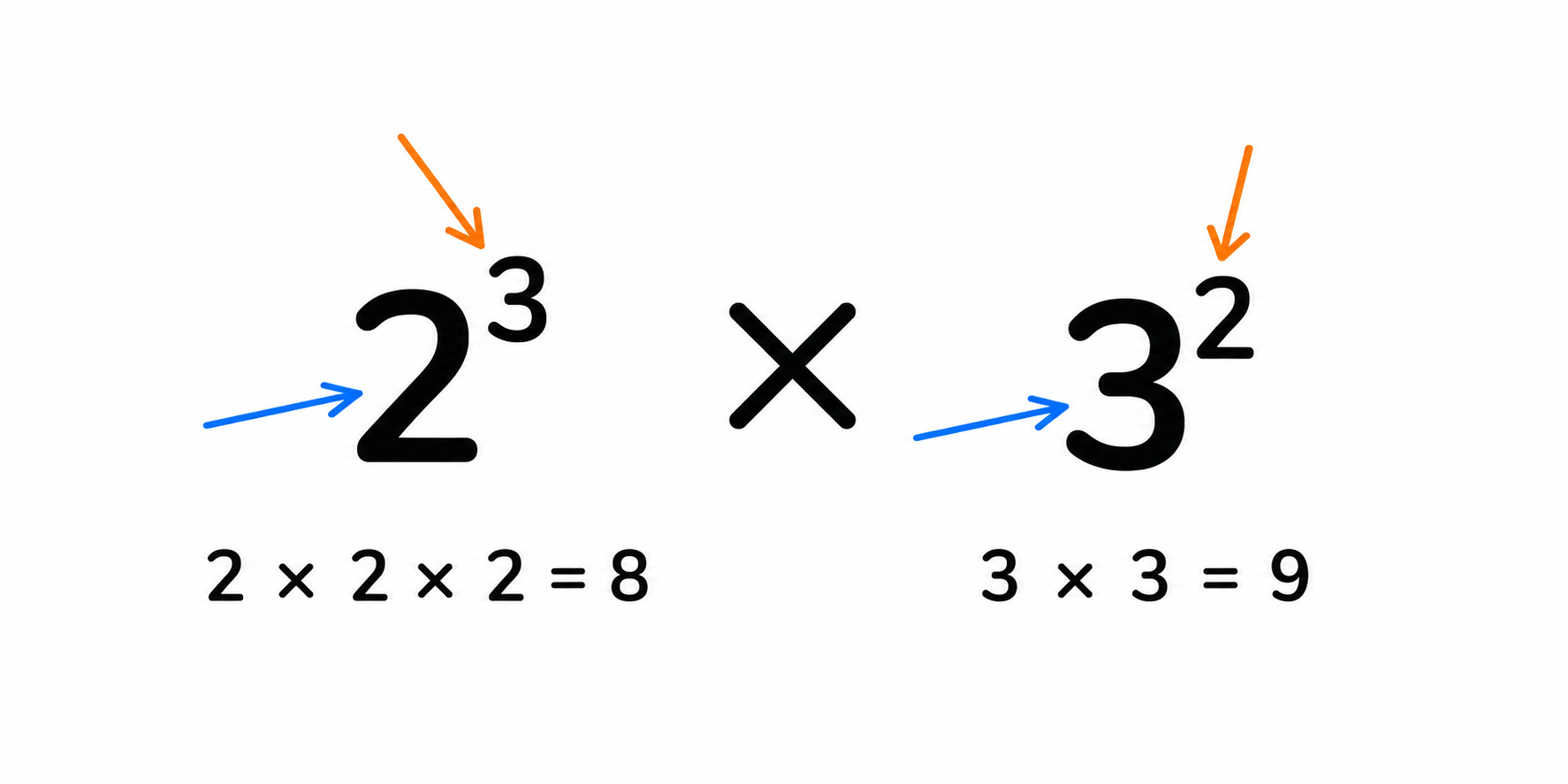
Here, means "multiply by itself times" and means "multiply by itself times." A few vocabulary points worth noting:
- In , the number is the base and is the exponent. We read it as "two to the power of three" or "two cubed."
- In , the base is and the exponent is . We read it as "three to the power of two" or "three squared."
- If a prime appears only once, we can write it with an exponent of (like ) or simply write the prime on its own (like ). Omitting the is the standard convention because it keeps things tidy.
Converting from Expanded Form to Index Form
Turning an expanded factorisation into index notation takes just two steps. Let's walk through them with .
From our earlier work with repeated division, factorises as:
Step 1 — Count each prime. Group the identical primes and tally them up.
| Prime | How many times? |
|---|---|
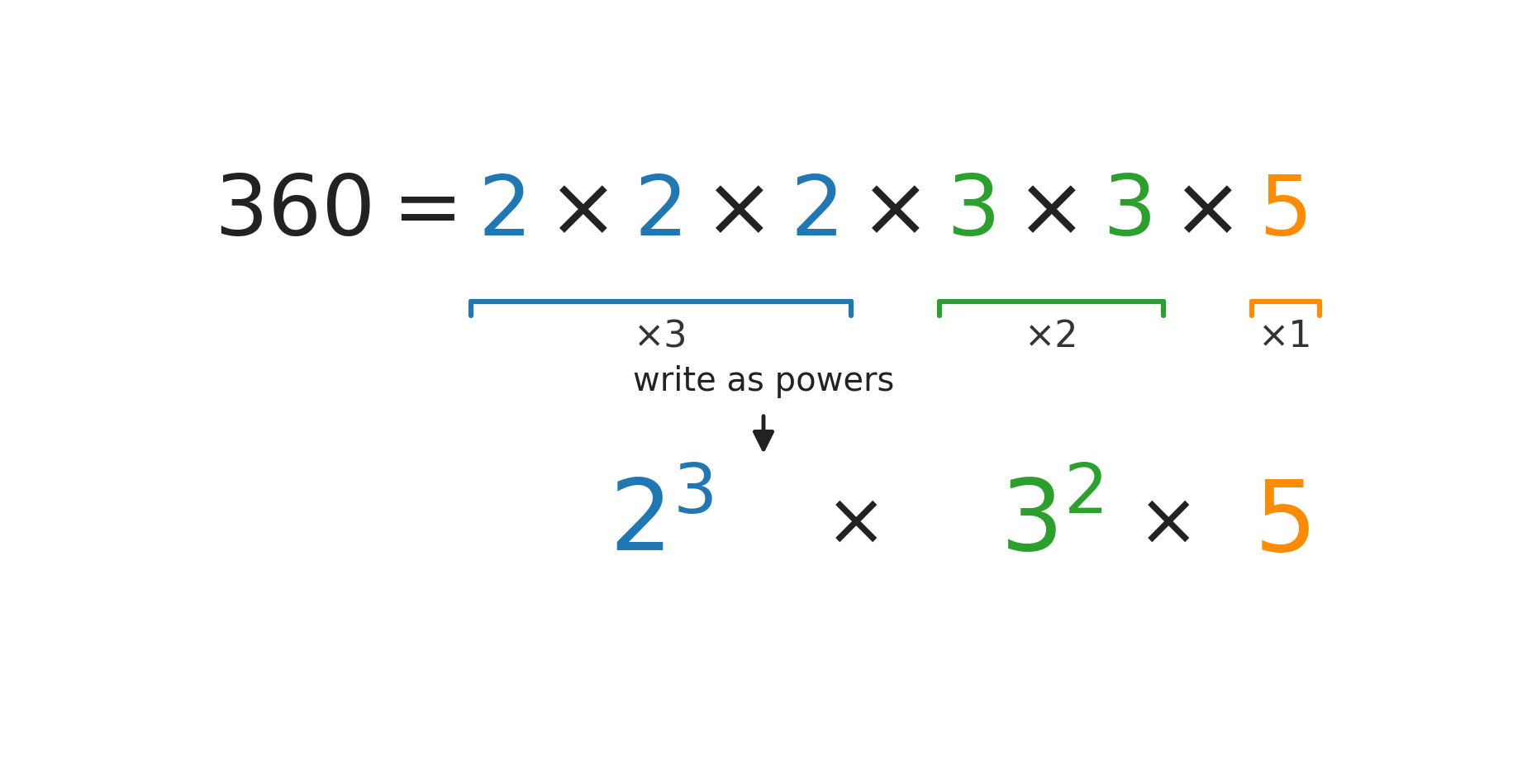
Step 2 — Write base and exponent. Replace each group with the prime raised to its count.
That's it. The primes should be listed in ascending order, which happens naturally when we use factor trees or repeated division because those methods already produce factors from smallest to largest.
Converting More Factorisations
Let's practise the conversion with a few more numbers so the process becomes automatic.
Example 1:
Using repeated division or a factor tree, we find . There are four s and one , so:
Example 2:
The expanded factorisation is . One , two s, and two s, giving us:
Example 3:
Working through repeated division yields . Three s, one , and two s:
Notice how much quicker the index form is to scan, especially as numbers grow larger. At a glance, you can see exactly which primes are involved and how many times each one appears.
Reading Index Form Back to a Number
Converting in the other direction is equally important. Given an expression like , we need to expand each power and then multiply everything together to recover the original number.
Let's work this one out step by step.
Now multiply the results: , then .
This skill doubles as a verification tool. Whenever you write a factorisation in index form, expand it and multiply back — if you land on the original number, you know every base and exponent is correct.
Common Pitfalls
A few small mistakes come up often when learners first work with index notation. Keeping them in mind will save you time and frustration.
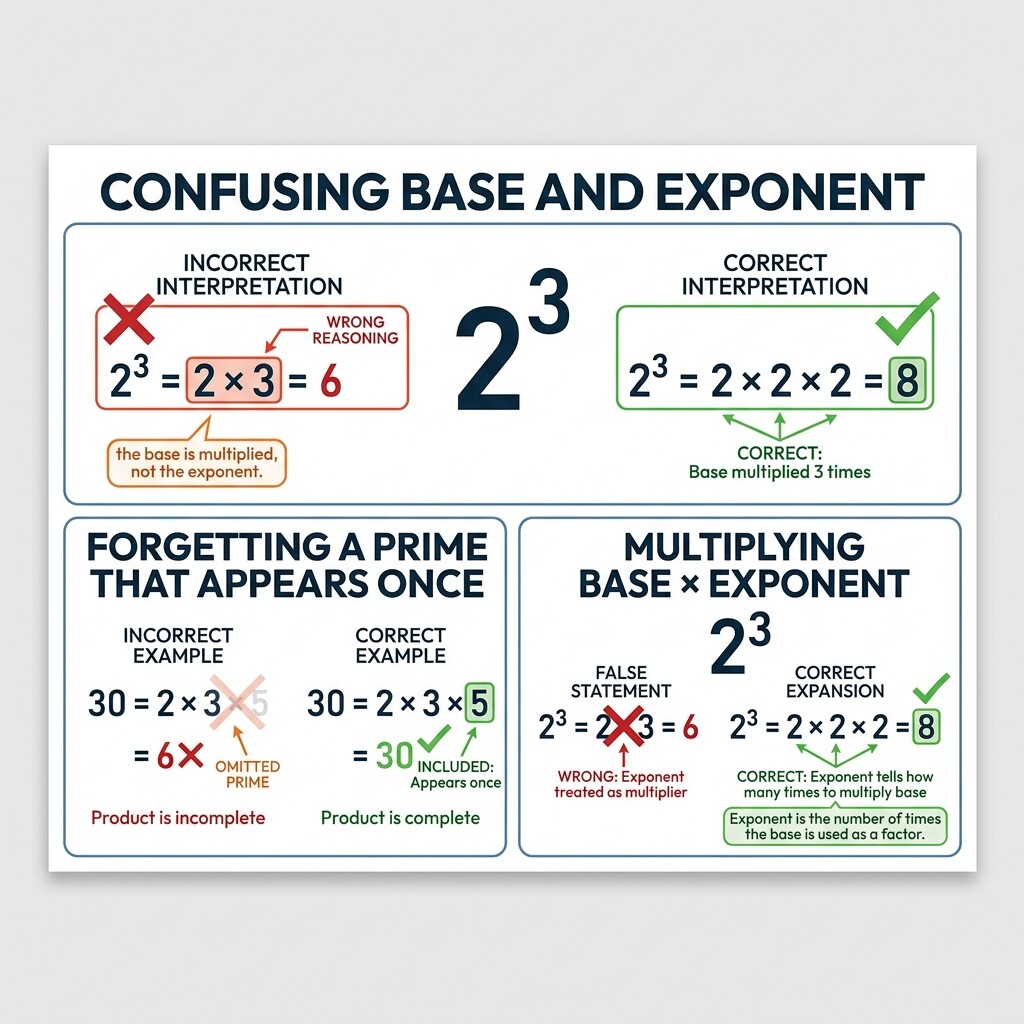
- Swapping the base and the exponent. In , the base () is what gets multiplied, and the exponent () tells how many times. Writing instead of gives a completely different value ( versus ).
- Dropping a prime that appears once. If shows up in the factorisation, it must still appear in the index form even without a written exponent. Leaving it out changes the product entirely.
- Multiplying the base by the exponent. A common slip is reading as instead of . Remember, the exponent tells you the number of copies, not an extra factor to multiply by.
Conclusion and Next Steps
In this lesson, we completed our prime factorisation journey by learning index notation, a compact way to express repeated prime factors using a base and an exponent. We practised converting expanded factorisations into index form by counting identical primes and writing each group as a power, and we worked in reverse — expanding index-form expressions back into products to recover the original number. Combined with factor trees and repeated division from our earlier lessons, you now have a complete toolkit for breaking any composite number into primes and presenting the result clearly.
Time to put it all into practice! The exercises ahead will have you matching expanded and index forms, filling in missing bases and exponents, writing full factorisations in index notation from scratch, and computing products from index expressions. This is a great way to cement everything and finish the course on a strong note — let's go!
