Build Bias-Awareness Habits
Pause and Notice Your First Reaction ⏸️
Now that you know how to spot bias, it’s time to build some simple habits to help you handle it as it happens. These habits aren’t just for special situations—they can become a natural part of how you think every day. In this lesson, you’ll learn three easy habits that work well together:
- Pausing for a moment to notice your first reaction
- Using a quick checklist to double-check your thinking
- Saying or writing down your assumptions so you can look at them clearly
These habits support each other and help you stay on track, even when bias tries to sneak in. With practice, they’ll make your thinking stronger and more fair.
When you first hear something or need to make a decision, your brain reacts very quickly, sometimes before you even realize it. These first reactions can be influenced by hidden biases. To avoid letting bias take over, practice pausing for a moment before you respond or decide.
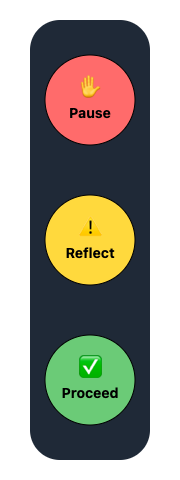
A simple way to do this is to count “one Mississippi, two Mississippi” in your head. This short pause gives you time to notice what you’re feeling. Are you excited, annoyed, or sure you’re right? These feelings are clues that bias might be at work.
For example, imagine you’re reading a news story that makes you feel angry right away. Instead of reacting immediately, pause and ask yourself, “Why am I feeling this way? Am I jumping to conclusions?” This habit helps you slow down and make choices based on facts, not just your first reaction.
📝 Use a Simple Bias Checklist Before Deciding
While pausing helps you catch biases in the moment, using structured checklists or prompts takes bias management to the next level by systematically checking your thinking before important decisions. Just as pilots use pre-flight checklists to ensure safety despite their expertise, you can use bias checklists to ensure quality thinking despite your intelligence. These tools work because they force you to consider specific questions you might otherwise skip when you're confident in your initial judgment.
Here are some easy questions you can use:

- What evidence do I have for my opinion?
- Is there anything that disagrees with what I think?
- Am I making any guesses or assumptions?
- Who might see this differently, and why?
If you’re deciding which product to buy, you might notice you’re leaning toward the one you saw in an ad first. Use your checklist: “Am I choosing this just because I saw it first? What do reviews say about the other options? Am I assuming the most popular one is always best?” This helps you look at your decision from different angles.
Say or Write Down Your Assumptions 🗣️
We all make assumptions, which are things we believe are true without really checking. These can sneak into our thinking and cause bias. To catch them, try saying your assumptions out loud or writing them down.
Start by finishing the sentence, “I’m assuming that…” For instance, “I’m assuming that this plan will work because it worked last time,” or “I’m assuming everyone will agree with me.” Don’t worry about whether your assumptions are right or wrong. Just get your thoughts out.
Once you see your assumptions, take a moment to ask yourself how sure you are about them, what proof you have to support them, and what might happen if you’re wrong.
Here’s how this can look in a real conversation:
- Natalie: I don't think we should hire remote workers. They're just not as productive as in-office employees.
- Marcus: Okay, help me understand. What are you assuming there?
- Natalie: Well, I'm assuming that... people work harder when someone can see them. And that remote workers probably watch TV during work hours.
- Marcus: How confident are you about those assumptions? What evidence do you have?
- Natalie: Pretty confident, I guess. Though now that you ask... I'm mostly basing this on one bad experience with a remote contractor last year.
- Marcus: What would happen if those assumptions were wrong? What if remote workers were actually more productive because they have fewer distractions?
Notice how Marcus helps Natalie say her assumptions out loud and gently asks questions to help her think about them. This makes it easier for Natalie to see where her thinking might be biased and to consider other possibilities.
As you prepare to practice these bias-awareness habits in the upcoming activities, remember that developing these habits is like building any other skill—it takes time and repetition. These next exercises will help cement these habits so they become automatic parts of your critical thinking toolkit, preparing you for more complex bias management challenges ahead.
