Disrupt Your Thinking by Involving Other People
Know Your Defaults ⚙️
When you’re solving problems or making decisions, your instincts tend to guide you down familiar paths—sometimes without you realizing it. As Cheryl Strauss Einhorn argues in her research in the HBR Guide to Critical Thinking, even the most open-minded person has blind spots built into their habitual way of solving problems. The solution is not just to think differently yourself—it is to deliberately involve other people who think differently than you.
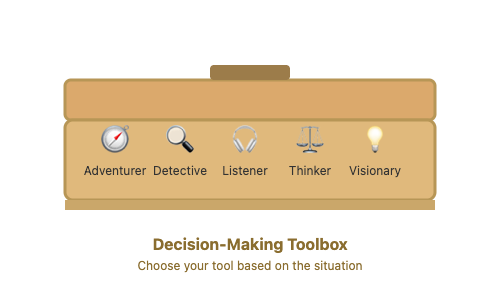
Everyone has patterns and blind spots shaped by their go-to approach. For instance, are you someone who jumps in quickly, craves more data, seeks advice, prefers time to think, or constantly looks for new options? These are just a few of the most common decision-making styles, and each brings its own set of built-in biases.
Consider these common Problem-Solver Profiles (PSPs):
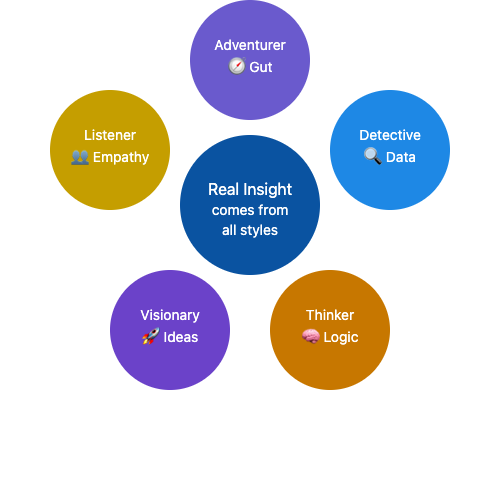
- The Adventurer: moves fast and trusts their gut, often skipping careful planning and underestimating what’s involved.
- The Detective: dives into data, looking for evidence to drive their choices, but sometimes misses the big picture by getting bogged down in details.
- The Listener: relies on input from trusted people, but risks letting strong personalities or “popular” opinions overrule what’s truly best.
- The Thinker: values time to weigh options thoughtfully, but can get stuck in overthinking and play it too safe.
- The Visionary: pushes for novel solutions, but may get distracted by what’s flashy or unique, even when it isn’t practical.
Most people relate to more than one style, but one usually dominates. Take a few minutes: which style fits you best? When you look at past decisions, what patterns show up? Pinpointing your default mode—and the recurring ruts it creates—will help you get a clearer view of which perspectives you tend to overlook.
Invite Contrasting Perspectives 🧠
It’s easy to stick with your default style, especially if it’s led to some successes. But relying on it too much can leave you with big blind spots, keeping you from seeing the whole problem or the best solution. The key is not just to bring more people into your process, but to bring in the right people—those who think differently and can highlight what you might miss.
If you are an Adventurer, your optimism and planning bias can make you feel unstoppable and lead you to underestimate what’s involved. Invite those impacted by your decisions to share their concerns and priorities, instead of charging ahead. Their feedback helps you spot obstacles and time demands you might otherwise miss.
As a Detective, your frame blindness can lead you to lose the big picture while confirmation bias tempts you to focus only on evidence that supports your assumptions. Recognize that other voices are valuable beyond data. Talk with other stakeholders who can connect dots, challenge your assumptions, and offer insights from lived experience, even if it can't be measured.
For Listeners, authority bias can make you too influenced by powerful voices, while liking bias may lead you to favor ideas from people you like. Check whether your go-to people always agree with you and seek someone outside your usual circle to prompt a more rounded discussion.
If the Thinker PSP is your default, you may be prone to loss aversion—choosing safer options out of fear of losing. Relativity bias, where you compare decisions instead of seeing them on their own merits, may also affect you in some decisions. Try setting time boxes for decisions and recruit a peer to check in on your progress. This helps prevent endless thinking and brings in more decisive energy.
If you are a Visionary, you may experience saliency bias, which draws you to the boldest ideas. You also might have the tendency to overvalue originality just because it’s rare, known as scarcity bias. Practice sanity-checking your ideas with others who can test their practicality.
Let's see how this looks in practice when a manager recognizes their profile and strategically involves someone with a different perspective:
- Ryan: I've been analyzing the engagement survey data for days now, and I keep finding more variables to consider. I'm not sure I'm getting any closer to a decision.
- Jessica: It sounds like you might be in Detective mode—deep in the data but possibly missing the bigger picture. What if you talked to someone who thinks differently?
- Ryan: You're right. I've been so focused on the numbers that I haven't stepped back to ask what direction all this evidence is really pointing toward.
- Jessica: Maybe get Alex in—they're great at calling out the bold move when others get tunnel vision.
- Ryan: Good idea. I think bringing them in will help balance my urge to cover everything with some bigger-picture thinking.
Notice how Ryan catches himself falling into the Detective's trap of getting lost in details. By recognizing his profile's bias, he can deliberately seek out someone whose Visionary tendencies will complement his analytical approach—not to replace his data-driven thinking, but to balance it with a wider view.